What's all this about?
It's goodbye to the Audi RS 3, and it's also - more poignantly - goodbye to the German firm's most iconic engine: the inline five-cylinder. After more than 50 years in service for the company and having become synonymous with Audi, more so than any other manufacturer who dabbled with the layout over the years, the straight-five is being retired due to strict EU7 emissions regs which will come into force in 2027.
That is sad. So what, precisely, is the car I'm looking at here?
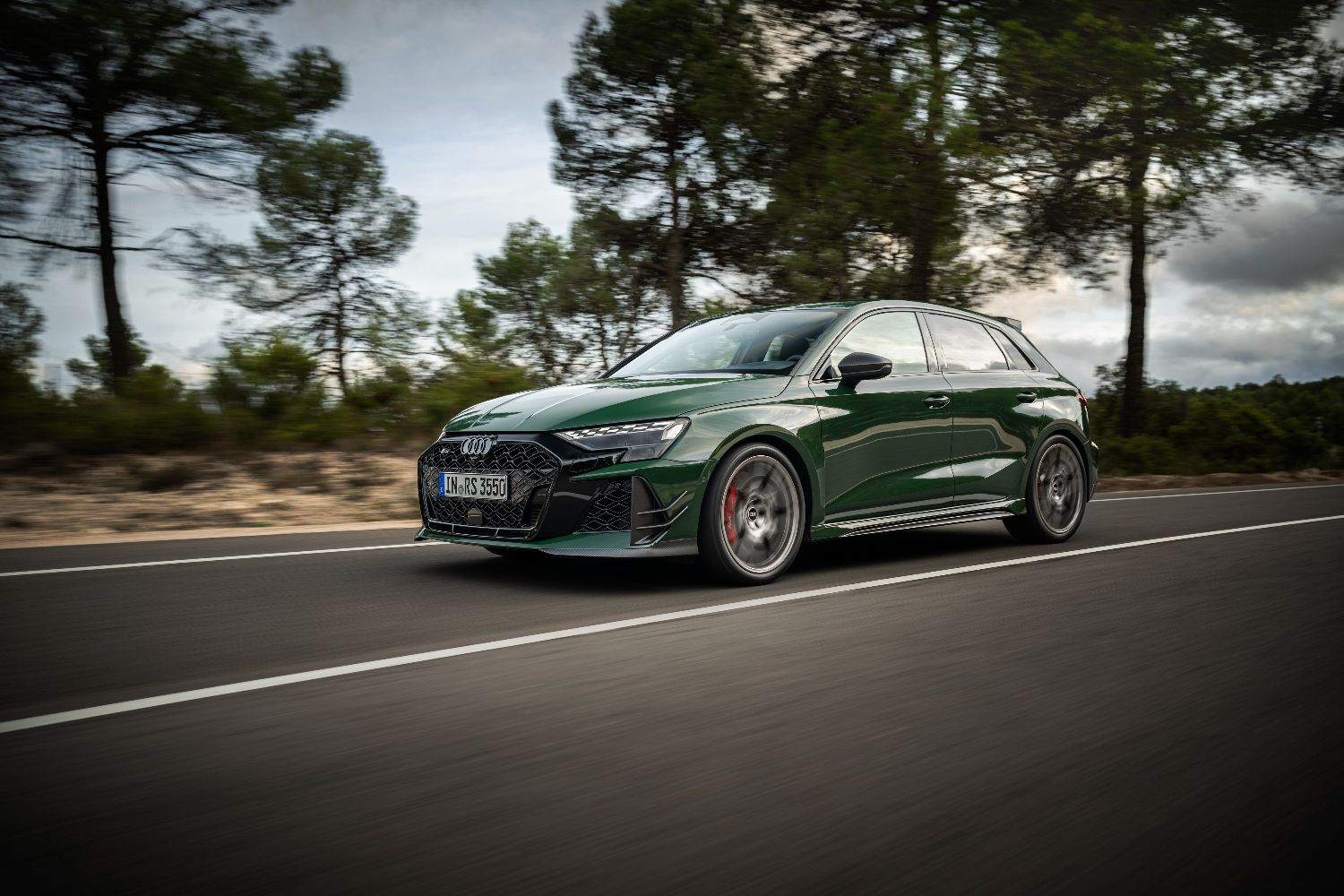
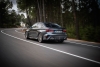
Its full name is the Audi RS 3 Competition Limited. Just 750 examples of it will be made for the entire global marketplace, with the split of body shapes falling 585 in favour of the Sportback and just 165 coming in Saloon form. Don't get too excited, though; we've got an allocation of 11 of the 750 for the UK, they're all in Sportback bodies, they're all in Malachite Green, and they're almost certainly all accounted for already. Also, the Competition Limited will cost around £90,000, according to an Audi UK spokesman, when the regular RS 3 Sportback starts from £62,450 at the time of writing. Quite the premium, we're sure you'll agree.
It assuredly is. So what makes the Competition Limited so special to justify that price?
Well, aside from the rarity and the melancholic symbolism of it being the last of the five-pot Audis, you get coilover suspension, primarily. This technology has been introduced to devastating effect on some run-out editions of Audi Sport's RS fare in recent years, such as the utterly mesmerising C8 RS 6 GT Avant, as well as the series-ending Competition and Edition 25 Years variants of the B9 RS 4.
On the RS 3 CL, the coilovers come with twin-tube dampers, which are made of stainless steel up front and aluminium at the rear. The front shocks further have external reservoirs, while at the back are larger-diameter tubes and thicker piston rods, plus an uprated and stiffer anti-roll bar. There will be three modes of adjustment for the coilovers, with 12 settings for low-speed compression, 15 for high-speed compression and a further 16 settings for rebound. Obviously, and as with the other Audi RS cars on the same set-up in the 2020s, these can only be altered physically at the suspension itself, rather than on a button in the cabin, but Audi reckons it's a simple enough job as owners only need to place the car on a ramp to get it done; no body parts or trim have to be removed to access the adjustment switches, for instance, while the car will also be sold with a special, dedicated toolkit for this role and instructions on how to use it. You can even drop the ride height of the Comp Limited 10mm closer to the deck than a regular RS 3.
All sounds good. Does it get any more power?
No, the 2.5-litre five-cylinder turbocharged unit, which is the star of the show, remains at ceilings of 400hp and 500Nm. So the 0-62mph time of the car is still 3.8 seconds, but the top-speed limiter has been raised as standard to 180mph. There's more to the Competition Limited, though, such as carbon-ceramic brakes (a cost option on any other RS 3 but standard here) with red callipers, 19-inch wheels with the ability to clothe them in Pirelli P Zero Trofeo R tyres (with non-Trofeo P Zero rubber the default selection), and then a lot of bespoke matte-effect carbon fibre on the exterior. All of the roof spoiler, front splitter and canards on the leading bumper are made of the stuff, among more, but these three items specifically are of a design unique to the Competition Limited.
And what else is there to note about the styling and the interior, for example?
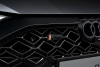
On the outside, three colours are offered, which are Daytona Grey metallic, Glacier White matte and then the aforementioned Malachite Green. While the former two are sold on the other RS 3s, Malachite - which hasn't been seen on any Audi since the road-going versions of the mega Audi Sport Quattro of the 1980s - is only available on the Competition Limited. Beyond that, the 19-inch wheels are finished in Neodymium Gold, there are black, red and white RS Heritage 'RS 3' logos front and rear, a small legend in the quarterlight glass on the flanks of the car reads 'RS 3 Competition Limited', and finally the DRLs at the front of this limited edition do a start-up/locking animation which mimics the 1-2-4-5-3 firing order of the inline-five. Which is a nice little bit of Easter-egg geekery for those in the know.
Inside, more Neodymium, clothing the seat centres and the door cards. This shade is complemented by Ginger White, which is deployed on the seatbelts, all the contrast stitching in the cabin and the various 'RS 3 Competition Limited' logos you'll spot within. Another self-referential nod to aficionados of Audi's performance past is that the dials in the RS 3's Virtual Cockpit cluster are white, just like the analogue items in the first five-cylinder Audi RS product of them all, 1994's RS 2 Avant (no, we've not forgotten the original Quattro, but that was before RS' time), while some exquisite carbon-backed RS Sports bucket seats are installed up front. The finishing flourish is a sequentially numbered graphic on the Audi's transmission tunnel to tell you precisely which of the run of 750 cars you are presently sitting in. Having been invited to Munich for a secret-squirrel poke around the Competition Limited, on the same day we also saw the incoming RS 5 PHEV, this read '000/750' because the show CL we sat in was a pre-production prototype.
Anything else to add on the car at this stage?
Only that Audi's engineers have cut away some of the sound-deadening from the front firewall of the RS 3 Competition Limited's shell, so that you can better hear the five-cylinder's yowling and the exertions of the standard-fit Sports exhaust, without the car falling foul of European noise regulations.
And that's really it, is it? The five-cylinder is going for good?
Yep. It never really caught on, though; at least, not with any other manufacturer bar Audi. Lancia flirted with the idea in some military trucks of the 1930s, but the first inline-five, mass-produced passenger car was Merc's turbodiesel 300D of 1974, beating Audi and its petrol-powered 2.1-litre R5 by a couple of years. That latter engine was shown in 1976, making this year the 50th anniversary of the Audi five-pot, but it really entered meaningful public service in 1977's 100 saloon.
From thereon in, aside from brands associated with Audi (like VW and SEAT, which only rarely used five-cylinder engines over the years), a mere handful of other manufacturers ever even ventured into the realm. Most notably, Volvo, and by extension Ford, had a go at it, as did Fiat in that period when it was making the Bangle-designed Coupe, plus those odd Bravo and Marea models with 20-valve fives in them. Even Honda, Land Rover and GM flirted with it, but the technology just didn't take off... except with Audi.
Its most famous application was clearly in the Quattro of the 1980s, but over the years it has made its way into the TT RS and RS Q3, although its most widely known home is in the nose of the RS 3 - hence the Competition Limited being the fitting finale for Audi fives. That said, the 2.5 400hp engine might still have some life in it yet, as it has already materialised within other in-group models not wearing four rings, such as the Cupra Formentor VZ5, and there's a rumour we might get a run-out Volkswagen Golf R with a five-cylinder unit before too long. Otherwise, though, the ultra-low-production RS 3 Competition Limited will be the full stop on a five-decade-long love story between Audi and the venerable five-cylinder engine.
Matt Robinson - 10 Mar 2026