What's this about?
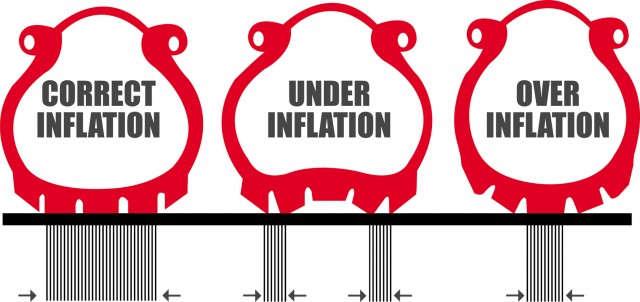
The air pressure of your car's tyres is an important consideration for road safety. Over-inflated tyres can be more liable to blow out than ones that are under the correct pressure. Equally, under-inflated tyres tend to cause handling problems when you are on the road, particularly noticeable when you are cornering tightly or manoeuvring at higher than usual speeds. Therefore, knowing how to check the pressure of each of your car's tyres is an essential skill that all motorists should know.
Understanding Tyre Pressure
Understanding Tyre Pressure
Always consult an expert in the field of tyres if you are in doubt about what tyre pressure you need to inflate your ones to. I use Point-S for all of my tyres and they will be able to let you know the manufacturer's tyre pressure recommendations, if you have any doubt. However, you should be able to find this out for yourself in most cases. A car's recommended tyre pressures are usually noted inside the fuel cap, in the jamb of the driver's side door or within the owner's manual. Have a look, and bear in mind that some cars have differing amounts of pressure recommended for the front wheels as they do for the back. In the UK, two measurement units are commonly used. The first is known as bar, the second is PSI. It does not matter which you use so long as you don't mix them up and you understand the gauge pressure. An average mid-sized family car will have tyres set at 34 PSI, which is equivalent to 2.1 bar.
Confirming Tyre Pressure
Once you know what the tyre pressure ought to be, it is time to check what it actually is., Firstly, remove the screw cap that covers the tyre's valve. This is a little black plastic cap that usually sits a little proud of the hub cap and is easy to spot. Now connect a pressure gauge to the valve. These are held in place over the top of the valve and will give a reading on a digital display or a rotary gauge. If the tyre is under-inflated then it needs extra air and it is possible to inflate it using an air pump. However, many of these gauges and pumps are combined, when used at a petrol station, so all you need to do is attach the nozzle and wait for the display to show the current pressure. If the tyre is over-inflated with too much pressure, then you can allow air to escape by carefully pushing on to the valve with the gauge.
Paul McShane - 10 Sep 2014