Styling
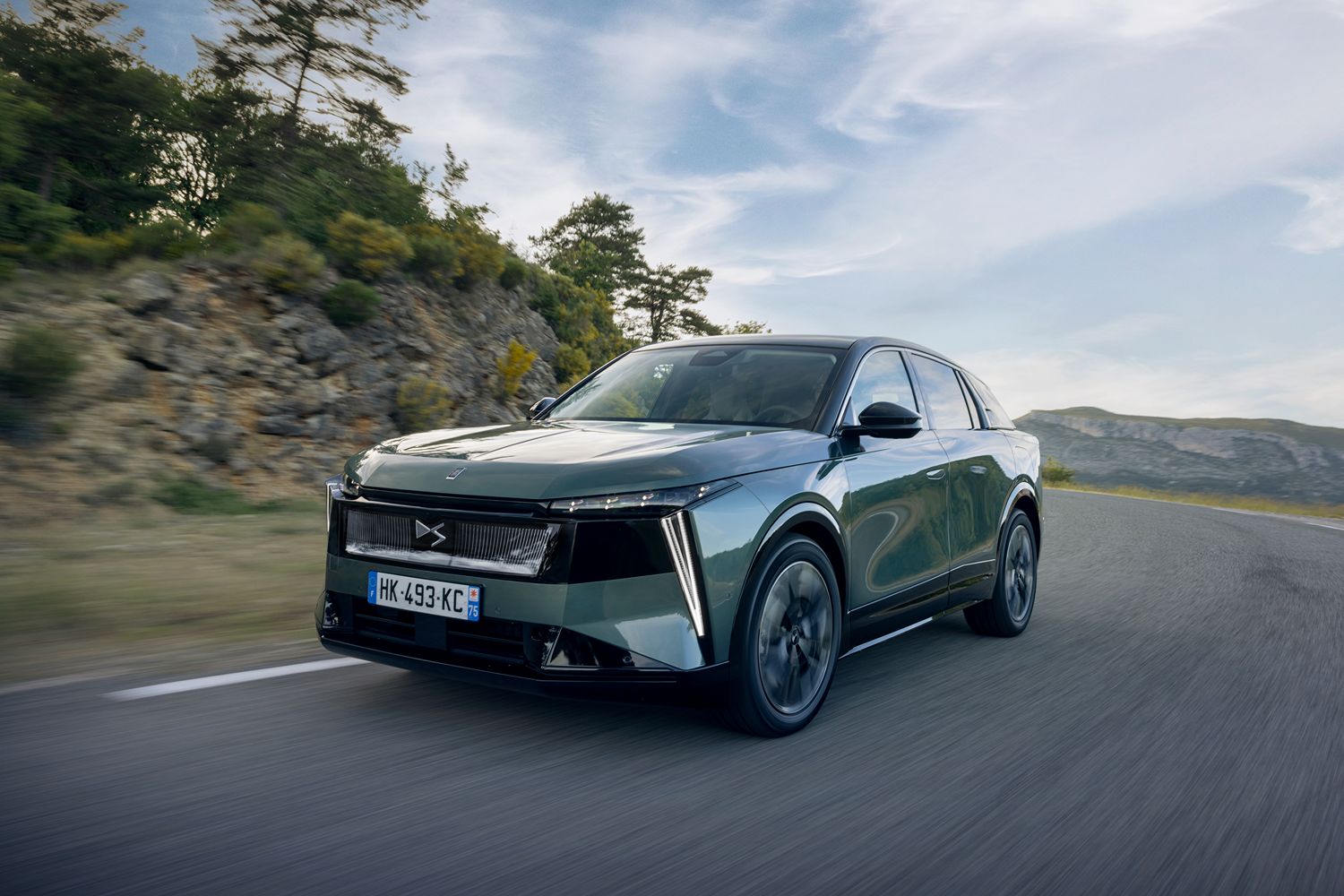
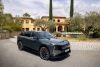
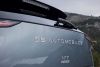
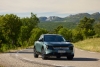
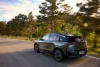
Big, as it is verging on 4.7 metres long, angular and yet unmistakably Gallic, the DS No.7 is reasonably easy on the eye. Sure, it is a little bit overwrought in places, most specifically in that riot of conflicting creases and details in the C/D-pillar area (and why is the charging flap so enormous?!), and we've also got the
massive font on the bootlid reading 'DS Automobiles'. Aesthetic overcompensation for still-lukewarm customer perception of the brand, perhaps? Maybe.
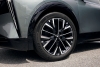
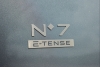
But it generally looks decent, and there are some interesting two-tone options to enliven the No.7's appearance, helpful as the main six-strong colour palette for the car is pretty muted and, dare we say it, dull. It's also aerodynamically optimised, a 0.26Cd figure most impressive for something so tall and blocky like this, and helped no doubt by a range of 19- to 21-inch alloys that have their faces designed to cut through the air with minimal drag. We also like the big V-shaped DRLs up front, although we're not sure why the 'E-Tense' logo, which denotes this is the electric No.7 and not the Hybrid, on the tailgate must be so teensy. Certainly not in relation to that aforementioned gigantic text above it.
Interior
High-quality stuff inside the DS No.7 and with the materials, textures and colourways available, it undeniably feels like an upmarket creation when you sit in it. There are, however, once again a few minor critical observations to make. The first is that the digital-camera rear-view mirror inside the No.7 is ludicrously hot to the touch if you reach up to adjust it. This is surely the first time a car can lay claim to the feature 'heated interior mirror', we guess. Ditto that sort of 'rays of the sun' illumination pattern on the transmission tunnel, which doesn't quite get as scalding as the mirror, but regardless has a warmth to it that suggests maybe DS didn't fully contemplate the cooling requirements needed for various fancy electrical features throughout the cabin.
Luckily, the central cubby in the armrest is cooled, so if (and when) you burn your hand by grasping the interior mirror then you can chill it off by plunging it into this storage zone with immediate effect. But there are further areas of concern to note, primarily where the aspirational No.7's STLA Medium underpinnings are evident, and thus its ties to non-premium machines like the
Vauxhall Grandland Electric become painfully clear. Such as the super-wide but rather shallow 16-inch infotainment touchscreen, which is really in the wrong aspect ratio for decent satnav mapping, either proprietary or on mirrored smartphone platforms.
Still, this and the DS Extended Head-Up Display cluster arrangement all looks crisp and attractive, and we like the efforts the French firm has put in to make its switchgear feel bespoke. It's more intuitively laid out in here, too, than it was in the DS 7 predecessor, although the less said about that ghastly cross-spoke steering wheel - which has made its way to this SUV from its debut in the No.8 - the better.
Practicality
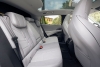
There's an almost completely flat footwell across the second row of the DS No.7, so leg- and headroom are generous back there. Also, given the width of the car and the plushness of its rear bench, the idea of seating three adults side-by-side doesn't seem to be totally unreasonable. Wonderfully, material quality doesn't drop off in the back of the No.7 like it does in some supposedly higher-class German machines - we're looking squarely at you,
Audi Q4 e-tron - and then behind the passenger compartment is a useful 560-litre boot. This rises to 1,570 litres with the versatile 40:20:40-split rear seats folded down, although the most potent No.7 E-Tense with dual motors loses a bit of capacity here due to its additional rear motor beneath the boot floor (515/1,525 litres respectively). There is no frunk in the DS, though, due to the presence of the ICE-sporting Hybrid in its family.
Performance
As we've already touched upon in this review, the DS No.7 sits on the STLA Medium platform, which ties it in with the likes of the
Peugeot 3008 or E-3008 and more. Therefore, if you know those cars' battery and powertrain configurations, a lot of what we say about the No.7 is going to be eerily familiar to you. Although, in fairness to the latest DS, it matches the No.8 spec-for-spec, so it has slightly more power than its Peugeot, Citroen and Vauxhall cousins.
Of the four distinct variants of the DS No.7 available, three of them are pure EVs under the E-Tense umbrella. The opening salvo is the E-Tense FWD, fitted with a 73.7kWh nickel-manganese-cobalt (NMC) battery and a 190kW front e-motor. In normal use, this No.7 delivers 230hp and 343Nm, but it can pump up the former figure to 260hp in a time-limited 'boost' phase. Expect 0-62mph in 7.7 seconds, as it weighs a chonky 2,091kg, and a range of 337 miles.
The next step is the car we're focusing on primarily here, the E-Tense FWD Long Range. It's still the one front-mounted motor with 343Nm, but it's up to 207kW here - which means 245hp nominally and 280hp on the boost. However, its NMC power pack is enlarged to 97.2kWh, which brings its weight up to 2,138kg, and so the 0-62mph time is ever so slightly slower at 7.8 seconds. Nevertheless, what will draw people in here is the claimed WLTP range: it's 460 miles, making this one of the longest-legged EVs out there of any size, shape or price.
Representing the pinnacle of the E-Tense line is the AWD Long Range. Same larger battery as the car mentioned above, but this one has two motors, one on each axle, and regular power of 350hp, rising to 375hp during the boost phase. Torque also climbs considerably to 509Nm, so with its AWD traction and stronger electric muscularity, the 0-62mph time comes down to a commendable 5.4 seconds. The weight's up again, though, to 2,252kg, and this and the added grunt reduce the AWD Long Range's one-shot driving capability to 422 miles.
Then comes what looks like the fudge on DS' part. The No.8 is a pure EV line-up, but the closely related and supposedly similarly prestigious No.7 is not. Thus, the entry level to No.7 ownership is in fact the No.7 Hybrid 145, teaming a PureTech 1.2-litre three-cylinder turbo petrol engine to a 21kW (28.6hp) e-motor and small battery pack (it's a non-plug-in vehicle). System outputs here are 145hp and 230Nm, resulting in a ponderous 10.4-second 0-62mph time - this, despite the fact the Hybrid 145 weighs a shocking 535kg less than even the basic E-Tense FWD model, and is fully 696kg trimmer than the E-Tense AWD Long Range. DS reckons that the No.7 Hybrid 145 will do between 50.4- and 53.3mpg, with associated CO
2 outputs of 121-127g/km.
We drove both the E-Tense FWD Long Range and the Hybrid 145, and the DS No.7 is way, way more convincing as an EV than it is as the HEV. While we're not against the 1.2-based petrol-electric system in other, smaller and cheaper Stellantis cars than this, the underpowered and gruff 145 powertrain's ceiling of abilities is considerably lower than the sort of suave set-up you'd expect to find in a car like the No.7. It feels woefully out of its depth in this class, and while there are small-engined, lowered-powered versions of the
Audi Q3 and
BMW X1, as examples, the Teutons never put engines as strained as this one in their products.
It's not as if the FWD Long Range is some superstar for performance by comparison, you understand, as the car's surprisingly vast bulk does make itself known with what we'll describe as 'adequately brisk' acceleration, rather than pick-up that's 'pleasingly strong'. But the smooth, quiet and immediate way the E-Tense delivers its power, plus the well-judged blended braking system, make this No.7 much more pleasurable to drive than the one with a tiny three-pot installed and struggling away up front.
One note of caution here relates to the indicated electrical consumption of our No.7 E-Tense FWD Long Range. On a 100-mile test loop in hot conditions, for the second half of this drive it managed a very credible 4.9 miles/kWh - enough, if you could keep that up, to see it exceed its official 460-mile range on a full battery.
However, that was basically running mainly downhill from mountainous terrain, so including the first half of the test loop and the preceding climb up, a far less scintillating 2.8 miles/kWh was the overall result for the entire trip. At such a rate of volty consumption, the DS would be all done and dusted in just 276 miles. Hopefully, the reality in more regular, real-world driving conditions would be somewhere between the two - so around 350-ish with ease - but we weren't exactly mercilessly thrashing the E-Tense for the 100-mile test. More time in the car back here in the UK will validate whether this is an EV which has admirable efficiency or not.
Ride & Handling
There's another good reason to go for one of the Long Range, big-battery E-Tense models over the No.7 Hybrid, and that's the fact you can have the 97.2kWh EVs with the DS Active Scan suspension system. This, teamed to laminated and acoustically isolating glass in the front and side glasshouse, results in a car with marvellous, sumptuous and thoroughly enjoyable ride and rolling refinement. Even on bigger 20-inch wheels, the DS just floats along in near-silence at all road speeds, with a spectacularly louche gait that makes it a rewarding long-distance companion. State the caveat clearly, though: we were on some pretty pristine French roads, so we'll reserve full judgement on this aspect of the No.7 until we've driven it back here on the cratered highways of old Blighty.
Anyway, the obvious pay-off of such a comfort-oriented outlook is that the No.7 is no great shakes in the corners, primarily because - as the driver - you're holding that godawful steering wheel. It's not only ugly to look at and an annoyance for hand placement because of the joint positions of its spokes, but it's a really strange shape too; deeper than it is wide. We can't help feeling that both the No.7 and No.8 DS models would be significantly improved, simply by the fitment of a much more prosaic and conventional steering wheel.
Despite this, it's not the wheel itself which is the main problem with the No.7's dynamics. One area where the E-Tense EVs benefit over the Hybrid 145 is that they run multilink rear suspension, whereas the HEV DS sits on a torsion beam. But you won't feel much of an uplift in cornering ability when driving the E-Tense FWD Long Range back-to-back with the Hybrid 145.
You can squarely lay the blame at the extra half-tonne of bulk the EV is having to cart about the place in this regard, which ultimately limits any playfulness in the corners that the front-led No.7 might possess. Both body and wheel control are fine, and there's lots of grip to utilise too, but undernourished steering that lacks any genuine feel and a sensation of fun-sapping understeer never being too far from proceedings (odd, as the weight isn't all up front in an EV, is it?) all serve to temper the driver's expectations of the French machine's chassis. It's OK - clean and assured and safe. It's just not very engaging or memorable on a challenging road, although serving as mitigation for DS few electric SUVs in this sector ever are.
Value
The major complication for the DS No.7 is that its pricing structure is heavily skewed towards pushing you into the Hybrid 145, which is considerably more inexpensive than any of the E-Tense cars - and if you go for the AWD electric, prepare for some sharp exhalations of astonishment at the list prices of something which, underneath it all, ain't that much different to a Vauxhall Grandland.
There are three specifications for the No.7, which run Pallas, Etoile and La Premiere. All four drivetrains are offered in all three trims, with the exception of the AWD which only comes in the higher two grades. So there's an 11-strong line-up for the No.7 family, with kit being decent on the Pallas and getting considerably more generous as you move up the hierarchy from there, so there's no real issue with the value quotient of the DS SUV.
No, it's more the bare prices which astound. The Hybrid 145 looks competitive, starting at £38,920 and peaking at £46,890 for a La Premiere, although as we've already said, whether something with a wheezing 1.2-litre engine can ever feel worth 47 grand is another thorny question entirely.
Yet the E-Tense
starts from £49,190 for a FWD Pallas. Our FWD Long Range Etoile is another eight-thousand pounds again. And the electric AWD? It's £61,190 as an Etoile and a gobsmacking £66,690 for the flagship La Premiere. Bear in mind that the most expensive pre-options spec of the Vauxhall Grandland Electric is the GS at £39,095 and you can see from whence our misgivings stem. OK, the Griffin has a smaller 73kWh batter (304 miles of range) and a 325hp powertrain, but for what is ostensibly the same EV skateboard underneath, should you really be paying the best part of 28 grand more for the DS, purely for its glitzy interior finishing and clever Active Scan suspension? Hmm.
Verdict
Aside from the early, somewhat misguided efforts from DS Automobiles, such as the
Citroen model that would go on to become the risible DS 4 Crossback and the
deeply confused, and confusing, DS 5, we've actually always been quite taken with the cars from this French firm. And the new No.7 is no exception; in many ways, it's a very easy thing to like.
But, by crikey, like so many DS models before it, it's an incredibly hard car to unequivocally recommend, or indeed imagine tearing up the sales charts. Much of what the DS does is good or very good, especially when it's specified as one of the cultured E-Tense models, and the 460-mile claimed range plus suppleness of that DS Active Scan suspension are strong lures to the company's showrooms. Yet does it do anything particularly standout or compelling that would cause you to ignore a whole host of longer-established premium rivals, especially as you'll be paying the far side of £53,000 for any Long Range variant of the EV? Sadly, we have to say on this first evidence, we think not. The No.7 is an intriguing, leftfield alternative to the norms in this sector, and not much more than that.