Styling
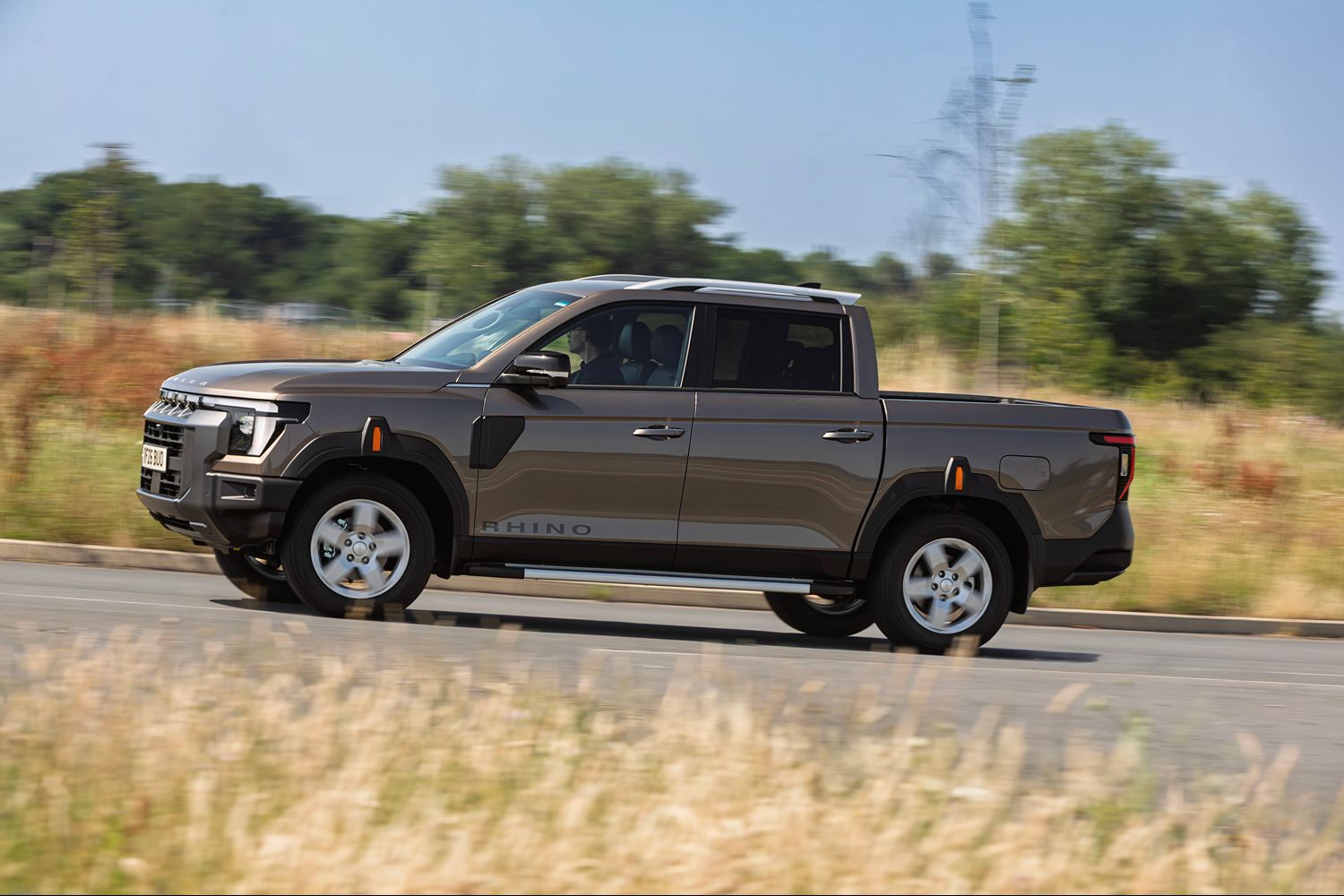
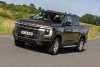
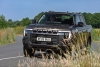
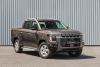
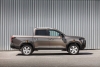
Quite dramatic styling is the hallmark of the new KGM Musso Rhino (and yes, as 'musso' is the Korean for 'rhino', this is effectively the 'Rhino Rhino'), the most obvious feature being that distinctive, coast-to-coast LED lighting signature at the front. As we're of a certain age, for some reason it puts us in mind of one of the Recognizer ships from the original
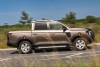
Tron movie, but it undeniably gives the Rhino plenty of presence. Other chunky styling details, including side steps, and those unusual vertical reflectors at the tops of the wheel-arch cladding ensure the Musso Rhino is an eye-catching thing, if not exactly what you might ever term 'beautiful'.
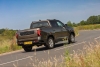
There are two main body styles as well, which are the regular double-cab Rhino we're driving here and then the Rhino+. The latter is a long-wheelbase variant, grafting another 110mm in between the axles and a further 200mm of metal to the rear overhang, resulting in a KGM Musso that's only 40mm shy of a gigantic 5.5 metres long overall.
Also, although that slatted light signature at the front is supposed to be reminiscent of the Rhino's recent precursor, the Musso EV, then as we shall come to see in a forthcoming review of the latter, while they might both be called KGM Musso the Rhino and the EV are not the same truck at all; a peculiar decision by the Korean firm and unlike, say, Toyota, which offers both diesel and EV powertrains in the same body of its
latest-generation Hilux.
Interior
KGM has made an effort at modernising the cabin of the Musso Rhino, but by 2026's prevailing standards this is an archaic and dated interior as trucks go. It might stand comparison with something similarly at the budget end of the market, such as the
Isuzu D-Max, but the plush and almost SUV-like passenger compartments of the
Ford Ranger and
Volkswagen Amarok are leagues ahead of the KGM's effort. Worryingly, so too is the cabin in the Musso EV.
It's outmoded in here because of the unrelenting sea of charcoal-grey, durable plastics that abound. The Korean manufacturer has attempted to inject some high-tech overtones with the twin 12.3-inch digital screens, one for the infotainment and the other for the instrument cluster, but neither of these are replete with what we might term cutting-edge graphics or configurability. The central touchscreen also looks like a plonked-on afterthought, perched up high on the console.
Still, kudos for the fact the Musso Rhino has proper physical climate controls and buttons/switchgear that look like they might be operable by gloved hands, something important to the end users in the one-tonne pick-up class.
Practicality
When it comes to passenger accommodation in the second row, there's nothing wrong with the KGM Musso Rhino's offering. An almost-flat floorwell and good headroom means at least a quartet of taller people ought to be more than comfy sitting in this truck, while even three abreast across the back bench, for the full complement of five humans, doesn't look out of the question.
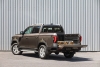
But when it comes to practicality with pick-ups like this, we're not really talking about the space in the interior or the boot capacity, as with a conventional car or SUV. Instead, you'll be interested to know some of its workhorse and off-roading stats. For this SWB Rhino, the loadbed at the back measures 1,300mm long, 1,570mm wide and 570mm deep. It'll take 1,090kg of payload, comfortably qualifying it as a 'one-tonner', or 1,011 litres if you want it expressed by another metric.
As for other data, the approach, breakover and departure angles of the KGM are 30.9, 20.3 and 27.8 degrees respectively, while it offers up 245mm of ground clearance - that's decent. The Musso diesel also has fully selectable and part-time 4WD, with 2Hi, 4Hi and 4Lo ratings, and it'll lug the maximum 3.5 tonnes of braked trailer if needs be. Shame the wading depth is pretty poor by truck and 4x4 standards, though; it stands at just 300mm. For reference, a Hilux can ford its way through 700mm of water, while the Ranger and D-Max go 100mm deeper than that if required - making them almost three times as capable as the Musso for this one facet of their abilities.
For completion's sake, the Rhino+ has a loadbed that accounts for the full 310mm stretch of the LWB truck over the SWB, which means a length in the bay of 1,610mm - the other dimensions remain the same. The payload is also increased accordingly, to 1,200kg or 1,262 litres. Its bigger frame does erode the approach/breakover/departure angles compared to the SWB, though, with 30.6, 20 and 24.5 degrees the new numbers, but it also has 3mm of additional ground clearance for 248mm overall.
Performance
The latest KGM Musso Rhino is powered by the company's tried-and-tested e-XDi 2.2-litre four-cylinder turbodiesel engine, allied to a six-speed automatic gearbox. Oddly enough, while the power is much the same as that of the outgoing Musso at 202hp, it seems to have lost some torque, as it's down to 400Nm smeared across a 1,400rpm band in the 2026 Rhino.
Clocking in at 2,196kg as this SWB model (and 40 kilos more for the extended Rhino+), both the straight-line performance and refinement of this unit are what you might term 'agricultural'. There's no official 0-62mph sprint for this diesel machine, although something in the order of 12 seconds seems likely (and possibly a tad optimistic), while the noise the thing generates as it revs up under duress is pronounced.
The six-speed slusher is a dolt, as well, so you can sometimes attempt to take moderate gaps in fast-flowing traffic when turning out of side roads and then be wildly panicking that you're about to get rear-ended by a Scania, because when you put your foot down in the KGM it takes an age for the drivetrain to hook up and respond, and when things do finally happen in the acceleration realm then they're underwhelming in the extreme.
Sure, once you've got it up to cruising speed, or you're not using big applications of the throttle, the Musso Rhino's powertrain is about acceptable for the way it propels the truck along the road, but you have to remember we were sampling the Korean machine with barely any load onboard (more anon). Quite how preposterously lethargic it would feel when taking a laden Europallet in the back, or hauling a twin-axle horsebox along, is anyone's guess.
It at least proved to be reasonably economical during our short test-drive of the vehicle, although bear in mind we hardly subjected it to a red-hot go once we'd sampled the glacial tardiness of the drivetrain once or twice. Across a 25-mile route from Swindon to Oxford, it gave back an indicated 29.8mpg; about par for a 200hp-ish diesel truck like this, in all honesty.
Ride & Handling
Yeesh. Anything with a live axle at the back and an emphasis on crawling about in the scenery is not going to ride like an SUV, we know that. But even by the lower ride-comfort standards of the one-tonne pick-up truck world, the KGM Musso Rhino has uncomfortable manners. We said earlier that we barely had any load onboard, but the press team behind the event had cobbed six bags of sand in the back in a vain attempt to tie the rear axle down and improve the comportment of the Rhino. The ruse failed. Shuddery, firm and bouncy at times, there's no way you could consider this pick-up in any way a close alternative to a traditional SUV when it comes to refinement.
There's not much point talking about the handling of the KGM Musso Rhino, because one-tonne trucks are not built for this sort of thing in the first place, given their primitive rear suspension and off-road-biased chunky rubber... and also because we didn't really test the way the Korean takes on corners that much anyway. What we could discern, though, was that the steering set-up on the truck deserves some praise, as it's one of the more direct and feelsome arrangements we've encountered in this class.
We also did an off-roading course on the fringes of the Cotswold Water Park in the diesel Musso, but as the scorching British weather this year had baked the facility drier than the Argentinian football team's attackers in front of the Spanish goal across 120 minutes of action, it was a largely pointless exercise, as at no point was the truck ever at any vague risk of getting stuck. Except for when it grounded out its rear diff on a smallish incline. Whoops.
Value
At £38,995 excluding VAT for the KGM Musso Rhino, and another grand on top for the Rhino+, obviously this truck's strength is its value. That places it in about the same ballpark as basic double-cab versions of the Toyota Hilux and Ford Ranger, although all versions of the KGM come with a comprehensive kitlist including HID LED exterior lighting, dual-zone climate control, the twin 12.3-inch screens with TomTom navigation plus wireless Apple CarPlay and Android Auto, radar cruise control, heated and ventilated front seats, heated rear seats and steering wheel, a 3D around-view camera system with front and rear parking sensors, Nappa leather upholstery, and 18-inch alloy wheels, among much more - making them tantalising options in this market sector.
Verdict
A worthy and sturdy new entrant to the pick-up truck class, the KGM Musso Rhino is going to tempt customers in on the strength of its value-for-money quotient. That it also looks good on the outside and can do much of what is required (save for wading through deep water) of a workhorse 4x4 only help to strengthen its case. True, its 2.2-litre powertrain is slow, noisy and unrefined, and the unladen ride comfort is bordering on the dreadful, but if you can get past those details then the Musso Rhino is well worth checking out.