Styling
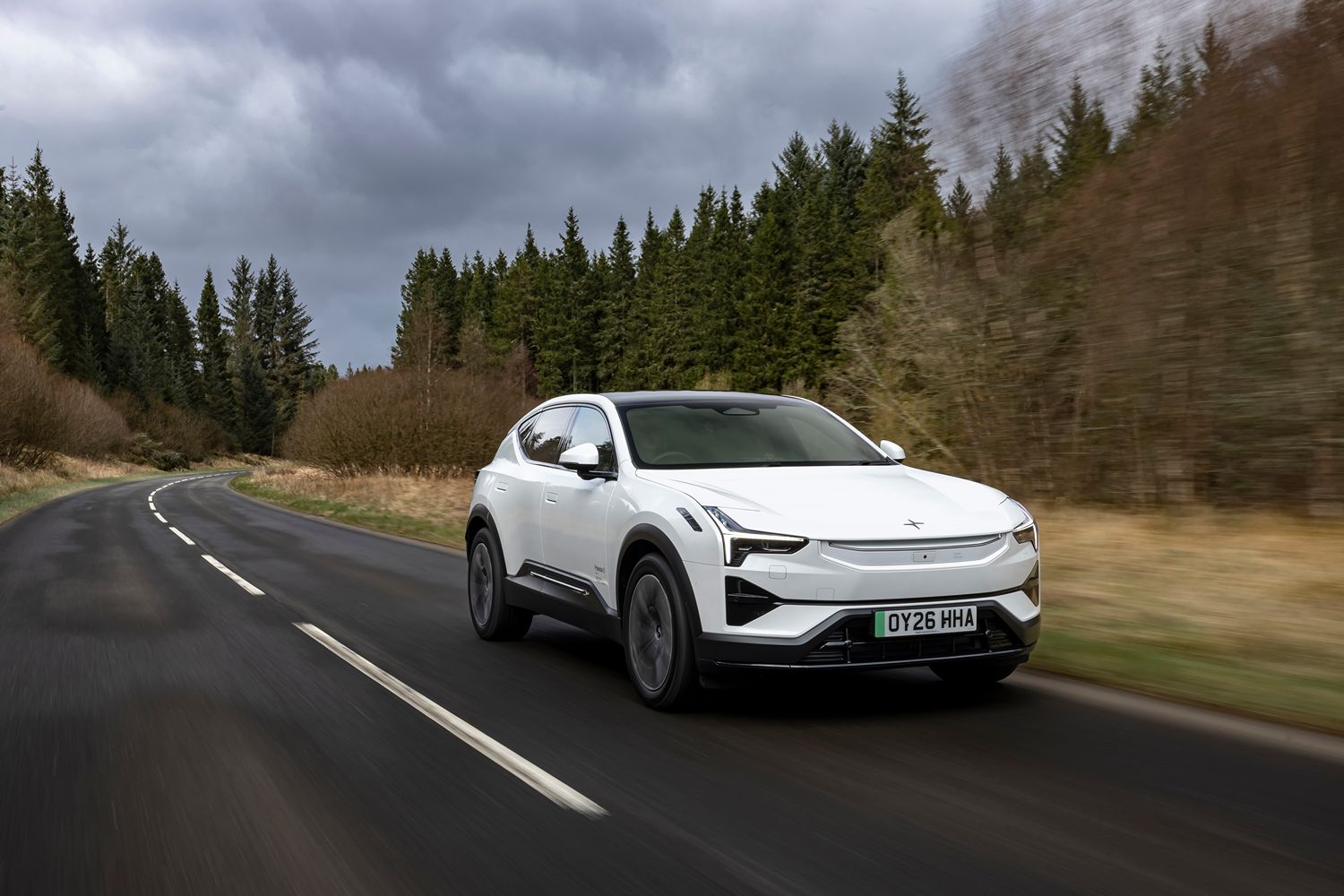
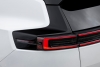
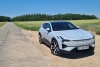
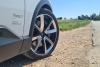
You won't spot much of a difference externally between the Polestar 3 Dual Motor and the Polestar 3 Performance. There's slightly less Swedish Gold on show on the former (the brake callipers were a silvery-grey to match the Magnesium bodywork of our week-long tester, and neither were the valve caps for the tyres in the glittering yellowy paint) and ordinarily, the DM wouldn't come on the 22-inch Performance forged and polished alloy wheels as standard - it instead runs the same 20-inch Aero rims as the Rear Motor entry-level P3, with the 22s equipped here a hefty £2,000 option.
So really, the only concrete external identifier that would give the DM's game away, aside from the lack of gold-tinged gewgaws, is that Polestar company-wide conceit of putting the model specs down at the leading edge of the base of the front doors, where in this instance it reads '106kWh/400kW'. If it was a Performance, it'd say '500kW' after the slash instead. Anyway, all things considered, any Polestar 3 looks good on the outside and this Dual Motor example is no different.
Interior
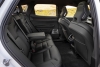
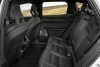
Again, there's hardly any differentiation in the Dual Motor from any other 2027MY Polestar 3, which means a beautifully built and tastefully reserved cabin, which nevertheless does place a little too much emphasis on the 14.5-inch Google Built-in infotainment system... oh, and despite the fact they're supposed to be seen on all updated P3s, there are still no labels on the haptic steering-wheel buttons. Grr.
Thankfully, though, with the gorgeous and supportive sculpted buckets up front, plus a reasonably intuitive digital interface with the crisp, clear Polestar graphics in that particular font, the inside of the Dual Motor is a suitably pleasant place to have to spend some time. Incidentally, there is one minor difference here between the 544- and 680hp cars. The Dual Motor's seatbelts are black with a central Swedish Gold pinstripe, but for the Performance the whole belt is rendered in the brighter colour. So now you know.
Practicality
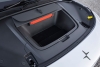
Right, we can't keep starting with 'not much to report here', because it's once again the same as the other models, but with acres of rear passenger legroom and a flat floor in the second row, plus plenty of useful in-car storage solutions, the Polestar 3 Dual Motor is not without its practicality merits. It still has the bloody stupid system whereby you have to tap the touchscreen to open the glovebox and the main boot at the back isn't enormous, rated at 484 litres (including 90 litres of underfloor storage) with all seats in use - that figure is identical to any other P3, by the way. But the Dual Motor does have a slightly larger forward cargo area under its bonnet than that found in the Performance, as it measures 32 litres here but just 23.8 litres in the 680hp car. Also, the Dual Motor can lug the same 2.2 tonnes of braked trailer as the Performance, as well.
Performance
The '27MY Dual Motor might only be the 'mid' tier of the family, but with 544hp it's more powerful than the old 400-volt Polestar 3's former flagship, the 517hp
Dual Motor with Performance Pack. However, the newer car doesn't quite have the torque to match the old DM PP, with 740Nm playing 910Nm, but the fresh Dual Motor is still quicker to 62mph from rest by two-tenths, popping in a stunning 4.5-second sprint. It also has a claimed range almost 50 miles in excess of the old P3 range-topper, theoretically managing up to 394 miles between top-ups of its goliath 106kWh NMC battery pack. And if you keep it on the 20s, this is the only version of the Scandi EV that'll go beyond 400 miles officially, as the less-potent Rear Motor has a smaller 92kWh battery and 374-mile best for its one-shot capability.
It therefore all looks pretty rosy for the Dual Motor and, in practice, you certainly couldn't realistically want for any more straight-line speed than this. The 544hp P3 is a properly rapid, startlingly insistent big EV and it feels like the quoted 140mph top speed could be easily surpassed with a different arrangement for the reduction-gear transmission (maybe if the Polestar used a two-speed set-up like the
Porsche Taycan, for instance). We also like the powerful, progressive and pleasing brakes, which are 400mm front, 390mm rear ventilated discs, just like they are on the Performance.
The problem is, the price gap and indeed perceived value difference between this model and the Performance isn't really big enough (see Value section, below), and the latter does feel another step quicker and stronger again. And it's not as if opting for the 544hp twin motors massively improves the Polestar 3's consumption. When we drove the Performance through the middle of Kielder Forest earlier this year, on a test loop in which there was plenty of enthusiastic 'helming' and the route wasn't particularly conducive to economical EV motoring, it managed 2.45 miles/kWh. Across 429 miles of mixed-roads testing, with predominantly more sympathetic use and lots of steady-state cruising, the Dual Motor turned in 22.4kWh/62.1 miles, or 2.8 miles/kWh. That's not brilliant, even for a 2.5-tonne-plus electric SUV capable of 0-62mph in well inside five seconds.
Ride & Handling
Like the Performance, the Dual Motor has fully adaptive air suspension, although the grandest Polestar 3 has its own special, sportier state of tune than this 544hp mid-grade car. The basic Rear Motor, however, has conventional springs with frequency selective dampers (FSDs) and we found it to lack the necessary vertical control when tackling a challenging back-road with any degree of vim and vigour.
No such concerns with the Polestar 3 Dual Motor, which is a generally lovely thing to drive. It masks its bulk very well indeed and there's no significant amount of excessive body movement to report. On the huge 22s, the grip is near-endless thanks to the broad contact patches (295-section at the rear, 265 front) on the specially developed Pirelli P Zero rubber (the Aero wheels are clad in Michelins) and Polestar is to be commended for equipping steering as good as this on a zero-emission SUV; its among the best, most satisfying set-ups we've sampled of this kind. Thankfully, the car also works beautifully in the ride and refinement departments, with the air suspension making it a supremely comfortable long-distance hauler while the in-cabin suppression of external noise contributors is deeply impressive.
So, like any Polestar 3, the Dual Motor is great in all the dynamic disciplines, even if it isn't quite as involving and well-sorted as something like a
Porsche Macan Electric, especially the superb GTS derivative. But (and you know this caveat was coming, didn't you?) it's not as rewarding from behind the wheel as the Performance - whereas the stronger P3 sacrifices hardly anything for ride comfort nor rolling refinement in terms of the pay-off. And the real-world range is hardly going to be any different on the two, judging by the way this DM gulped down electric while on test. Thus, wouldn't you just stretch a little further financially for the Performance instead?
Value
There's a nominal £7,500 gap between the Dual Motor and the Performance, with the former coming in at a smidge beyond £84,500 and the latter slightly more than £92,000. However, when you chuck on the two-grand 22s and also £1,600 HD LED headlights, as with our test car, then you push up to £88,140. And once you're down to a mere £4,000 of difference in order to get in the Performance, with its extra 136hp, 130Nm and Polestar-tuned chassis, then making a cogent case for the Dual Motor starts to become ever harder still.
That said, at the time of writing, Polestar was offering significant £10,000 savings on all variants of the 3, with a Rear Motor starting from £66,540, the Dual Motor here kicking off at £74,540 and the Performance capping out at £82,040. Sure, that doesn't place the DM in any more favourable a fiscal position relative to the Performance sibling in its own stable, but maybe it's a little easier to justify picking the 'worst' model of a given range at £74,000 than it is at 88 large (with options).
Verdict
In isolation, the Polestar 3 Dual Motor is a wonderful thing, as prestige electric SUVs go. Aside from some interior niggles, the modest boot and sheer expense of the machine, it does everything very well and nothing badly at all. Buy one, and you'd be more than happy with it. Delighted, even.
But we feel it's the most obviously compromised model in the P3's line-up. Sometimes, the middle way can be best with these sorts of EVs, offering healthy speed and plenty of kit for a suitably tempting price when compared to the grander derivatives. However, at this sort of level of outright expenditure, we don't feel there's enough of a gulf between this and the more-powerful, better-to-drive Performance to make the Dual Motor - as undeniably good as it is - tempting enough to punters. Even if it is ostensibly the longest-legged Polestar 3 on offer.