Styling
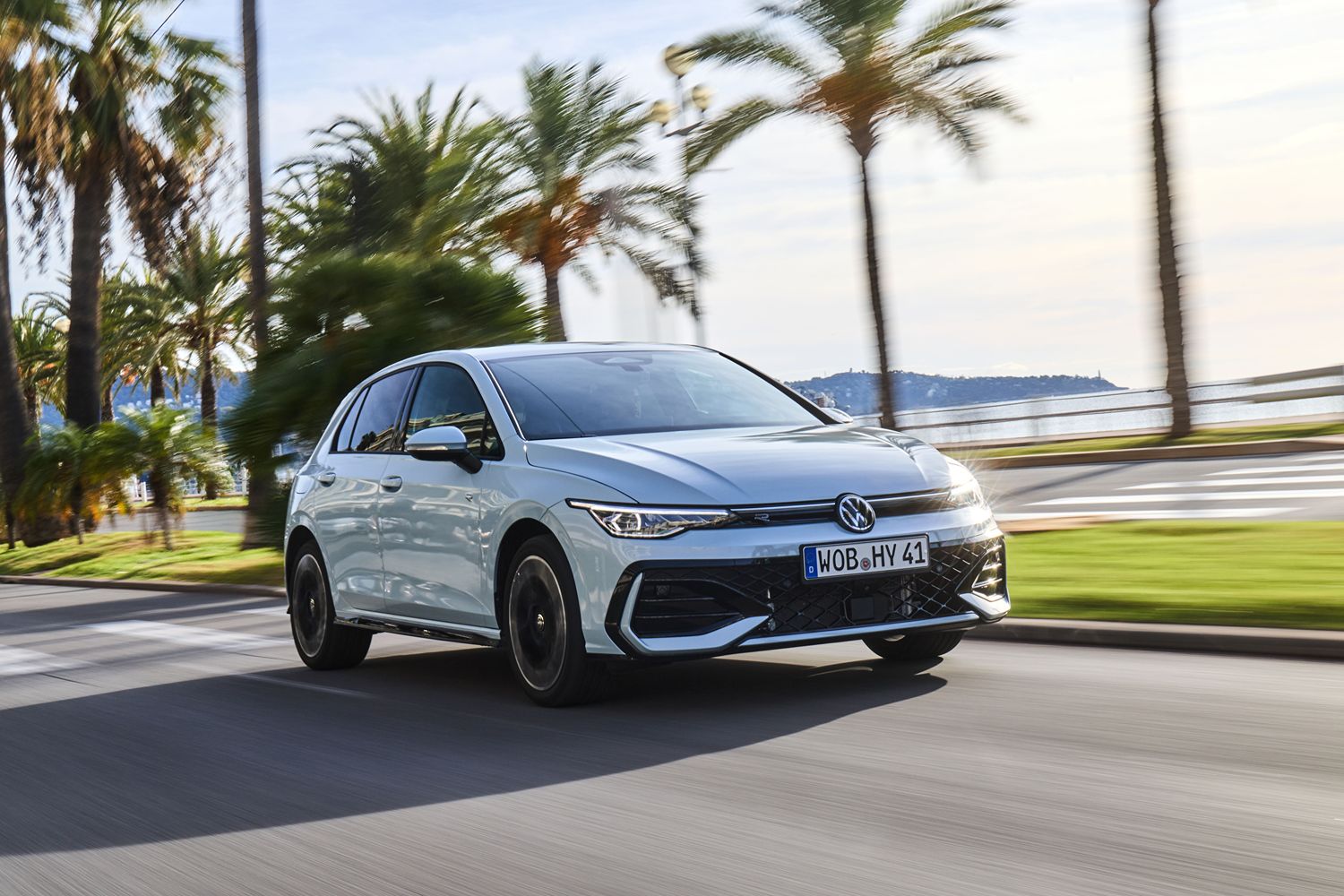
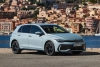
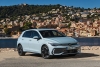
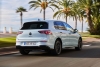
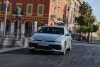
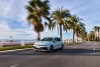
With respect to anyone reading, if you don't know what a Mk8.5 Volkswagen Golf R-Line hatch looks like by now, then we're not entirely sure where you've been living for the past three years. The Hybrid is, essentially, no different to its stablemates (which is to say, it looks good with that hawkish face and tidy proportions throughout), save for a small 'Hybrid' emblem on the tailgate.
Interior
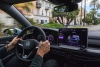
Volkswagen improved the eighth-gen Golf with the 2024 facelift and update, and its cabin is less teeth-gnashingly frustrating to use now than it was when the Mk8 first appeared back in 2020. Having said that, it's still not perfect, thanks to the sliders for climate control and so on, but four main shortcut switches on the main fascia, proper buttons on the steering wheel, and improved graphics and response rates in the infotainment make the interface far less painful than it could be. Material quality in the car also feels better than those early 2020 models we sampled, too.
Practicality
Due to the placement of some of the hybrid ancillaries, the Golf HEV has a boot as small as that found on the PHEV versions, such as the
GTE. This means it possesses just 273 litres of space with all seats in use, a reduction of 101 litres from the regular ICE hatch or the eTSI, and a modest 1,129 litres with the 60:40 split-folding second row dropped down. Also, this is the worst tow-car Golf, if you need that sort of thing, with the Hybrid only capable of hauling a maximum 900kg of braked trailer.
Performance
There are 115- and 150hp versions of the plain 1.5-litre four-cylinder TSI petrol engine in the Golf Mk8 family, which are equipped with manual transmissions. If you want a seven-speed DSG auto, you must have the MHEV, which comes purely in the 150hp flavour in VW's stalwart hatch. There are then 204hp eHybrid and 272hp GTE PHEVs above that, so you can see the 170hp/310Nm HEV slots neatly into a gap in the Golf's present offering.
There will also be a 136hp take on this same HEV set-up, but the 170hp model feels sweetly done. It suffers from the same slightly hesitant transmission as we experienced in the T-Roc Hybrid with this fresh-to-group powertrain, but because the Golf is 105kg lighter than the SUV then it feels much brisker for acceleration response, so you're less cognisant of the switches between the Golf's EV, series hybrid and parallel hybrid phases. It doesn't feel like a 7.5-second quoted 0-62mph time is a case of Wolfsburg over-egging the pudding, that's for sure.
The 1.5 is also restricted to 4,500rpm as a result of its strange single-speed gearbox, which in turn limits the top speed of the Golf Hybrid to 112mph. However, the payoff is that the four-pot unit, which can be a bit raucous in other VW applications where it can rev out to 6,000rpm and higher, is mainly subdued here. Furthermore, its printed eco-stats are considerably better than the taller, heftier T-Roc Hybrid, while they also eclipse those of a 150hp eTSI Golf. And so it proved on a mainly urban test route in the south of France, where the HEV gave back an excellent indicated economy of 51.4mpg, without much cautiously considerate driving on our part.
Ride & Handling
As the hybrid module and tiny 0.64kWh NMC battery (1.6kWh gross) only add 48kg to the kerb weight of the Golf, thankfully the new Hybrid variant of the Volkswagen stays the right side of 1.5 tonnes. This makes it dynamically very, very much like any other Golf: the handling is clean and tidy, albeit not very involving, and the ride and rolling refinement are largely excellent by class standards. Nothing new under the sun, and all that.
Helping with the Golf's dignity in and around town (it suffered none of the low-speed crashiness, side-to-side sway in the wake of speed bumps nor leaden behaviour of the T-Roc Hybrid we drove earlier on the same day) was the fitment of Dynamic Chassis Control (DCC) dampers. We're not sure if these are a dealbreaker on the Mk8 Golf R-Line as they are on the Mk2 T-Roc R-Line; we'd have to try a non-DCC version of the hatchback in the UK to make sure. But, from the car we drove in France, there are no complaints with the Volkswagen's supple and controlled ride quality from our side.
Value
Commanding a roughly £1,200 premium over existing eTSI models in the same spec, we're predicting a Volkswagen Golf Hybrid R-Line like our tester should cost about £35,160 here once prices are finally confirmed. The HEV should come with all the kit you'd expect of an R-Line Golf and it's due to go on sale before 2026 is out, with any luck.
Verdict
An obvious new rival for the likes of the
Honda Civic e:HEV and the
Toyota Corolla Hybrid, the Volkswagen Golf Hybrid is as neatly executed as you'd expect of this company. It drives well, it handles well, it rides well, it keeps quiet at speed well... it does very Golfy things, fundamentally.
For all that, though, and while the HEV is a welcome addition to the VW's ranks at this stage, it seems to be answering a question that nobody was particularly asking of the Mk8.5 range. There's a certain use-case to be made for fleet drivers, who don't have access to charge points either domestically or at their place of business, but for everyone else, either the eTSI or eHybrid already did the job the Hybrid is doing, only with more refined gearboxes and other benefits to their cause (the MHEV is cheaper, the PHEV drives on electric for far longer and at much higher speeds).
So while, out of the T-Roc and Golf applications we've tried so far, the latter is the better effort with the all-new Hybrid powertrain, what you're really looking at here is the start of this system's spread across the wider VW Group. Expect to see it in, ooooh, we dunno... let's say, for example, a
Skoda Octavia, anytime very soon. Watch this space.