Styling
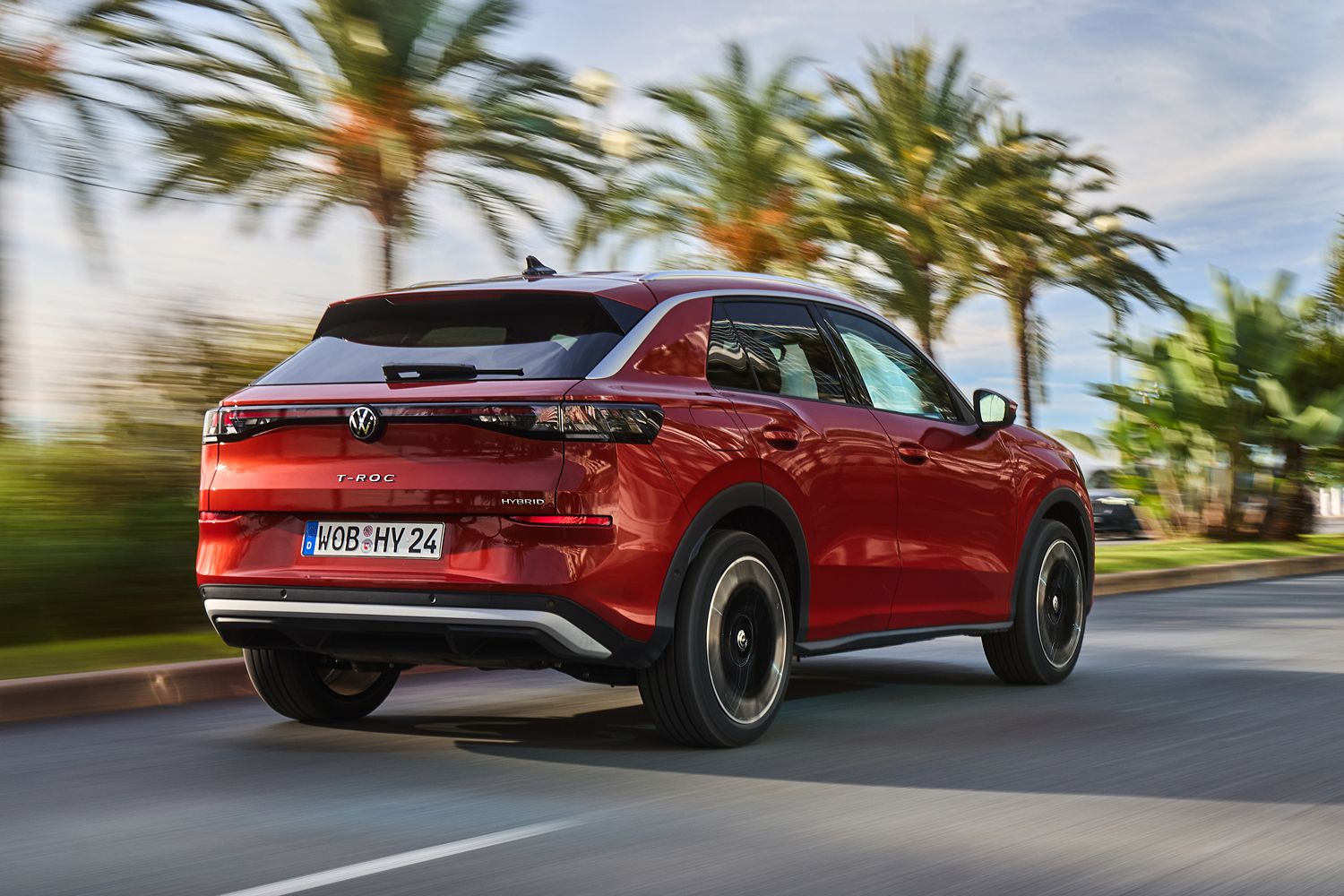
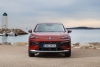
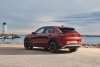
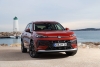
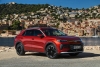
The Mk2 T-Roc is a little more pleasing on the eye than the
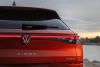
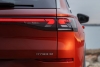
original, with its swoopier lines and linked light clusters at both ends of the car. As ever, sportier R-Line trim strengthens the vehicle's overall aesthetic appeal, while the only difference between this newcomer and the pre-existing eTSI T-Roc is the adoption of a 'Hybrid' wordmark on the right-hand side of the tailgate.
Interior
As outside, so within, as the Hybrid's cabin looks almost identical to that of the T-Roc eTSI. The only real alterations are revised HEV-related graphics for both the main 10-inch Digital Cockpit and the addition of powertrain energy-flow displays on the 12.9-inch central touchscreen, but otherwise material quality is good, and there's a bit of youthful vibrancy to the dash design and upholstery finishes. That said, the second-gen T-Roc still has a very button-light interface, although the switches on the steering wheel are at least proper physical items and not awful haptic affairs, but we could do with a few more master controls beyond a single Smart Dial down on the transmission tunnel, an item which has been lifted from the
Mk4 Skoda Superb. Still, the VW SUV has a largely likeable passenger compartment, as things stand.
Practicality
Rear-seat leg- and headroom in the Volkswagen T-Roc is fine, even for taller people, but due to the placement of some of the HEV gear for the Hybrid model, it has a significantly reduced boot compared to an eTSI. Whereas the latter has 475 litres to play with, when all seats are in use, and up to 1,350 litres with the second row folded down, the new Hybrid's equivalent stats are 340 and 1,212 litres. Also, even though it has more power and torque than the eTSI, the T-Roc HEV can tow 600kg less of braked trailer, with a limit of just 900kg at its disposal.
Performance
As Volkswagen UK has, so far, only sold the latest T-Roc with the eTSI MHEV powertrain (with a choice of either 116hp/220Nm or 150hp/250Nm outputs), then the 170hp/310Nm Hybrid becomes the
de facto range-topper (although there's also a 136hp/288Nm iteration of the new powertrain coming too). The 170hp car is quicker to 62mph than the 150hp eTSI, but only by four-tenths of a second because the HEV module adds 48kg to the kerb weight and so this VW is almost 1.6 tonnes at the kerb.
Having had the hybrid drivetrain explained to us by a VW engineer, who said it was most similar to Honda's i-MMD set-up when operating, in essence the T-Roc Hybrid is a range-extended EV, a series hybrid and a parallel hybrid all in one. Up to 37mph, it will do its level best to run in all-electric mode. Above that speed and on part-throttle openings, or if the tiny 0.64kWh usable NMC battery has been depleted, then the 1.5 TSI up front fires into life, but it isn't connected to the front wheels - instead sending power to the generator, which in turn charges the battery for the main propulsion motor. Only under heavy throttle loads and at higher speeds does a clutch close and lock the four-cylinder turbo engine to the driven wheels, turning the T-Roc into a parallel hybrid.
The transmission here is best described as one longer ratio (sixth, in effect) taken from one of VW's DSG 'boxes. It's not a CVT or a reduction gear, and that affects how the Hybrid accelerates. If you're running it around in town, engine off, and you suddenly open the throttle a long way, it can be a slightly laborious process while the onboard control systems work out what to do with clutches, e-motors, single-speed transmissions and TSI engines before getting on with the job of accelerating. It's never clunky, just a bit slow to respond; almost like a form of turbo lag, in a way.
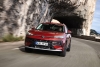
But once the engine is hooked to the wheels, the T-Roc Hybrid feels suitably brisk. And on a 45-mile crawl around the French Riviera, the VW also proved to be suitably real-world efficient, turning in a commendable 45.6mpg consumption figure during that time.
Ride & Handling
We road-tested an R-Line eTSI for a week in the UK earlier this year (review of that car to come on the site) and we also drove the T-Roc Hybrid R-Line back-to-back with a Golf Hybrid on the same launch event (yep, review of the Golf also forthcoming too). And our advice is this: make sure you get Dynamic Chassis Control (DCC) dampers for £765. Or stick with a lower-spec HEV with smaller wheels than the 18-inch items on this car.
Grief, the T-Roc Hybrid R-Line was firm. Like, too harsh in and around town, the very environment its drivetrain is designed to excel within. With no give in the tougher R-Line suspension and a permanent, acute sense of the unsprung mass hanging at all four corners of the car, the VW introduced too much fidget, lateral head-toss and lumpiness to its low-speed comportment. In short, it rode poorly.
We know, though, that an R-Line eTSI with DCC fitted conducts itself with a huge amount more grace than this, so while the rest of the refinement and handling is as you might expect of a regular T-Roc like this - i.e., polished, but not particularly engaging - we're very strongly advocating for the extra 800 quid on the switchable shock absorbers.
Value
Prices for the Hybrid have not been confirmed as yet, but VW's UK reps said the new powertrain would command a circa-£1,200 premium over the equivalent eTSI - as in, a 136hp HEV would be £1,200 more than a 116hp eTSI, while this 170hp Hybrid requires the same uptick over a 150hp MHEV. Available HEV trims should be Match, Style and R-Line. As a result, an R-Line Hybrid like this will cost more than £40,000 before options when it goes on sale at the very end of 2026, meaning it'll succumb to the 'rich tax' on VED, regrettably.
Verdict
The second-gen Volkswagen T-Roc is an admirable C-segment SUV and the addition of the Hybrid powertrain is an understandable decision on the manufacturer's part. Execution-wise, Wolfsburg seems to have done a good job on the HEV set-up, slightly slow-witted transmission aside, so if you want greater electric-driving capability in towns and cities from your T-Roc than the eTSI can currently provide, this variant is the answer. Watch out for the standard R-Line suspension, though, as if our test car had DCC, it might have gained an extra half-star in the final reckoning. And it'd have bagged another point-five if the vehicle's overall price stayed the right side of 40 grand.