Styling
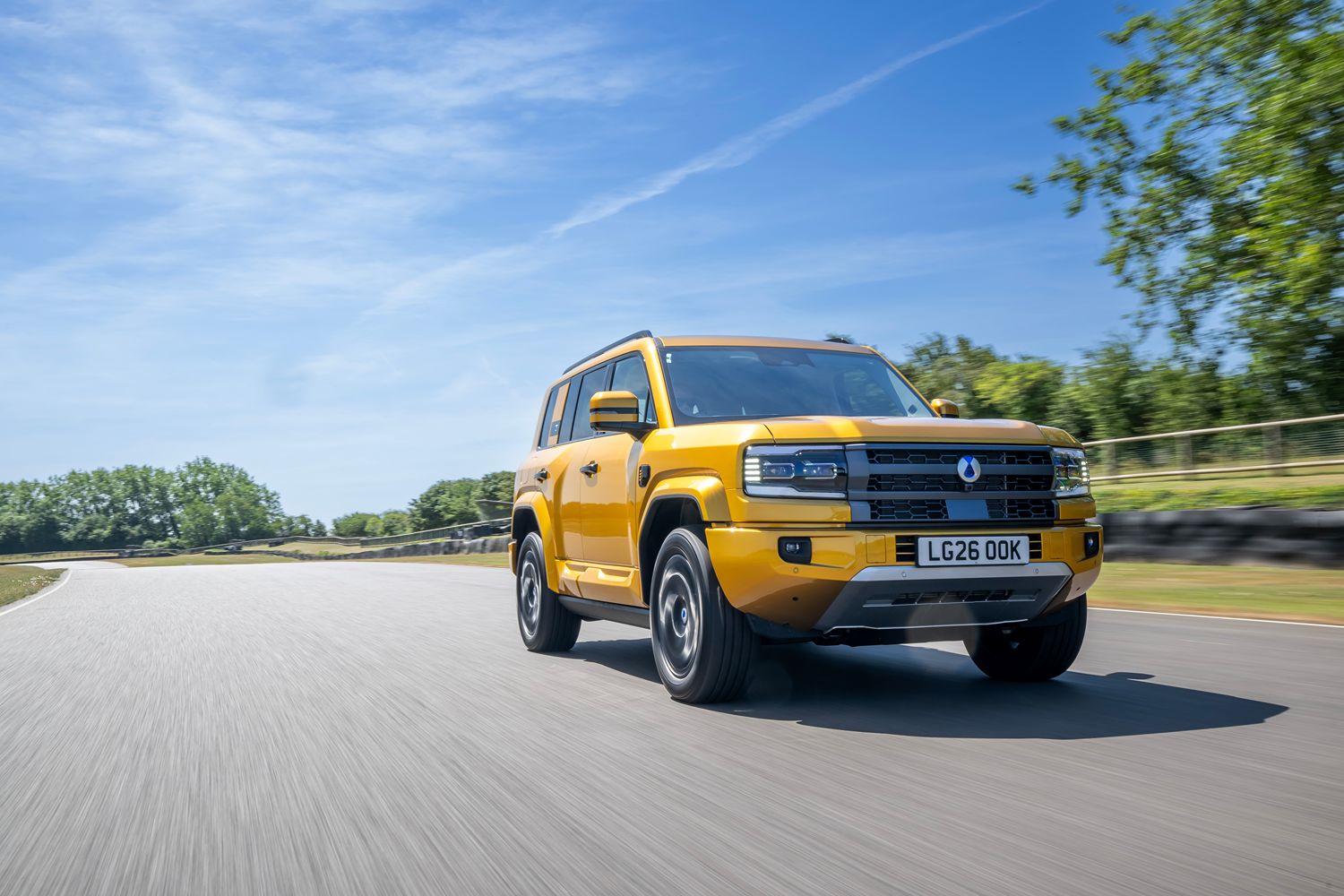
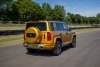
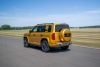
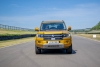
The exterior of the Denza Bao 5 is one of its strongest suits, especially in the distinctive and rather lovely shade of Tarim Poplar Gold that you can see in the pics, but there are obviously some hints of the design that look rather similar to the established competition. Despite the fact the Bao 5 is a five-door machine, with a boot-mounted spare wheel and a side-hinged tailgate (which is on the 'wrong' way round for right-hand-drive markets like ours) then there's a clear similarity between this and a
Land Rover Defender 90, while there are also aesthetic elements of it that'll put you in mind of a
Toyota Land Cruiser. That said, we do think the Denza SUV/4x4 has undeniably chunky kerb appeal, and it runs on either 18- or 20-inch alloys depending on the spec.
Interior
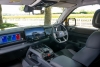
As we got a very brief go in the Denza Bao 5 at a preview event for the brand ahead of the 2026 Goodwood Festival of Speed, we haven't had a good prod and a poke around the cabin to determine just how solidly built and/or well-finished it is. Certainly, with the eye, the first impressions are favourable, and there's a repeated 'lock' motif throughout the cabin - although we think it's visually more like the interlinked sections of a chain. But that's considerably wordier than 'lock', isn't it, so presumably this is why the marketing team at Denza went with the shorter, catchier phrase.
Anyway, you can espy this lock-related design in the overall shape of the main dashboard with its flanking grab handles, and you'll see it if you look at the central transmission tunnel side-on. The emblem further recurs in the air vents, for the opening handles on the doors, for the armrests on the door-cards, and even on the visible fascia grilles for some of the 18 speakers equipped as part of the standard-fit Devialet uprated sound system. This, along with the Nappa leather of our Ultimate test car and the screen-heavy interface (one 15.6-inch infotainment touchscreen, flanked by two 12.3-inch digital units and then topped off with a 50-inch driver's head-up display), does give the Bao 5's cabin an overall upmarket and high-tech ambience, but we'd need longer with the car to ascertain whether a) it's all bolted together properly and made with the best possible materials, and b) how easy to use, or alternatively infuriating, the human-machine interface is.
Practicality
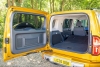
No complaints here, aside from that hefty old tailgate which opens towards the kerb if you're parked, correctly, to the left-hand pavement. Or which also precludes you getting too close to other vehicles or roadside/car park fixtures if you want to open the boot fully. Moving on, as the Denza Bao 5 is in the region of 4.9 metres long in both specs, with 2,800mm of that made up by wheelbase, there's plenty of room in the second-row seating for even taller people to get comfortable. The boot itself, door issues aside, measures 475 litres with all seats in use and up to 1,736 litres with the rear bench folded away, that massive latter figure a direct corollary of the Denza's boxy exterior form.
We'll come onto the off-road tech the Bao 5 is fitted with as part of the next two sections of the review, but briefly here it has a couple of locking diffs, one for each axle, plus the Ultimate flagship grade also comes on DiSus-P variable suspension with an adjustable ride height. Nominally, the Denza stands 220mm off the deck, but it has fully 140mm range-of-movement around this starting point, able to either hunker 50mm closer to the ground for a 170mm overall ground-clearance figure, or alternatively jack itself up by another 90mm to allow for 310mm of clear air beneath its chassis and hardware.
In regular ride-height mode, the Chinese manufacturer claims the Bao 5 has approach and departure angles of 35 and 32 degrees respectively, but set at 310mm these improve to 39 and 35 degrees accordingly. Beyond that, the 4x4 is also rated to lug up to 2.5 tonnes of braked trailer; perhaps restricted from the maximum permissible 3,500kg by its PHEV nature. And that brings us neatly onto the next section of the piece...
Performance
On the face of it, the Denza Bao 5's printed figures look mighty impressive. With system peaks of 544hp and 760Nm, it comfortably outpunches the likes of the aforementioned Land Cruiser, as well as the
Ineos Grenadier and
Jeep Wrangler too. Indeed, it's not far off a
Mercedes-AMG G 63 or the pre-update version of the monster
Defender Octa (sadly, the latter has been trimmed from its 635hp zenith to 540hp to satisfy emissions regs, as part of the midlife overhaul this year).
All very noble, and tempting data for customers looking for a prestige bargain. The problem is precisely
how the Bao 5 achieves those numbers. It uses a PHEV system which isn't a million miles away in spec-terms from those set-ups employed by cars like the
BYD Dolphin G supermini. While parent firm BYD refers to its PHEVs as 'DM-i', for 'dual mode, intelligent', the Denza configuration here is called 'Super DMO' - 'dual mode off-road'. One of the principal differences, aside from its sheer power, is the fact the combustion engine in the Bao 5 is longitudinally arranged, which Denza is claiming is a world-first longitudinal electric-hybrid system.
But the engine is that same 1.5-litre turbocharged four-cylinder unit you'd get in any BYD DM-i. Here, it delivers 150hp and 240Nm of its own, but just like in DM-i, the DMO basically deploys the four-pot as a kind of range extender or generator for the onboard electrical propulsion; only under extreme throttle loads does the petrol engine actually turn the Bao 5's wheels directly.
That job is therefore mainly handled by a couple of whopping e-motors, a front-mounted unit coming up with 272hp/360Nm and accompanied by a rear item that brings another 388hp/400Nm to the party. The absolute combined maximum might of the DMO could theoretically therefore be 810hp and 1,000Nm, but Denza obviously has engineered the system to 544hp and 760Nm, still commendable outputs.
And that leads to rapid on-paper times of 4.8 seconds for 0-62mph in the Elegance model, or five seconds dead for this Ultimate we're driving here. The problem, though, is that with its body-on-frame construction, and a necessarily large battery pack (31.8kWh Blade LFP) to power all of this, and two locking differentials plus a central 'energy' diff, and an electronically controlled variable gearbox, and an engine, and big wheels and brakes, and luxury interior fittings and seats, and a large frame, the Denza is... well, it's got a bit of a weight issue. Actually, scratch 'a bit of' from that last sentence. There's no way of sugar-coating this: as an Elegance, the Bao 5 weighs a startling 2,940kg. As this DiSus-P equipped Ultimate on 20s? The figure is a jaw-dropping 3,035kg.
Three. Tonnes. Not since the
Land Rover Discovery 3 and 4 generation wallowed into view have we had such a bloater hit the roads as this. And you've probably guessed precisely where all this preamble is going - the fact is, the Denza Bao 5 never,
ever feels close to 544hp. The amount of time it took it to crawl from about 40- up to 60mph out on the roads would have us questioning things even if its claimed power output was half this number, and remember we were driving it with full battery charge at its disposal. Of course, the way the DMO operates, you'll never be completely without the assistance of the e-motors and thus in the dreaded situation of relying on a 150hp four-cylinder turbo to shift 3,035kg of pseudo-SUV about the place all on its own, but even so the depleted-battery performance on this is surely going to be something to behold.
In the Bao 5's defence, the mechanical isolation of the 1.5-litre engine is superb, as it's almost inaudible even when it is working at full chat to help the dual e-motors, and the whole drivetrain does at least deliver its power smoothly and effectively. There are also some other impressive stats connected to the DMO nature of the Denza, including 56 miles of electric-only range, CO
2 emissions of just 30g/km, and a WLTP economy figure of 68.9mpg. It also has ultra-rapid (for a PHEV) DC charging of 100kW, so a 30-80 per cent top-up will only require a purported 16 minutes of hook-up.
But we'll conclude this section by saying the depleted-battery economy figure Denza itself states is a rather more alarming 26.4mpg (we didn't get long enough at the wheel of the Bao 5 this time around to prove or disprove this assertion), while there's one thing the bulky Chinese newcomer surely doesn't feel in the slightest - and that's quick.
Ride & Handling
Oh dear. OK, so we've already mentioned that the Denza Bao 5 is kind of straddling the gulf between luxe-SUV and durable 4x4. In terms of its body styling, the interior finishing, the claimed power and torque numbers plus on-road performance, and the PHEV drivetrain, it's very SUV-esque; but it has a ladder-frame chassis, a proper '4Lo' mode in its advanced transmission, a claimed trio of diffs, and of course that DiSus-P adjustable suspension with its colossal peak ride height of 310mm.
Curiously, Denza in its bumf on the one hand says the Bao 5 has three locking diffs, one on each axle and then another in the centre. It then goes on to outline that the front and rear diffs are electronically controlled items, while the middle item is in fact an 'energy centre lock' that "intelligently distributes torque between both axles 30 times faster than a traditional mechanical diff". There is, of course, no mechanical link (propshaft) between any of these items, however, so quite how successful the Bao 5's underpinnings will be away from the tarmac remains to be seen.
That's because we only drove the Denza on metalled roads, and only then on the bobbly lanes surrounding the Goodwood Circuit. And, grief, our overriding memory of this car is its shockingly poor ride. The amount of fidget and shudder coming up through the Bao 5's frame is quite astounding in this day and age, especially when many of its rivals have become considerably more gentrified on-road, all without losing any of their mega off-road capabilities.
This, remember, is also in the model with the adaptive DiSus-P suspension too, so we'd be intrigued (and not a little apprehensive also) to sample the Elegance on its regular set-up. Suffice it to say, travelling in the Bao 5 for miles and miles on end would not be a comfortable experience, if this juddery and firm ride quality is anything to go by.
It rather detracts, too, from a driving experience which isn't bad overall. The steering, for instance, is nice and direct, and reasonably well-weighted. There's not too much pitch, dive or lean from the Bao 5, although we will again remind you that we didn't drive it for very long, so we haven't fully explored its at-the-limit road-holding skills. And the levels of acoustic isolation that already impressed us in muffling the exertions of the 1.5-litre blown four up front also extend to minimising anything too excessive in terms of wind ruffle, tyre roar or suspension clonks from making their way into the passenger compartment.
So it's a shame the ride 'quality' is such a dominant part of proceedings. Admittedly, in the round, the Denza is nothing like as agricultural to be in as, say, a
classic Defender, but this rigid level of comportment does make it feel well off the prevailing standards in this sector of the marketplace. We're not sure if there's time for Denza to once again tweak the DiSus-P suspension settings ahead of the Bao 5's wider market launch in the UK, but if it could do so and just bring a greater degree of dignity to the rolling comfort levels, it'd make this leftfield Chinese machine so much easier to recommend than it is right now.
Value
The Denza Bao 5 will be sold in two main specifications in this country. The first is the Elegance, which costs from £69,500. For that, you get leather upholstery, heated and ventilated front seats, heated rear seats, a heated steering wheel, a panoramic sunroof, 12- and 10-way electrically adjustable front chairs (driver and passenger respectively), the 18-speaker, 840-watt Devialet sound system, a 4.5-litre central cubby that can either be refrigerated to a -6 to +6 degrees C range, or alternatively heated to 35-50 deg C (see the
Aion V for a very similar Cool HotBox arrangement), the full digital array inside including 12.3-inch passenger screen and 50-inch HUD, a digital key, a 50-watt wireless charging tray for smartphones, double-wishbone hydraulic suspension, and 18-inch alloy wheels, among more.
Stepping up to the Bao 5 Ultimate requires £78,880, and it adds the DiSus-P intelligent hydraulic suspension, Nappa leather, a second 50-watt smartphone-charging pad, ventilation for the rear seats to go with the fronts, a digital rear-view mirror, 20-inch wheels on Pirelli tyres, fixed brake callipers on the front axle, a fully enclosed spare-tyre cover, and electrically deploying side-steps.
As you can see, lots of standard kit for not a lot of money, and pricewise the Bao 5 is in the zone of the Land Cruiser and the lower rungs of the Defender ownership ladder, while being a lot cheaper than any G-Wagen. The Jeep Wrangler, meanwhile, is on a brief hiatus while its parent company works out how to make it conform with the latest European tailpipe-emission standards, but it's supposed to be in line for a return to our market - and
when we last drove it, the American icon was in the ballpark of £65,000 as a Rubicon.
Verdict
On this brief, initial showing, the Denza Bao 5 feels like it might regrettably fall between two stools. It's neither quite luxurious nor comfortable enough to pass itself off as a properly top-end SUV, while the strange PHEV arrangement and electronic diffs underneath suggest it won't be as truly capable off-road as some of its long-established 4x4 competitors.
Nevertheless, there's promise here and the value of the car looks appealing, even if nearly 80 grand for the range-topper could be construed as brassy in the extreme for an unheralded brand that is looking to gain a foothold here. We'll conclude here by saying we need much more time, in a wider variety of driving scenarios, to bring you a definitive verdict on the overall merits of the Bao 5, but for now we've got one main takeaway from this opening sample of its dynamics - sort the ride quality out, Denza, and you could have a strong contender here.