Styling
Perhaps slipping out of using the royal 'we' for this review, I started work on an independent BMW specialist magazine in April 2003. It was just about the time the E39 M5 was bowing out of service, with slightly more than 20,000 examples put together in a production run that was only a little more than four years long. And I remember thinking at the time that the E39 M5 was a big car, a physically imposing thing. Perhaps even a bit of a barge, compared to the taut henchness of its then-contemporary M3, the E46.
One glance at its physical dimensions today suggests my memory isn't failing me as badly as I thought. The Beemer is almost 4.8 metres long, has a wheelbase of 2,830mm and clocks in at a still-chunky 1,795kg DIN. And yet, parked in BMW UK's main multistorey at its Farnborough HQ, sitting directly alongside the brutalist form of the modern-era, Anglesey Green G99 M5 Touring I'm due to drive back to my Notts base later in the day (for a subsequent one-week test drive), the E39 looks absolutely
tiny. It is dwarfed by the hulking form of the G99, a machine which is fully 17cm wider across the beam and which suddenly looks every single one of its 2,475 kilos when presented in this startling juxtaposition.
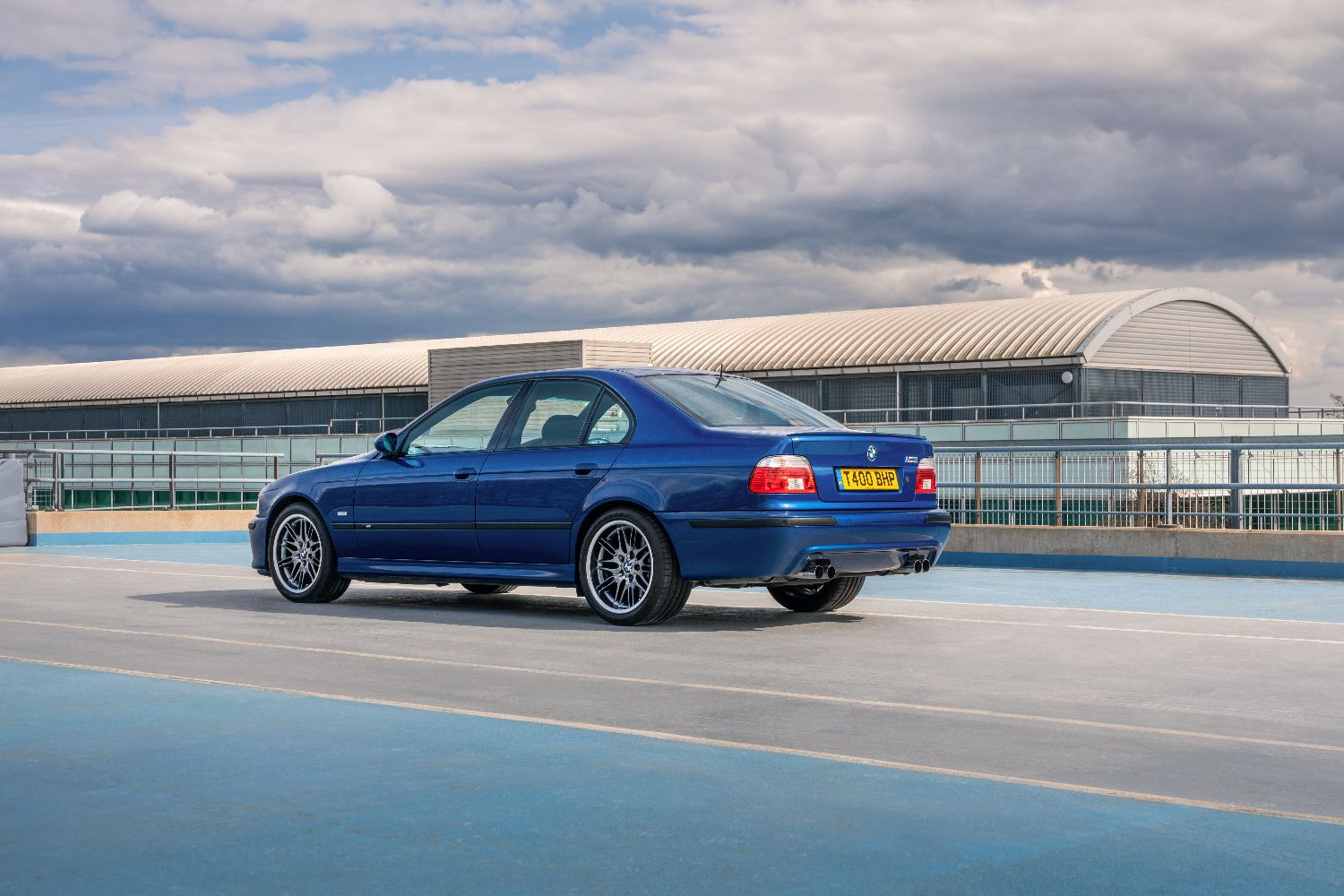
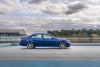
Of course, it helps that the daintier E39 is in the spectacular colour of Le Mans Blue, because it's a 2002 model and therefore a 'life-cycle impulse' example, which is abbreviated as LCI and basically means 'facelifter'. Anyway, it further aids the fourth-gen Five that its perfectly understated form has aged like the finest of fine wines in the intervening decades since it went off sale.
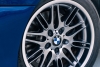
Not much actually marked the M5 out to the cognoscenti of the day, but its immaculate stance, those sublime deep-dished 18-inch alloy wheels finished in Shadow Chrome, the beefier bumpers and altered trim strips, the ultra-discreet 'M5' logos on the front doors and, the
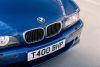
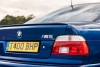
pièce de résistance, those signature quad exhaust tips poking out at the rear were enough to give M fans the knowing nod. And given the BMW UK heritage car is now wearing the fabled T400 BHP licence plate - it was on a Silverstone example back when 'I were a lad' on
Total BMW magazine and we borrowed it from the press fleet for a buying guide on the model - then the E39 simply couldn't look any better if it tried.
It looked fabulous then, it looks fabulous now, and I have no doubt that it will continue to look fabulous in another 25 years' time. BMW M's styling reached its zenith with this thing, it really did.
Interior
If the impression of the not-small E39 BMW M5 seeming physically diminutive starts on the outside, that sensation is continued within. The windscreen is right up in your face, with no stupidly deep dashboard construct, housing wiring and safety gear and god knows what in this day and age, sitting between you and it. The A-pillars are almost preternaturally slim, and while I don't remember this from driving it when it was new back in the early 2000s, or from the few owner examples I went on to sample in the years following its passing while working on various car mags, the driving position leaves you perched up ever so slightly higher than you might truthfully want to be. Your hair, if you've got any remaining (no comment, yr'honour), will be brushing the Beemer's headlining.
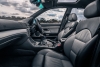
But it's all so wonderful in here. Everything looks and feels made of the best-quality materials of the early 2000s, which - in this low-mileage example belonging to BMW UK - all appear to have effortlessly withstood the test of time. Every single one of the little orange pixels in its idiosyncratic trip-computer display in the cluster is still glowing brightly. Those grey-faced dials continue to convey an air of something special about to happen, before you've so much as turned the fixed-blade key in the M5's ignition barrel (remember those?). That magnificent conceit of having a series of extinguishing yellow lights around the rev counter, which go out as the engine and its vital oils get up to primary operating temperature, finally allowing you access to the 7,000rpm redline, are as fantastic today as they were back in 2002.
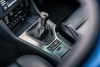
It's just beautiful. And, predictably as it's from a simpler age before baffling levels of technology had to be shoehorned into every car, ergonomically bang on the money. Sensible physical controls abound and are exactly where you would want them to be, while they operate with a solid tactility that's most gratifying. The tall, H-gate gearlever rises out of the tunnel and is topped with that illuminating three-stripe M logo, one of the most revered emblems in the automotive world. There's a proto-version of iDrive sitting in the dash, the menus on the screen operated by one of the rotary dials on the unit's fascia; and there's something a little poignant about being old enough and knackered enough to remember 'iDrive proper' arriving (to much consternation and confusion on the part of almost everyone who used it) in the
E65 7 Series, only to still be here working in the industry as this now-brilliant technology fizzles out in favour of BMW's present predilection for ginormous touchscreens.
Anyway, dials, dash, haptics, a trio of pedals in the driver's footwell, the perfect three-spoke M steering wheel, and that exquisite grey-and-black two-tone leather upholstery together all serve to make sitting at the E39 M5's wheel feel simultaneously special, modern and yet traditional, all at the same time.
Practicality
No complaints here. It looks like a pair of actual adults could sit in reasonable comfort in the back of the E39 M5, even if squeezing five fully grown people in the cabin might be a little more discomfiting. But at the back of the car is a 460-litre boot, which remains pretty capacious by saloon standards today. Even the
outgoing G80 M3 only manages 20 more litres than the old-timer.
Performance
With a swept capacity of 4,941cc, let's first of all not fall into the trap of calling this M5 a 5.0-litre. As a BMW purist from the late-'90s/2000s age, I've always been annoyed by people not correctly terming it a 4.9; only the succeeding, V10-powered
E60/1 M5 had a 'true' 5.0-litre, at 4,999cc. Ahem. Sad and pedantic rant over.
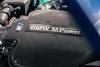
Whatever you want to call it on a capacity basis, the S62 is surely going to go down as one of the all-time great production engines. It was a serious evolution of the then-extant M62B44 4.4-litre V8, with the bore and stroke increased to take it out to 4.9 litres. And while a big-capacity, normally aspirated V8 might seem refreshingly old-school when viewed through the prism afforded by our 2026 vantage point, it was an advanced engine for the time. It was the first BMW V8, for instance, to use double-Vanos valve timing, while each of the eight cylinders had electronically actuated individual throttle bodies. The compression ratio was ramped up from the M62's 10.0:1 to 11.0:1 here, while dual air intakes with mass-flow sensors handled each bank of four cylinders apiece. The timing chain was beefed up to a duplex affair, the camshafts were hollow for greater responsiveness, there was a semi-dry-sumped oil system, and managing the whole lot was, at the time, the most-powerful ECU in the motoring world, an item specially developed by Siemens for the job.
The net outcomes, we all know by now: 400hp, 500Nm, 0-62mph in 5.3 seconds and enough grunt to see the 1.8-tonne M5 headbutt its
de rigueur 155mph V-max limiter. Rumours were that derestricted development examples could hit the 'magic 300' - km/h, that is, which is 186mph. And yes, I know; if you're a pedant like me, following on from my apoplexy about calling the S62 a 5.0, then you'll already be nasally telling anyone who'll listen that the reg T400 BHP is factually erroneous. It should be T394 BHP. Or maybe T40 OPS. Yes, yes. Whatever.
What cannot be argued with is how sumptuous this engine remains to this very day. The heritage press E39 M5 doesn't have fancy aftermarket airboxes or stainless-steel pipes to make the most of its voice, and in some ways there's something vaguely American about the low-revs rumbling the S62 makes. But once you swing its tachometer's needle past 3,500rpm, the engine note hardens into something more technologically advanced, insistent, and downright delicious. As it howls its way cleanly around to peak power at six-six and on to that 7,000rpm ceiling, the noise might not be thunderously loud, but it unequivocally demands your attention; sort of in the way that Leonard Cohen was maybe not quite as powerful nor astounding a singer as Marvin Gaye, but his voice could still truly haunt you nonetheless.
And the speed is immense. Not neck-snappingly violent, as some 700-800hp machines tend to be these days, but instead a glorious, long, linear pull of rich acceleration that feels like it is never going to end. You rinse the E39 M5 through all of second, third and fourth in its long-throw, characteristically knuckly gearbox, and you will certainly be troubling the sorts of roadside speed-monitoring devices that have proliferated in the UK in the years since the 4.9-litre Five departed the new-car realm. It's properly, relentlessly quick, without ever being savage. It's
perfect.
Ride & Handling
If anything can live up to the jewel of a V8 mill underneath the E39 M5's bonnet, it's the gem of a chassis on which the BMW is based. It's an M Power masterpiece. And what makes it so utterly bleedin' marvellous is that it does not require recourse to adaptive damping this and air suspension that. There's no adjusting the E39 through an endless myriad of settings before you set off, no tweaking the shock absorbers on the move. You get in, you drive it, you determine how sporty it feels through the twin mediums of your hands on the wheel and your right foot on the gas.
You simply won't ever find a better trade-off between ride comfort and dynamic acuity in any car with fixed-rate suspension than this. The aluminium-intensive MacPherson front struts and BMW's capable multilink rear set-up came with shorter spring height, specifically tuned dampers, thicker front and rear anti-roll bars, and other carefully thought-out tweaks by M, in order to make the ultimate E39 feel like a thoroughly rounded supersaloon and not a hot-rod engine dominating its surroundings.
The resulting car is heavenly. Every aspect of the way it gets down the road is perfectly in tune with everything else, so the E39 M5 feels cohesive and of a majestically unified piece. The ride quality, appraised as firm by a few critics of the time, is today remarkably supple. Thank 18-inch wheels with reasonable sidewalls on the tyres for that, because while they were huge alloys for 2002, today they're pretty much the preserve of superminis and smaller crossovers. The way the Beemer oozes over broken tarmac and filters out the worst edges of big impacts to its chassis is quite delightful.
And yet it's a phenomenally balanced and playful car, the long wheelbase and crisp, linear throttle plus nat-asp engine allowing you to adjust your corner angle almost at will. Even the less-talented driver should be able to coerce the E39 M5 into easily controllable oversteer, but if you want it to hook up to the surface and dissect every corner with as much speed as it can physically carry, the BMW can do that too. Tip it into the bends with vigour and you'll feel a little bit of tendency for the V8-toting nose to wash wide, but terminal understeer never once rears its head. And while there is lean from the shell as the weight of the M5 settles on its springs, and some trace pitch and dive under heavy acceleration and braking, it's again never discouraging; instead, it's the E39's underpinnings communicating with you, the driver, as clearly as they possibly can.
Is the M5 kinematically immaculate, then? Well, no. Not quite. The six-speed manual has a very distinctive feel as it clunks across the gate, and there's not the tightness and immediacy of throw that you might get from some of the finest H-gate transmissions down the decades. It also doesn't like to be rushed too often, as the clutch and flywheel on the BMW are dealing with a not-insignificant amount of mass in the overall reckoning. You need to be considered, patient even, with your shift actions in the M5.
Then there's the steering, the much-maligned recirculating ball effort that all V8 E39s had to endure due to packaging reasons. It's nowhere near as bad as the fiercest opponents of the system would like to have the uninitiated believe, but there's undeniably more of a vagueness about its weighting and feel just off the dead-ahead. Once you've got some significant lock dialled in, the consistency of it improves markedly, but honestly there are better steering systems in the automotive world - and in BMW's own back catalogue - than this.
And finally, the brakes. The E39 M5 is from the era when BMW M, for all its prowess in other areas, seemed unable to grasp that potent retardation was as much a key part of going quickly on the roads for prolonged periods as was a work-of-art powertrain. The discs on the M5 are large enough, as they're 345mm front and 328mm rear rotors, and as long as you give them a sizeable-enough breather between your most ferocious deceleration phases then they'll stand up to public-highway use without too much alarming fade. But two-piece floating callipers mean that repeated abuse will see the pedal on the BMW going worryingly long sooner, rather than later.
Nevertheless, for a sensational loop around some fine roads in southern England, for that afternoon there was no other automotive companion I'd have rather been driving than the E39 BMW M5. Its few, minor foibles are comprehensively outweighed by the sheer genius inherent in the rest of the package, and there's little doubt that this 24-year-old four-door remains one of the most-stunning supersaloons of all time.
Value
The crazy-money era for E39 M5s seems to have passed, and tired, ropier examples with six-figure mileages and patchy provenance are still sub-£20k. Better cared-for but still leggier models, typically the earlier LCIs, are in the £20,000-£30,000 bracket, and you can only exceed that latter figure with the latest 2002 and 2003 cars, usually with less than 100,000 miles on the odo and spotless history to match. The very best will be fetching upper-30s these days, but BMW's example is an extraordinarily well-kept specimen in a highly desirable colour specification - and it has not yet breached the 26,000-mile barrier. So something like £40,000 would appear to be in the right ballpark, maybe more given T400 BHP's singular background. But for a genuine member of automotive royalty like this, surely anything less than 50 grand is a bargain these days?
Verdict
They say time and tide wait for no man, but of course the E39 BMW M5 isn't a man, is it? And having experienced this tight-as-a-drum example almost a quarter-of-a-century down the line from when it was rolling out of a showroom as a new car, it would appear this Bavarian has, amazingly, managed to avoid the erosive march of the intervening years. This is a high-performance saloon that has lost not one scintilla of its deeply ingrained allure, a machine from a period in automotive history when tyre and chassis development was nearing its peak, but the vehicles themselves were free from the corrupting influences of the smartphone-obsessed generations. Rightfully, the E39 M5 remains an icon. A legend. A
bona fide motoring superstar. It's still the elite supremo of the entire M car clan.