Styling
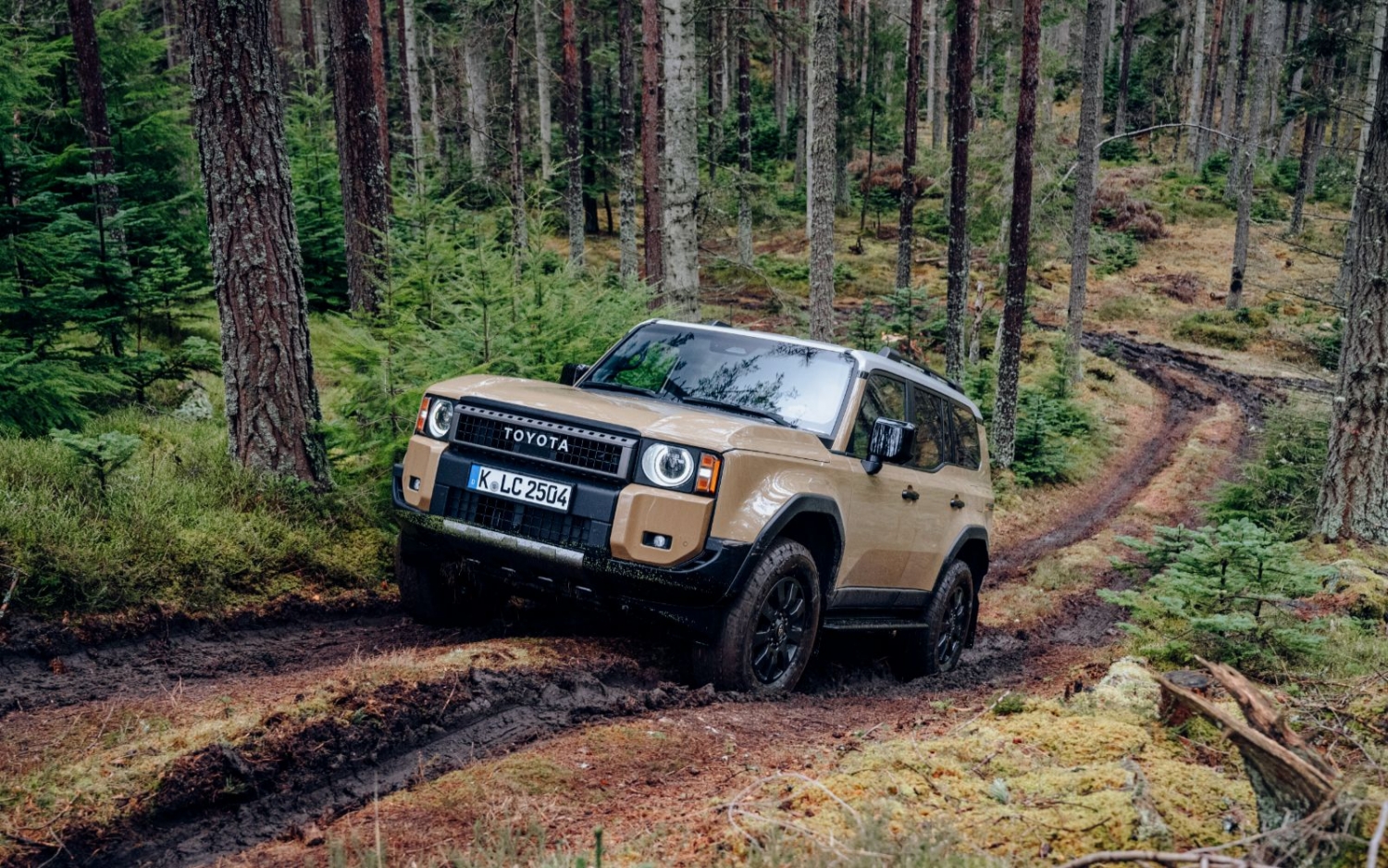
The retro-tastic styling of the Land Cruiser is going to be a huge part of its appeal. Slightly confusing matters here is precisely which of its ancestors it most clearly riffs off, but that's because the Toyota 4x4 has, over the years, evolved into three clear strands: Heavy Duty; Station Wagon; and Light Duty (otherwise known as the 'Prado'). And so, like the
Mk4 Suzuki Jimny before it, the Toyota works so well visually because it pinches little aesthetic bits from a wide variety of its predecessors and blends them together into a satisfying final product.
Technically, when viewed from a global framework, this J250 is the fifth generation of the Prado line, because the 'full' Land Cruiser Heavy Duty is still the J70 (which has been in production since 1984; yes, it's now into its fifth decade of service, but that's not unusual with pragmatic 4x4s - just look at the 68 years totted up by the
'classic' Defender, or the fact that the
G-Class was originally born out of a project for military vehicles in the 1970s), and we don't get either that or the opulent Land Cruiser Station Wagon in Europe.
Yet you'll see bits of Land Cruisers Heavy Duty, Station Wagon and Prado in the current one if you gaze at it for long enough. For the 2026 model year, the round-headlighted First Edition (which you can see in pictures here) has been discontinued, so all variants use oblong lamp units in the nose; a minor grumble. But the chunky appearance of it, the part-octagon wheel arches, the chamfered sides, and its general sense of purposefulness all add up to make the Land Cruiser J250 look magnificent no matter what spec it is in. We particularly like that flowing lower window-line, for instance, and the rear light clusters too. Oh, and don't think that because it's a Light Duty/Prado, the Land Cruiser has become a shrinking violet; it's a massive old thing, measuring 4,925mm long, 1,980mm wide and 1,925mm tall.
Interior
We're going to have to focus on the front of the cabin here, for a reason we shall come onto in the next section of the review. Anyway, the material quality in the Land Cruiser is broadly excellent, while ergonomically it works beautifully as you can tell all the buttons and switches have been designed to be easy-to-operate in either cold conditions or by gloved hands (the two situations are linked); this includes a proper, dedicated set of physical climate controls including assigned buttons for the heated seats (yes, Toyota; yes! Thank the lord for not needlessly putting this functionality onto a touchscreen).
Talking of which, technology is handled by an attractive 12.3-inch digital instrument cluster accompanied by another 12.3-inch display for the infotainment, which ordinarily includes navigation. Buyers of the Invincible 'civilian' version will also enjoy a 14-speaker JBL premium sound system and a head-up display for the driver, but all of the nav, the stereo and the HUD were missing from our test vehicle - see the section below - although at least the central screen very neatly, and wirelessly, runs either Android Auto or Apple CarPlay.
Practicality
Umm...
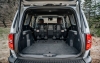
little bit awkward, this, as for some reason Toyota's lovely PR team in the UK managed to send us the Commercial version of the mighty Land Cruiser, rather than the expected civilian variant. This means the big 'SUV' has no rear seats, metal panels blanking out its rear windows and a whopping great cargo bay on it, so if you need to carry a lot of lengths of four-be-two then it's ideal; otherwise, you might find it a bit lacking, although with just two chairs and a 'cage' (of sorts) behind them, you could term this the 'Land Cruiser
GT3 Weissach' variant if you were feeling exceptionally charitable.
For those that
are interested in the Commercial's capabilities, it can take 810kg of payload in that lined rear interior space, with a maximum load height of 1,090mm, load length of 1,584mm and load width of 1,286mm. Any turbodiesel Land Cruiser can tow 3,500kg of braked trailer if you need it to, while an entire armoury of serious 4x4 gear (including a disconnecting front anti-roll bar, low- and high-ratio transfer cases, a pair of locking diffs, and Multi-Terrain Select with Crawl Control) means that while this J250 might 'only' be a Prado/Light Duty Land Cruiser, it's still pretty much unstoppable on rough terrain. Approach and departure angles, incidentally, are 32 and 17 degrees respectively, there's 205mm of ground clearance on the 18s and 215mm when the Toyota is equipped with 20-inch alloys, and the wading depth of all variants is a healthy 700mm.
In terms of what we know about the 2026MY Land Cruiser range in the UK, there is just one spec going forward for those buying this as an SUV, which is the Invincible. But while early J250s came to the UK in seven-seat specification, there are only five chairs now available in the regular model of the big Toyota. This is weird, because - even in 'our' Commercial variant - there were all the fixtures, fittings and mouldings not only for second-row passengers (including nice contrasting stitching on the rear door cards, with the window switches blanked out), but also where you'd position a couple of seats right back in the boot. However, once again this seeming retrograde step in terms of practicality is brought about by the price of green progress: the reason the 2026MY Land Cruiser is a five-seater only is because the battery pack for the 48-volt mild-hybrid system is situated where the sixth and seventh chairs would otherwise be situated. Shame.
Performance
Adding the mild-hybrid system to the Land Cruiser's 2.8-litre turbodiesel powertrain brings an additional 16hp and 65Nm of torque to proceedings at low revs. This still means the peak outputs of 205hp and 500Nm are quoted by Toyota, which are enough to shunt the almost 2.5-tonne Land Cruiser from 0-62mph in 10.8 seconds and on to a top speed north of 100mph (depending on wheel size, there's a slight difference in the V-max figures).
Despite these modest numbers, the Land Cruiser feels pretty punchy - and the eight-speed Direct Drive automatic is a big part of this. It's a really cultured and smooth automatic transmission, and because it reacts quickly to prods of the throttle then the Toyota feels less agricultural than you might expect.
Furthermore, the hybrid system does seem to eliminate any low-speed hesitance or lag the drivetrain could display when trying to overcome the huge inertia needed to get such a big, heavy vehicle moving from a standstill, so we found ourselves very much liking the 2.8-litre MHEV set-up in the Land Cruiser.
But is it what people want in a vehicle which is incredibly expensive in Invincible specification? Possibly not, no. Where both the Land Rover and Mercedes alternatives use creamy six-cylinder and even V8 powertrains in certain instances, a four-cylinder turbodiesel is always going to be somewhat unpalatable in a luxury vehicle like this. Not that it's a bad engine per se, and once it has warmed through and is operating in its preferred midrange, the 2.8 is suitably quiet and muscular. Yet it can sound rattly and uncouth at cold idle, while revving it out results in a coarse roar from behind the bulkhead. A nice V6 diesel might have made a big improvement here, although sourcing one of those for European regs wouldn't have been straightforward for Toyota (there's a 3.3-litre V6 in the J300 Land Cruiser, mind).
And don't go expecting amazing economy from a diesel-hybrid powertrain. With a lot of steady-state motorway miles under its belt, the Land Cruiser Commercial only managed an overall average of 28.4mpg fuel economy across 423 miles of testing. Indeed, it only breached 30-to-the-gallon on the few occasions we were pottering about sedately on local roads and at slower speeds, reflecting the fact that this is a relatively low-powered engine powering a physically gigantic and heavy body. Frugal, the Land Cruiser 2.8D 48V is not.
Ride & Handling
This Land Cruiser J250 uses the GA-F platform in a body-on-frame (ladder) chassis construction, which is more rugged 4x4 than appropriate for SUVs, a type of vehicle that tends to use a monocoque shell (like the current Defender, for example, although the G-Wagen is still on ladder underpinnings). Toyota has done lots of work to improve the refinement of this arrangement, both in terms of how the Land Cruiser isolates its occupants from exterior noise contributors and also its blend of body control/ride comfort.
To a degree, this hidden enterprise has delivered. This is a much more cultured and enjoyable vehicle to travel in than any other Land Cruiser we've tried previously, but it'll still betray its origins from time to time. For example, the ride is nice and civilised on smoother surfaces, while road and wind noise are suitably quelled. However, the Toyota will occasionally crash and shudder through larger imperfections like an unladen pick-up truck, with that sudden underlying thump coming through the chassis that's like hitting a solid object hidden under snow when you're sledging. It's these handful of leaden moments that otherwise mar the Land Cruiser's largely amenable behaviour, and just serve to remind you that while it is quixotically tilting at top-end SUV windmills, it's still a rough-and-tumble off-roader underneath it all.
The handling is surprisingly good, though, because this is the first Land Cruiser to use electric power steering (EPS), and it's not a slow system but accurate and well-weighted. Sure, you have to work around quite a bit of body roll and pitch/dive
in extremis in the Land Cruiser, while outright grip is limited by its all-terrain rubber, but as it clearly telegraphs when it is approaching its dynamic ceiling you can then hustle the Toyota quite quickly on twisting roads if you learn to read it correctly. It's a fun thing to drive on public highways overall, even with a few compromises still lingering as a result of its phenomenal off-road capability.
Value
And so we come to the crux of the matter. Obviously, we were driving the Commercial, which is just a smidge beyond 50 grand if you take off the VAT. That doesn't seem so bad for what you get, but if you decide you want seats in the back and the luxuries of a road-going passenger vehicle, then the news is not quite so positive. The 2026 Land Cruiser Invincible, despite being limited to fewer seats than the old non-hybrid diesel models which launched this J250 generation of the Toyota in the UK, is more expensive to buy because of the advanced hybrid gear. And so the basic price of the Land Cruiser is therefore approaching a scarcely believable £81,000, when a D250, 249hp
Defender 110 starts from £62,795. That's our biggest problem with the Toyota, rather than the few occasions when driving it when you're reminded of its ladder-frame construction.
Verdict
There's no doubt Toyota has significantly improved the Land Cruiser with this super-stylish generation of the old-timer, and there's a lot to like with the way it goes about its business. Sure, there are one or two refinement issues to note, and it cannot be ignored how expensive the Japanese machine is in the face of at least one of its primary, premium rivals, but if you like the way the new Land Cruiser looks then we're sure you'd be happy living with one on this showing. We're just eager to see if Toyota has any expansion plans for the range, with perhaps some silkier drivetrains in the offing. Here's hoping.