Styling
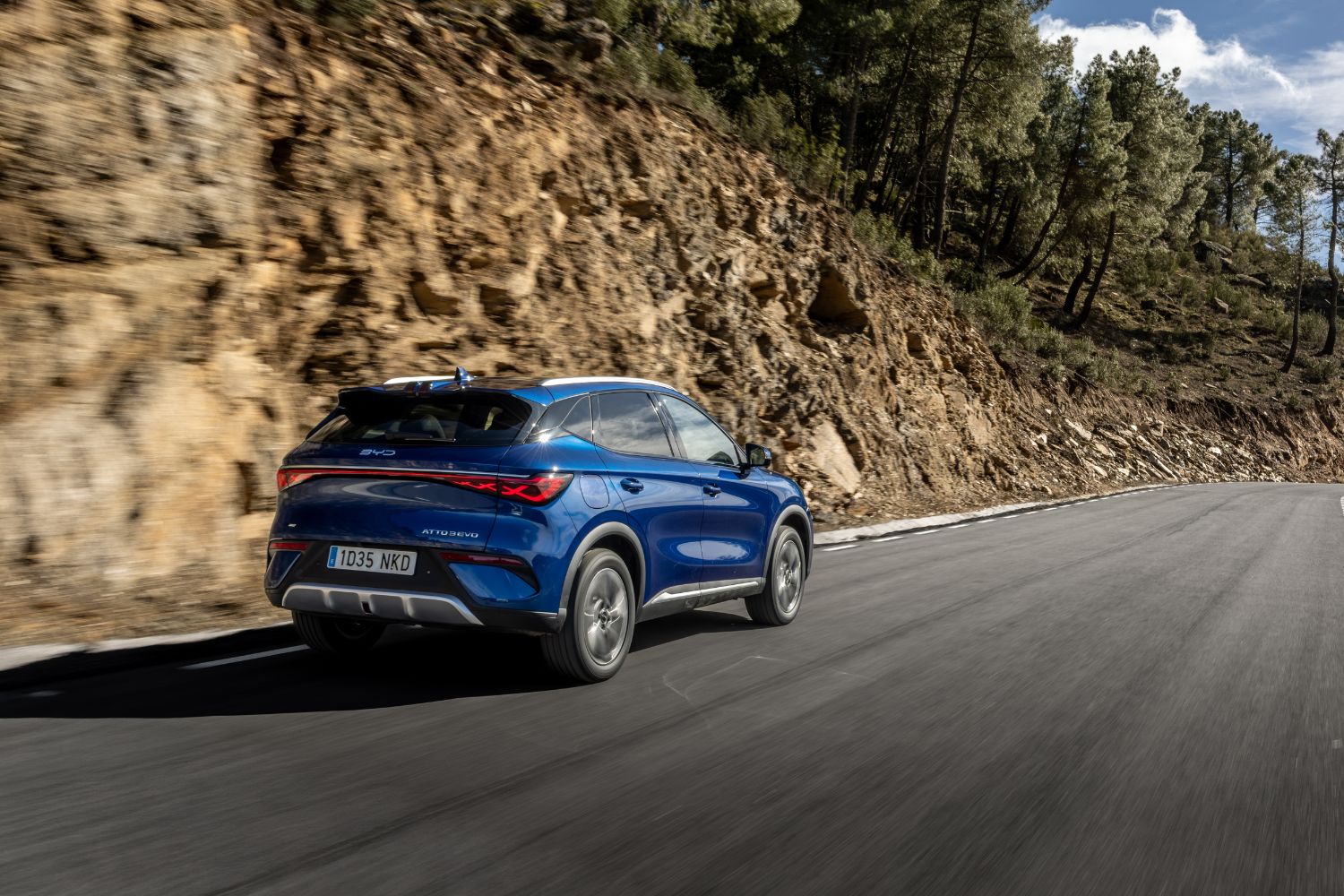
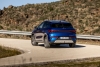
On the outside of the BYD Atto 3 Evo, there's not much to give away the game that this isn't the older model. Subtle are the alterations the Chinese company has made here, although the most obvious indicators are the new design of 18-inch alloys that are fitted to all variants, plus the fresh body colour of Iris Blue (which is what you can see in the pics). This paint finish does help give the BYD a little more aesthetic clout, because otherwise it's not the most memorable piece of car design as things stand.
Anyway, actual physical changes for the Evo include slimmer side-skirt details, a more pronounced 'floating roof' effect as a result of tweaks to the D-pillar, the obvious addition of 'Evo' to the 'Atto 3' bit of the boot badge, and then a more robust rear spoiler atop the tailgate, which also comes with a distinctive double-lamp high-level brake light affair. The end result is that the Atto 3 Evo is quietly inoffensive to look at, without ever approaching what you might term 'head-turning'. Yet this sheep's clothing hides the deeper development work that has gone on with the Evo, so we kind of like the underplayed effort.
Interior
There are a few more changes in here that should be easy enough to spot if you ever sat in, or owned, the 2022-2025 BYD Atto 3. Principally, the driver's instrument cluster has grown to 8.8 inches across the diagonal, while the central 15.6-inch infotainment display is retained but loses its ability to rotate. This old BYD party piece is gradually being phased out, as every car the company has launched in the UK since the
Atto 2 has had a fixed screen. This is because customers apparently weren't using the gimmick beyond the initial times they tried it out, while it also didn't support phone mirroring in the vertical position - so really, what was the point?
The other major modification is that the old gearlever which looked like something lifted straight out of an Airbus' cockpit has gone, replaced by a far more humdrum column-shifter. This has cleared up space on the transmission tunnel for a wireless and cooled smartphone charging pad, although it does delete some of the previous kookiness of the Atto 3's cabin. That said, there's still plenty of idiosyncratic weirdness in here, including some bizarre rotary door-opening handles, the air vents which (as our driving partner on the launch said) look like Oreos stacked end-on-end, and then the infamous 'guitar strings' in front of the door pockets, which actually play a tune if you strum them.
On top of this individuality, the build quality is generally decent throughout and the Atto 3 Evo's interior does at least look interesting enough, so it's a positive report on the BYD's cabin in the main.
Practicality
With plenty of useful interior storage solutions provided, including the sizeable door pockets behind the guitar strings, the BYD Atto 3 Evo is off to a good start on the practicality front. There's also a good amount of leg-, knee- and headroom in the second-row seating, while a flat floor in the back of the car suggests three people might be able to sit on the rear bench, as long as all the occupants were on the smaller side.
The best news, though, comes with boot space. The Evo has switched to the e-Platform 3.0 underpinnings, which - along with some repackaging tricks, including a slightly lower boot floor - has increased the boot capacity with all seats in use by 50 litres, to a figure of 490 litres. Fold the 60:40 split-folding rear bench down and up to 1,360 litres are available in the Evo (a gain of 32 litres over the old 1,338 figure of the pre-facelift Atto 3), but the relocation of its propulsion motor means that this upgraded BYD can now have a front boot, whereas electrical magubbins under the bonnet before precluded such a thing. With 101 litres of stowage there, the total boot space of the Atto 3 Evo with four or five people onboard is now 591 litres - 34 per cent greater than on offer previously.
Performance
OK, we've already touched on the e-Platform 3.0 in the section above, and now we come onto the most substantial and significant updates for the BYD. The old car was sold purely with a single front-motor set-up, rated at 204hp/310Nm and connected to a 60.5kWh 'Blade' lithium-ion battery pack. Performance was of the middling order of 0-62mph in 7.2 seconds, while the FWD layout made the Atto 3 rather unremarkable to drive.
But while the electric SUV might not wear the sort of in-yer-face styling that has denoted some of the most amazing cars of antiquity to wear the Evo sobriquet, its performance has certainly seen a massive shot-in-the-arm during this overhaul. We're not about to stick the resulting car into a pantheon that includes the hallowed likes of the
Mercedes 190E, the
E30 BMW M3, the Lancia Delta Integrale and the whole lineage of the
Mitsubishi Lancer Evolution, yet you can't help but admire BYD's ambition with the Atto 3 Evo, as while its price might not be changing (see Value section, below), the programme that the company has enacted here pushes the SUV well upmarket and pitches it into battle against some serious competitors.
This is due to the fact that even the 'basic' Evo, the single-motor Design, has 313hp and 380Nm, and gains of 109hp and 70Nm are enough to shunt the 1,880kg Atto 3 from 0-62mph in just 5.5 seconds. Above that, though, is a quite demented dual-motor model that ramps the data to the level of 449hp and 560Nm, and with a kerb weight that's still ten kilos shy of two tonnes, the benchmark acceleration sprint tumbles to a
hyperhatch-humbling 3.9 seconds.
You probably won't need the Atto 3 Evo AWD, mind. Because we only drove the RWD variant, and that was bonkers-quick enough for an electric crossover-SUV runaround like this that's operating in the sub-£40k sector of the market. Honestly, the way the single-motor BYD could spool up through the numbers on its digital speedo at a dizzying speed was quite eye-opening. It has enough shove to press the occupants of the car back in their seats for step-off launches, while the roll-on pace is comfortably more than adequate too.
About our only criticisms of the way the Atto 3 Evo RWD stops and goes relate to the drive modes, the regenerative abilities and the brake-pedal feel. Starting with the first of these, switching the BYD between the main settings of Eco, Normal and Sport seemed to elicit no changes whatsoever in the way the car went down the road; there was maybe a trace more fuzziness to the throttle on initial movement, but it didn't take much of a right-ankle flex to get full power from the Evo's motor and have the car surging forward. We've said this before and we'll say it again: if you're putting in selectable drive modes, there needs to be light and shade between them. In the BYD Atto 3 Evo, there's not.
Then, for regen braking, your settings are either standard or high. There is no one-pedal mode, as apparently someone high up in the company (we'll leave you to work out who that might be) doesn't believe in the system, so those who desire the strongest level of regeneration from their EV are going to be left wanting. And linked to this point, the brake-pedal feel is suspect at the top of its travel, especially in the standard regenerative setting. It's woolly and sometimes needs a sharper prod than is strictly necessary to get the Evo slowing down.
But overall, we heartily approve of the performance the BYD offers. And not just in terms of speed - the switch-up to e-Platform 3.0 more than doubles the Atto 3 Evo's peak charging rate, as the car now has highly advanced 800-volt architecture. So from a modest 80-89kW DC before, you're looking at 220kW here, reducing a 10-80 per cent cycle down to just 25 minutes. Not that you will be at public chargers too frequently, though, because the Atto looks good for real-world range. A 50-mile loop in the higher ground surrounding Madrid was conducted at 18.4kWh/62.1 miles, which works out at a commendable 3.4 miles/kWh; a very good return, considering we did a long run at motorway speeds, we had the BYD's climate control running almost constantly to cool the cabin, and there was plenty of ascent and heavy accelerator use during the test - although warmish temps of 10-19 degrees undoubtedly helped here.
A later toddle around Madrid's suburbs yielded an even more impressive 13.1kWh/62.1 miles, or 4.7 miles/kWh, although bear in mind all these indicated consumption figures were on one of those thoroughly annoying (and non-resettable) 'Last 50km' trip computers, which are prevalent on Chinese cars. The Atto 3 Evo is similarly afflicted by this sort of baffling set-up.
Either way, from our indicated efficiency, the BYD Evo should do anything between 254 and 352 miles, at these levels, from its much-larger 74.8kWh battery pack. So not a million miles away from the company's claim of 317 miles for this RWD as tested.
Ride & Handling
The good news with the Evo variant of the BYD Atto 3 keeps on coming, because it's no longer front-wheel drive and instead is powered from the rear. That makes the boot-space increase we mentioned earlier all the more amazing, given there's now a motor under the cargo bay's floor in all models of the Evo.
Furthermore, e-Platform 3.0 has a cell-to-body construction with the battery better integrated in the Atto 3's floor, so the rigidity of its body has improved. And the company has also decided to uprate the rear suspension from a four-link arrangement to five.
It's not quite such a glowing appraisal for handling, though, because while we will happily admit that the Atto 3 Evo is much more fluent and pleasing to drive than it was before, it has hardly been transformed into a scintillating drive. Like another primarily
rear-driven Chinese SUV we've tested recently, the Atto 3 Evo is capable and composed in the corners, with good body control and minimal realistic understeer. But it's not very engaging, denied a greater level of involvement by steering that's well weighted but oddly sticky off dead-centre, and also not blessed with anything meaningful when it comes to feel and feedback.
From this initial international drive of the car, what we can say is the BYD Atto 3 Evo's main strength will be its epic ride comfort and rolling refinement. It felt assured, it felt ultra-stable, it felt supremely comfortable and it kept itself extraordinarily quiet during our test run in the EV, but we sound a word of warning here: we drove the BYD on ridiculously well-finished roads in Spain. And on the very few occasions the surface conditions beneath the Atto 3 Evo's wheels were anything less than perfect, we detected an odd shimmy coming, seemingly, from that new five-link suspension at the back, as well as more noise from the suspension seeping through from the wheel arches and a slightly crashy feel to the wheel control. In short, the Evo felt amazing for rolling refinement here, but we remain to be convinced it will be anything like as dignified once we get it back to the utterly disgraceful, pockmark-riddled British roads of winter 2026. We'll report back once we drive the Atto 3 on home tarmac, then.
Value
Exact pricing for the UK range of the BYD Atto 3 Evo hasn't been announced as yet, but we know that the updated line-up will split into two very easy-to-understand models: the Design is the RWD car, the Excellence is the AWD ripsnorter. BYD's UK representatives indicated that the Design would be anything from £38,000-£40,000 once prices are confirmed, while the Excellence will sit in the £41,000-£43,000 bracket. And given the old Comfort and Design variants of the outgoing FWD Atto 3 were on sale for £37,730 and £39,730 respectively, then you can see the BYD EV has not lost its rapier-sharp edge when it comes to offering value for money.
Incidentally, in the Evo family then there are very minimal spec differences between the Design and the Excellence, besides the obvious additional motor and power/torque hikes that the latter brings to the party. Visually, the only separators will be the discreet 'AWD' badge on the bootlid and then a panoramic opening sunroof on the Excellence, which is one of only three equipment changes from the comprehensive standard spec on the Design. The other two items Excellence buyers will enjoy that Design customers won't are heated seats in the rear and a head-up display for the driver - everything else you see on the BYD Atto 3 Evo is therefore a given across the board.
Verdict
Cementing the adage that we're building up in our minds with repeated exposure to all of this company's varied products, BYD's EVs are far nicer to deal with than its
hybrids. And the Atto 3 Evo might be the very best car of the lot from this Chinese firm so far. It's not perfect, of course - the styling is still too apologetic, there are the usual infotainment annoyances, and while the RWD car drives better than the old front-driven Atto 3, it's hardly what you'd call a thrilling experience to be at its wheel.
But what BYD has delivered here is a transformative package of development work, that has turned what was previously a 'meh' electric SUV that you'd only ever suggest to someone on the basis that it was comparatively cheap to purchase, into something which is now more rounded, more likeable and more talented in all departments. And the fact that the company will still sell you the Atto 3 Evo - with 313hp, 300-plus miles of range and charging speeds more than twice as quick as they once were - for about the same price as the preceding front-wheel-drive model is thoroughly admirable. Sure, you might still end up with a
Skoda Enyaq instead, but the choosing to totally ignore the Atto 3 Evo in the reckoning is going to be a much harder decision to make now than it was before.