Styling
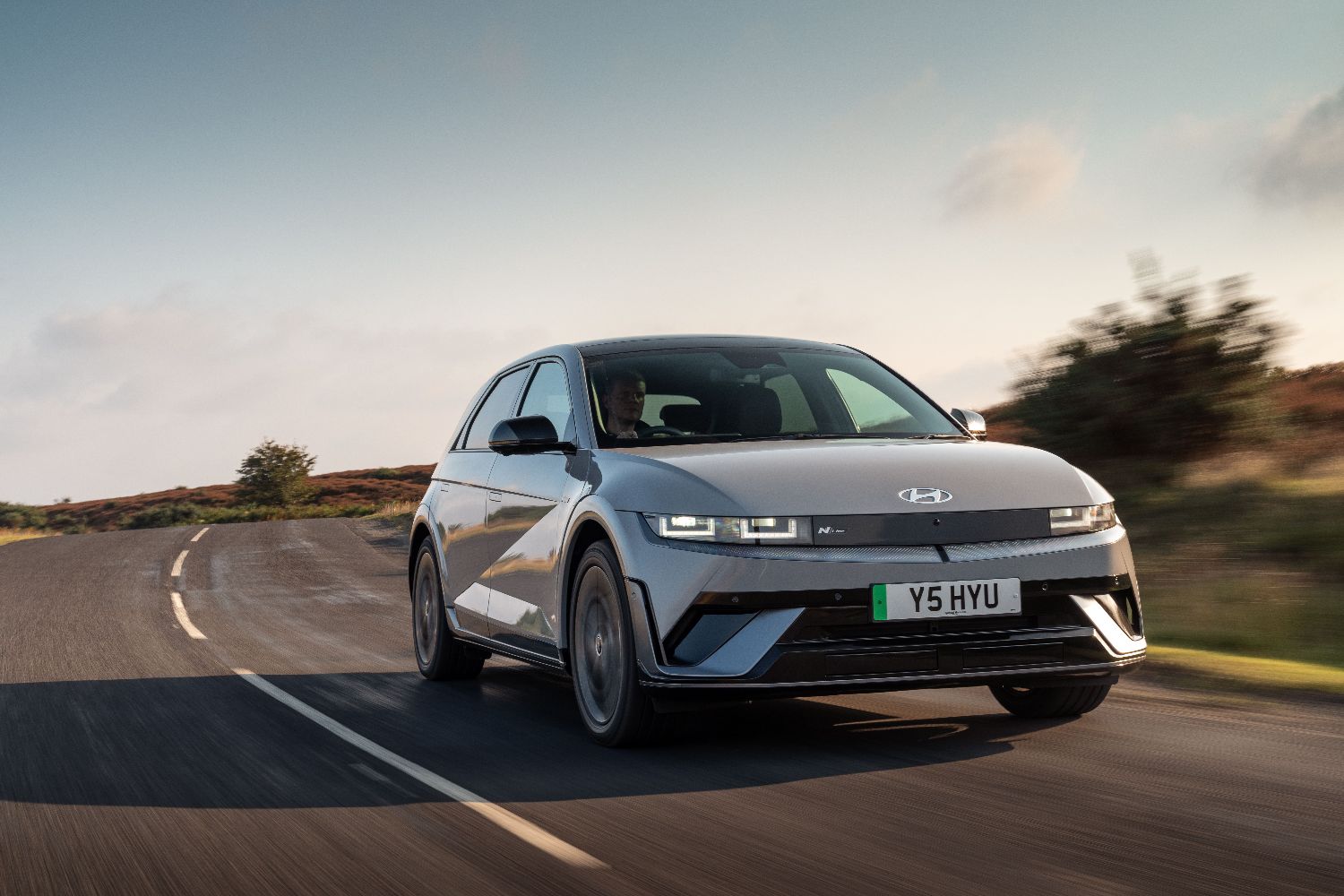
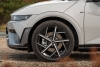
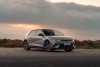
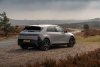
The Ioniq 5's brilliant, blocky form (which is more like a hatchback than it is an SUV, although many people refer to it as the latter, given how big it is on the outside) wasn't much changed as part of the 2024 facelift, with just alterations to the bumpers, slightly tweaked lights, an extended rear spoiler, new designs of alloy wheel, and a couple of fresh body colours added to the main range. The N Line and the upper S derivative tested here also benefitted from a 20-inch wheel which mimicked the appearance of the rims on the full-on Ioniq 5 N, as well as black detailing around the back bumper, glossy black door-mirror caps, 'N Line' exterior badging, tinted rear glass and meatier black finishing to the side sills. The best development, though, on all 2025MY-on Ioniq 5s with the N Line S included, is the addition of a rear windscreen wiper. This was purely brought in because owners of the original fed back that the supposed 'aero separation' that was claimed to do enough to keep the tailgate glass clean simply didn't work, so Hyundai has rightly responded with the fitment of a much-needed physical blade. Top stuff.
Interior
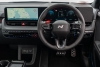
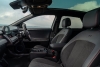
Again, inside the Ioniq 5 there have been changes which affect the whole range, then N Line S-specific details which lift the ambience of a lovely interior yet further still. The generic upgrades include a sliding centre console, pixel-design door armrests, an auto-dimming digital rear-view mirror and a dark surround for the twin 12.3-inch digital screens that sit high on the Hyundai's dash. The N Line models also gain sports seats, red accents in the cabin, a steering wheel inspired by the 5 N's item (including a red 'Drive Mode' switch), contrast stitching and piping, and chequered-flag design door armrests. The S builds yet further with a bounteous specification based on the Ultimate and Tech Pack model, plus Alcantara N Line front seats. The net outcome is that this particular Ioniq 5 has the easily best interior this side of... well, an Ioniq 5 N.
Practicality
No one should reasonably complain about the space and practicality of the Hyundai Ioniq 5's interior. Those large exterior dimensions lead to masses of room, even for taller people, in the second row of the car, and a bench so wide and a floor so flat back there that sitting three abreast shouldn't be too difficult. The boot stands at a minimum of 520 litres with all seats in use, which therefore can be officially termed 'a whopper', and then there are plenty of neat storage and stowage solutions dotted around the cabin to further help out with the complexities (aka, clutter) of daily life.
Performance
Aside from the N which its exterior styling and interior ambience seeks to mimic, the dual-motor AWD Long Range Ioniq 5 with the new 84kWh battery pack is the most powerful variant in the range. It serves up 325hp and 605Nm from its electric drivetrain, leading to strong performance on both levels: from a speed perspective, it'll do 0-62mph in 5.3 seconds, despite weighing nearly 2.2 tonnes, and from a stamina point-of-view it'll go up to 307 miles (it's actually 307.6, but we'll stick to whole numbers and not over-promise by stating 308) between needing charges.
To drive, the Ioniq 5 N Line S is a delight in terms of its power delivery, as you simply don't need any more get-up-and-go than this car provides. It's properly swift if you want it to be, while the judgement of both its throttle and brake pedals, the latter featuring four stages of regenerative braking including a full one-pedal mode, is also bang on the money, so making it smoothly accelerate and decelerate soon becomes second nature. The N Line S also has the full N's Active Sound Design so you can make the car emit various synthesised noises like a fighter jet or an
i30 N, although it stops short of offering the N e-Shift gearbox-simulating tech so the faked sounds aren't as convincing. To be honest, we drove the car without ever deploying this feature and we didn't miss it one bit.
As to economy, it looks like it should be enough for a big, heavy, powerful dual-motor EV like this. During our test drive, we did push the Ioniq 5's throttle pedal a long way down more than a few times, while the temperature was cool and we were using almost all of the Hyundai's in-cabin electrical drains. In such circumstances, 2.4 miles/kWh - while a low number - suggests that driven more carefully and, for want of a better word, normally, and in more favourable conditions too, achieving a more-than-acceptable level of 3 miles/kWh on a regular basis shouldn't turn out to be too hard.
There's one final performance plus point, and that's charging speeds. The Ioniq 5, of course, remains on its advanced 800-volt architecture, so if you can find a 350kW DC charger then the battery can be boosted from 10-80 per cent charge in as little as 18 minutes, despite its increased usable capacity. At 100kW, it'll be more like 35 minutes, while on a 50kW DC connection, the same charging cycle increases to one hour 16 minutes. Finally, a typical 7kW domestic wallbox would need seven hours 35 minutes for a 10-100 per cent top-up.
Ride & Handling
We're going to keep this very brief. The Ioniq 5 N Line S is wonderful to drive. Its handling and steering are both great, albeit not at the exalted levels of the N (which is totally understandable), but the way it fluidly and smartly goes through corners is totally overshadowed by how thoroughly comfortable, quiet and rewarding it is to simply cover distance in the car. Its rolling refinement is magnificent, better than we remember it from our first drive of the Ioniq 5 back in 2021, and while the N Line S might look sporty, it never once crashes or thumps about the place as if some dynamic tune of the suspension has been prioritised over sumptuous ride comfort. Instead, the Hyundai feels grandiose, elegant and suitably hushed at all times, and that's what makes it such a perfect EV foil to the all-in performance flagship that duly sits at the top of the Ioniq 5's range.
Value
The problem for the N Line S is that it gives away 345hp and 145Nm to the Ioniq 5 N, plus all of the majestic chassis hardware that makes the 650hp model so memorable to drive, but it's not massively cheaper on paper. At £56,505 as tested, the gap between it and the £65,800 N is considerably less than £10,000; and on a PCP deal, it might increase the monthlies by such a nominal amount that some people would therefore prefer to have the real thing and not the 'impostor'. However, bear in mind the N Line S has better one-shot driving range, much smoother suspension and a truly fulsome level of kit, offering pretty much every optional extra you can find in the wider Ioniq 5 family as part of the standard bundle.
Verdict
Originally launched with 58- and 73kWh batteries in 2021, then uprated at the top of the tree with a 77.4kWh unit for the 2023MY, it feels like the regular Hyundai Ioniq 5 range has now reached its apogee with the 84kWh pack and this highly desirable N Line S trim. Our only real complaint about this model is that it remains a pricey machine and the leap up to the N might be too tempting for some to resist, but in every other regard this is a brilliant, premium EV - in fact, one of our very favourites in the wider zero-emission scene.