Styling
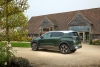
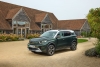
With looks inspired by the appealing
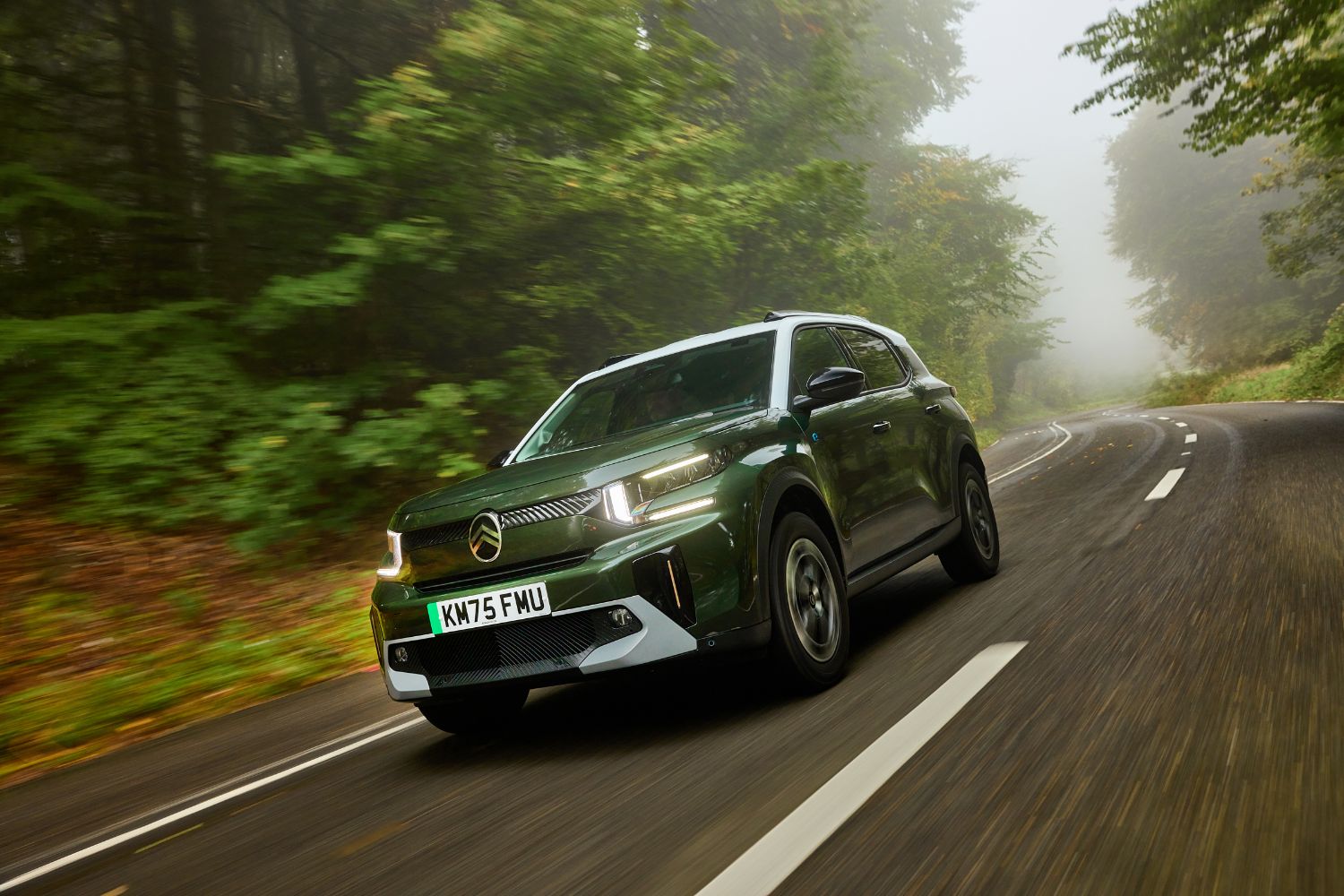
Oli concept, the second-gen C3 Aircross is a handsome thing, although painting it grey with a black contrast roof is a little sombre and takes away some of its aesthetic
joie de vivre; there are better and brighter finishes available for the cheeky crossover than this, we reckon. That said, we prefer the look of the Aircross to the closely related
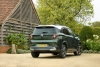
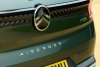
Vauxhall Frontera, what with the French car's square-bracket-shaped light clusters and big Citroen emblem bringing added razzmatazz, and the only signifiers to this model's all-electric powertrain are the 'e' badges on its front wings, the 'e-C3' logo on the bootlid, and its complete lack of tailpipes at the back.
Otherwise, the e-C3 Aircross is practically identical to the petrol and hybrid versions, so it's a conventional-looking machine that shouldn't put EV-nervous buyers off in showrooms. Incidentally, it is 375mm longer overall (with 130mm extra stretch in the wheelbase) and 83mm taller than its
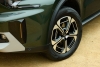
e-C3 hatchback cousin, but it's also weirdly 23mm narrower too. All C3 Aircross models, electric or otherwise, sit on 17-inch 'Aragonite' two-tone, diamond-cut alloy wheels.
Interior
In the not-too-distant past, Citroen was doing
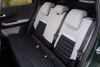
too many interiors that were centred on unremitting swathes of black (or charcoal grey) plastic. To be fair, you'll still find such material in the e-C3 Aircross, with some of the finishing somewhat basic in feel and reflecting the crossover's budget ethos. But, in the higher Max spec, a strip of light-grey fabric across the dash plus silvery fillets of contrast trim, as well as cream fabric on the wonderfully supportive comfort front seats, helps lift the Aircross' interior ambience notably. Mind, if we're grouching, we could do without the incredibly twee and 'yay!' red labels on the four door cards, filled with meaningless feelgood platitudes like 'be cool', 'feel good', 'have fun' and 'be happy'. We know what Citroen was trying to do with these and they probably meet approval with certain buyers, but for many people they're just a bit too cringe, in all honesty.
Practicality
A mix of the good and bad here, because amazingly, for such a small crossover, Citroen will sell you a C3 Aircross with seven seats onboard if you need them. Admittedly, the rear-most row of chairs are very, um, bijou, so calling it a full-on seven-seater is probably a stretch, but it's one of the few vehicles in the value sector that'll carry a septuplet of passengers if required, the Aircross going head-to-head with the
Dacia Jogger estate.
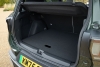
The problem, if you've spotted it, is that the Citroen's model badge in that instance is just 'C3' - because the placement of the large battery pack in the zero-emission e-C3 precludes the fitment of the third-row seating at all. However, given how small those chairs are, the payoff is that the e-C3 has a big 460-litre boot, rising to a suitably handy 1,600 litres with the rear bench folded down. In-car storage is also pretty good too, with big door pockets and some useful stowage cubbies, but a foible of many right-hand-drive French cars rears its head again here - the siting of the fusebox cuts into the glovebox markedly, so while its lid looks nice and wide, you can only use about half of the volume within to stash stuff.
Performance
No Citroen C3 Aircross is powerful, with outputs of 100- (petrol), 110- (mild-hybrid) and 113hp across the board. It's the e-C3 variant which lays claim to the last and therefore highest of these, but countering that is the fact that despite having the smaller of two battery options fitted, the EV clocks in at one-and-a-half tonnes at the kerb, when its two combustion-powered stablemates are about 200 kilos lighter in the 1,300kg range. The e-C3 also has what looks like a ludicrously weak 125Nm of maximum torque, which in turn leads to startlingly modest performance stats of 0-62mph in 12.9 seconds and a maximum speed limited to 89mph.
The good news is that the e-C3 Aircross doesn't feel anything like as reedy in reality as that data might have you think. It's actually pretty nippy, from a subjective viewpoint, and it has a decent amount of roll-on acceleration at higher speeds if you stamp on the throttle. Also, unlike other Stellantis EVs, you don't need to be in a certain drive mode to get the highest outputs from the e-motor, because the Citroen doesn't have switchable drive modes in the first place. Thus, with nicely calibrated brake and throttle pedals, and the supreme ease-of-use brought about by a single-speed reduction-gear transmission, the EV proves to be remarkably charming to drive.
For brief periods only, though. We know there's a whole argument which states all EVs do not need to be able to achieve the sort of distance in one hit that you might only drive once or twice a year, for example, and also that there have to be better-value, shorter-range electrics to sit alongside the bigger, grander and dearer medium- and long-range models available out there, but even so the e-C3 Aircross is severely compromised by its tiny 44kWh battery pack.
In theory, this gives it up to 188 miles of range, which sounds like plenty on the face of it. It also should suffice people who live in urban areas and who can plug it in to charge, regularly, on a 7.4kW AC wallbox. But we'd argue that the whole reason this Aircross exists, over and above the e-C3 hatchback, is that it is supposed to be a family-oriented machine instead, rather than a purely urban runaround. And therefore, it will more likely be travelling greater distances at a time than a city-bound e-C3 would be.
We live in the countryside, for instance. And just running our lad around, to school and his various sports and music clubs out of hours, often racks up 30-, 40- or 50-mile daily round trips on country lanes in short order. Furthermore, the e-C3 Aircross arrived in early January 2026 for testing, just when all the thermometers in the UK plunged to sub-zero temperatures after the weirdly mild Christmas of 2025. And in such conditions, we were getting really poor returns from the smaller battery of the Standard Range model. In fact, we drove it for only slightly more than 100 miles, almost all on lower-speed local roads, and we had to charge it twice, so fast was it depleting its battery and so low were the indicated range figures (often dropping into double digits as soon as we'd gone below 80 per cent of charge).
This still might not be an insurmountable problem, if the e-C3 Aircross wasn't then so bloody slow to charge at rapid units. Without a wallbox to call upon, we employed a nearby InstaVolt DC charger to top up the Citroen, and both times (in the very cold climate) it took the e-C3 a veritable age to put in an extra 50 or 60 per cent charge. We know it's not the charging unit's fault, because they're reliable boxes that we've used countless times with all manner of EVs, in varying weather conditions, and they've always delivered near 100kW. In the Citroen? They ran at 30kW, maximum. So we were sitting for more than an hour at a time, waiting for the teensy-tiny battery to get us back to barely a three-figure indicated range. Simply way too much faff and delay for what the e-C3 provided in terms of a driving experience, to the point that you end up thinking either the 54kWh Extended Range model is an absolute must (despite the additional purchase outlay) - or, rather more worryingly for the EV revolution, you realise that the alternative
hybrid drivetrain would be a far better bet for the Citroen C3 Aircross. Shame.
Ride & Handling
No problems with the way the e-C3 Aircross goes about its business, as its Advanced Comfort Suspension set-up with Progressive Hydraulic Cushions does a magnificent job of smoothing out even the roughest tarmac. Of course, as a softly sprung Citroen, the handling is rather loose and uninvolving, with a bit of lean evident from the e-C3's body when pushed through tighter bends, while the steering is also light and feel-free. However, the car has more than enough grip to match its lowly levels of grunt, so it's no wallowing mess in the curves - and of far more importance and helping the Aircross' overall likeability is that it remains super-quiet and thoroughly comfortable in towns, on open roads, and when travelling down dual carriageways and motorways. Yet the sneaking suspicion here is that adding the 1.2-litre three-cylinder turbo petrol engine that's fitted to both the 100hp 'plain' C3 Aircross and its 110hp Hybrid relation would hardly ruin the entire driving experience, yet the internal-combustion unit would lead to a far more usable day-to-day car than the Standard Range electric model.
Value
There's no doubting the Citroen e-C3 Aircross is great value, especially in Standard Range Max format as tested here. You get a large, attractive and nicely equipped car for a smidge beyond 25 grand, set amidst a product range which starts from roughly £21,500. Few electric crossovers get close to matching its inexpensiveness, while standard equipment is generous and includes the 10.25-inch infotainment system with Apple CarPlay, Android Auto and 3D connected nav, as well as a heated steering wheel and front seats, wireless smartphone charging, parking sensors all round, cruise control, climate control and all-round LED lighting for the exterior, among more.
Verdict
There's a really nice car you can specify in the Citroen (e-)C3 Aircross family, but sadly this Standard Range electric model is not it. While it rides beautifully well and looks nice, inside and out, the ultra-short-range nature of the vehicle and its painfully slow real-world charging speeds in adverse conditions render it an annoying machine to deal with for anyone but purely urban users. And if that's you, surely you don't need a crossover in the first place, and you could just stick with the cheaper, smaller-footprint e-C3 supermini as your city runabout instead?
Thankfully, as we've already touched upon, there are two solutions to the Citroen's issues that you can call upon if you live out in the sticks and you fancy having a new Aircross in some form. The first is to spend a little more cash on the 54kWh Extended Range e-C3, which'll go up to 250 miles to a charge and should therefore be a tad more practical for regular usage. Or, and sadly this is our preferred option, we'd suggest ignoring the worthy but compromised e-C3 Aircross entirely - and just sticking with a C3 Aircross with either the petrol or mild-hybrid propulsion instead. That way, we genuinely think you'd have one of the best and most charismatic small crossovers in the class, by picking this intriguing and promising Citroen.