Styling
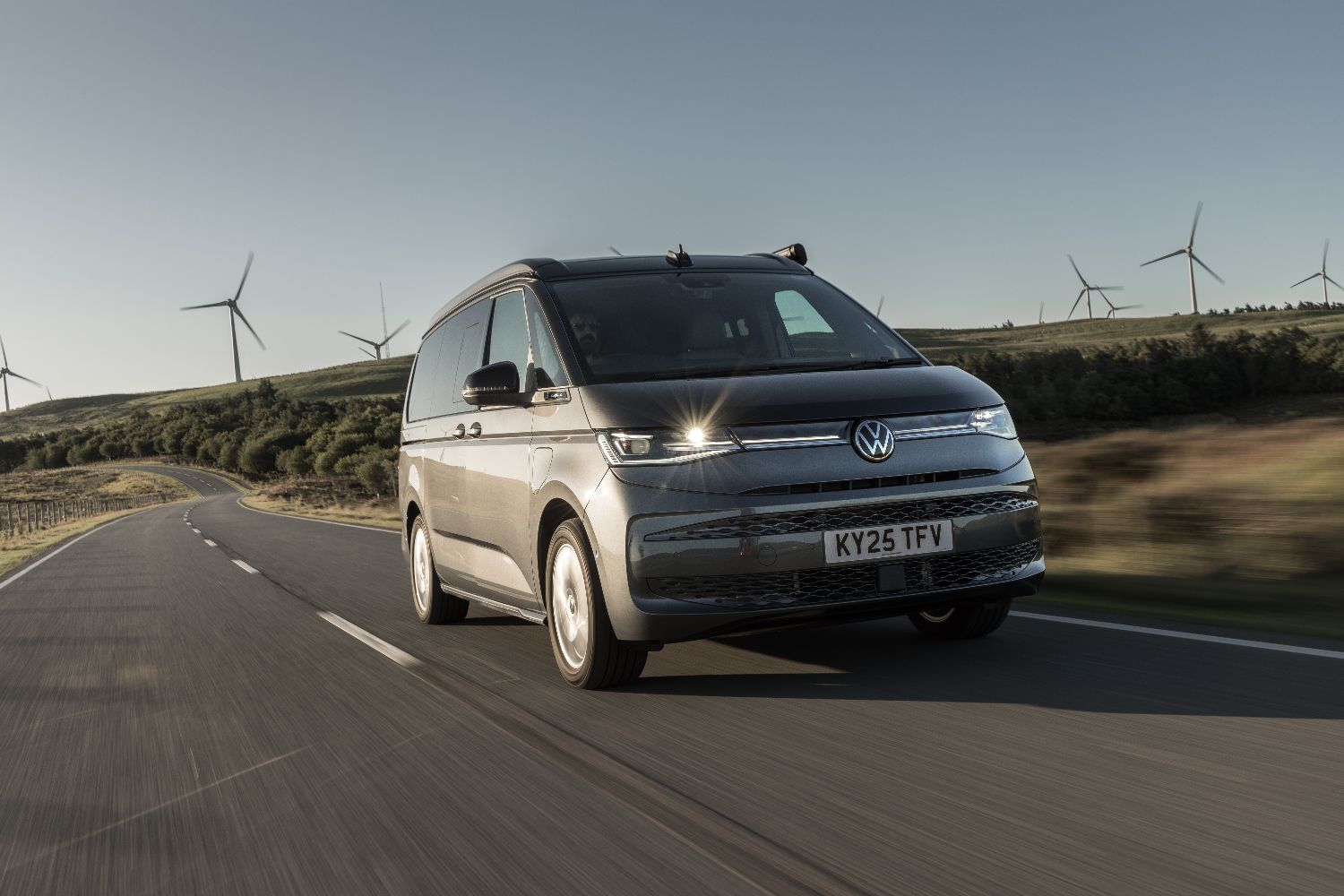
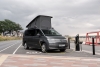
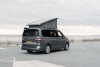
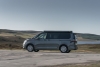
There's nothing really aesthetically wrong with the switch from Transporter to Multivan when it comes to the look of the 2026 California, because those two source vehicles are pretty close in shape when you boil it right down. No, our issue is more with the precise spec of TFV - VW's press office choosing to finish this flagship-spec Ocean in rather drab Indium Grey metallic (£984). It's a nice enough shade, as greys go, but it rather makes the campervan look utilitarian and boring, whereas some of the lovely two-tones offered for the Cali T7 (damn, even
we're at it now!) bestow it with a lot more presence. Shame that Candy White over Bay Leaf Green has bit the dust in the transition from the T6 model, though. Anyway, other than the fact its silver 18-inch 'Toshima' alloys could do with being perhaps an inch or two larger to better fill the arches, the VW motorhome remains a thoroughly stylish thing, peppered with some California legends (a big one on the boot and two smaller logos just aft of the A-pillars) plus an 'Ocean' sticker on the flanks to ensure people know they're not looking at a mere Multivan. If, somehow, they've missed the awning housing mounted high on the vehicle's left-hand side, of course.
Interior
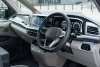
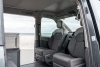
Ignoring the obvious bits at the back of the cabin and saving them for the next section of the review, up front the Volkswagen California now offers a great driving position, which retains the best bits of a van (high seating plus excellent visibility out of a large front glasshouse) with the preferred elements of a car - because it now sits on MQB, like the Multivan, which in turn is closely related to a
Golf or
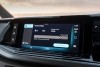
Passat. This means the quality in the California is uniformly superb, while the tech is advanced too (in the form of a ten-inch infotainment touchscreen and a Digital Cockpit Pro instrument cluster). As an Ocean, there's natty upholstery made from worthy recycled materials, although a few ergonomic points off the Volkswagen's score here because - while the Cali's steering wheel mercifully has proper buttons on it, rather than those ghastly haptic touchpads VW used a few years back - the camper remains one of the few modern products it sells where the temperature and volume sliders underneath its central touchscreen remain unilluminated at night. Why?! Grr!
Practicality
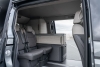
How much more practical do you want a vehicle to be, than something which contains four beds, one kitchen including a sink and fridge, a pop-up shower, patio furniture, two water tanks, numerous cupboards and a wardrobe, four seats, an engine, a gearbox, a plug-in hybrid system complete with big battery, a fuel tank and even a retractable awning into a shape which is 5.2 metres long, 2.2 metres wide and just shy of two metres tall? Actually, if we're being critical of the incredible, hyper-condensed packaging job Volkswagen has done with this latest California, it's that there's still a small degree of puzzle-solving familiarisation required the first time you set the van up to spend the night in it; as in, if you've got tables out and the seats in use, then you have to fold things away and pop things out in a certain order to make it all work smoothly, due to the limited floor space that's on offer. Also, you still must open the VW's front doors to make the chairs in the cab swivel round, which is a bit of a faff, but otherwise the Cali is a seriously impressive thing. We also like the new, plusher blinds for the front glasshouse area, which are now padded for insulation purposes, and one incontrovertible upgrade as a result of switching to the Multivan's shell is that the California has sliding doors on both sides of its body, instead of just one (like a Transporter) - making ingress and egress to and from the main cabin easier for all.
Performance
While the previous-gen California was predominantly diesel-powered, the new one has a choice of diesel, petrol or even plug-in hybrid (PHEV) powertrains. And it's the latter we're testing here. If you're of a certain age and an automotive fan (ahem...), then - like us - it'll likely frazzle your brain that a 2.7-tonne camper van can be reasonably powered by a 1.5-litre four-cylinder petrol unit. But power it said four-pot does, because the combustion engine is ably assisted by a punchy 85kW e-motor, with the whole lot serving up 245hp and 350Nm of system peaks. Volkswagen claims that the 4Motion-equipped eHybrid as tested here can crack 62mph from rest in just ten seconds, but in truth it feels even swifter than that. This is no laborious and slow camper, that's for sure, although watch out for the occasionally hesitant six-speed DSG autobox; you might not be able to nip into give-and-take gaps in traffic that you would in some other VW Group eHybrids with similar set-ups.
The published eco-stats for the California Ocean eHybrid 245 4Motion are, as you'd expect of a PHEV, a little far-fetched: VW claims it'll do 91.1mpg and emit just 70g/km of CO
2, while being able to travel up to 52 miles on electric power alone, courtesy of its 19.7kWh battery pack. However, we did almost 700 miles in the Volkswagen during the course of a week on test, most of these conducted at motorway pace and without charging the van from the mains electric. In fact, at one point, we made it top up its propulsion battery while we battered along the M4, and yet its overall return after 696 miles at its wheel ended up at a highly commendable 36mpg. This, then, is a rare instance where a PHEV might very well be the best powertrain choice of the lot.
Ride & Handling
For the kinematic portion of this review, the California has been notably improved by switching to the Multivan instead of the Transporter as its source material. The way it steers and handles, coupled with the comfortable and accommodating way it rides, is definitely a step up from the old T6 California, and despite its height and mass it has way more agility than the often-ponderous Grand California 600, which always felt alarmingly top-heavy. Refinement is good too, even if you do still hear some creaking and groaning from its interior fixtures and fittings that you obviously wouldn't in a plain old Multivan.
Talking of comfortable and accommodating, let's move onto how the van fares as a mobile hotel on wheels. With an auxiliary heater and a neat little digital control panel on one of the pillars behind the sliding doors, controlling the temperature of the Cali's interior is easy and you can get it nice and toasty warm for all occupants - providing you remember to fold the upper bed's baseboard up into the electrically raising roof prior to sleeping in it, of course, as then the heater can warm the air in that lofty cavity at the least. However, the canvas sides mean that if it's a freezing cold night (as it was for our first evening up in the rafters), then what heat is up there in the sleeping quarters will quickly dissipate. Mind, people don't often camp within the confines of the M25 at the back end of November, when snow falls throughout the night. Sigh. We are a bit weird.
But both beds, upper and lower (the latter requiring some precise folding and sliding of the two individual rear seats first), are remarkably comfortable once set up, while the lovely side awning and various openings to the Cali mean it would be a supremely pleasant place to spend a warm summer's evening. Perhaps we'll have to try the diesel model in June, then... just to be sure, y'know?
Anyway, final note to mention here: there is no ladder nor form of steps up into the higher sleeping area. If you want to climb up there, you must stand on the front seats and work your way into the bed area from there. It's neither for the infirm or possibly the tiny either, basically, unless (in the latter instance) you've either got someone to help lift you into the sleeping zone or alternatively your upper-body strength is phenomenal.
Value
Factory-order campervans are no longer a cheap business these days, although neither are traditional third-party motorhomes which are based on a commercial chassis-cab platform. Therefore, the new California remains split into three pricey specifications: entry level is the Beach (from £63,481 inc. VAT), which can sleep four people but which has a manual pop-up roof plus a smaller 'kitchenette' housed in the boot area of the van; the Coast (from £70,681 inc. VAT) adds the 'full' side kitchen and the powered roof; and then this Ocean (from £77,581 nominally, but optioned-up and fitted with the PHEV drivetrain as our test example was ultimately weighing in at a hefty £87,347) really only adds trinkets, gewgaws and plusher interior finishing from thereon in. Mind, most people want the Ocean, for the status it confers upon them at campsites and the seaside, and so on.
Understandably, nearly 90 grand for what is ostensibly a glitzy MPV might seem steep, especially when there are cheaper alternatives like the brilliantly named Ford Transit Custom Nugget or the not-so-brilliantly-named and all-new Citroen Holidays available from other manufacturers. On the flipside, the Cali is still less expensive (and cooler, we'd argue) than the Mercedes V-Class Marco Polo, although buying an old Transporter and converting it to sleeping duties is probably still going to be the most cost-effective way of getting a camper with a VW badge on it somewhere. It won't be as nicely finished as the Ocean, though.
Verdict
We've observed before, with both the T6 California and its Grand California relation, that these Volkswagen campervans are truly phenomenal pieces of packaging - but that the idea of actually spending a week or a fortnight in one, complete as your family of four, would take the most labyrinthine logical skills to make it all work. Still, that's maybe us nitpicking (although we remain convinced that the Cali would be better as luxurious accommodation for two, rather than four), because otherwise the shift to the Multivan family hasn't hurt Volkswagen's icon one bit. It remains a deeply alluring and desirable bit of kit, all things considered. Just, perhaps... don't sleep in it in winter, eh?