Styling
The Aion UT is not what you would call pretty, certainly not when held up against the overtly style-conscious European rivals like the glorious Fiat Grande Panda Electric or, of course, the sublime
Renault 5 E-Tech. Heck, even the
Citroen e-C3 runs aesthetic rings around it.
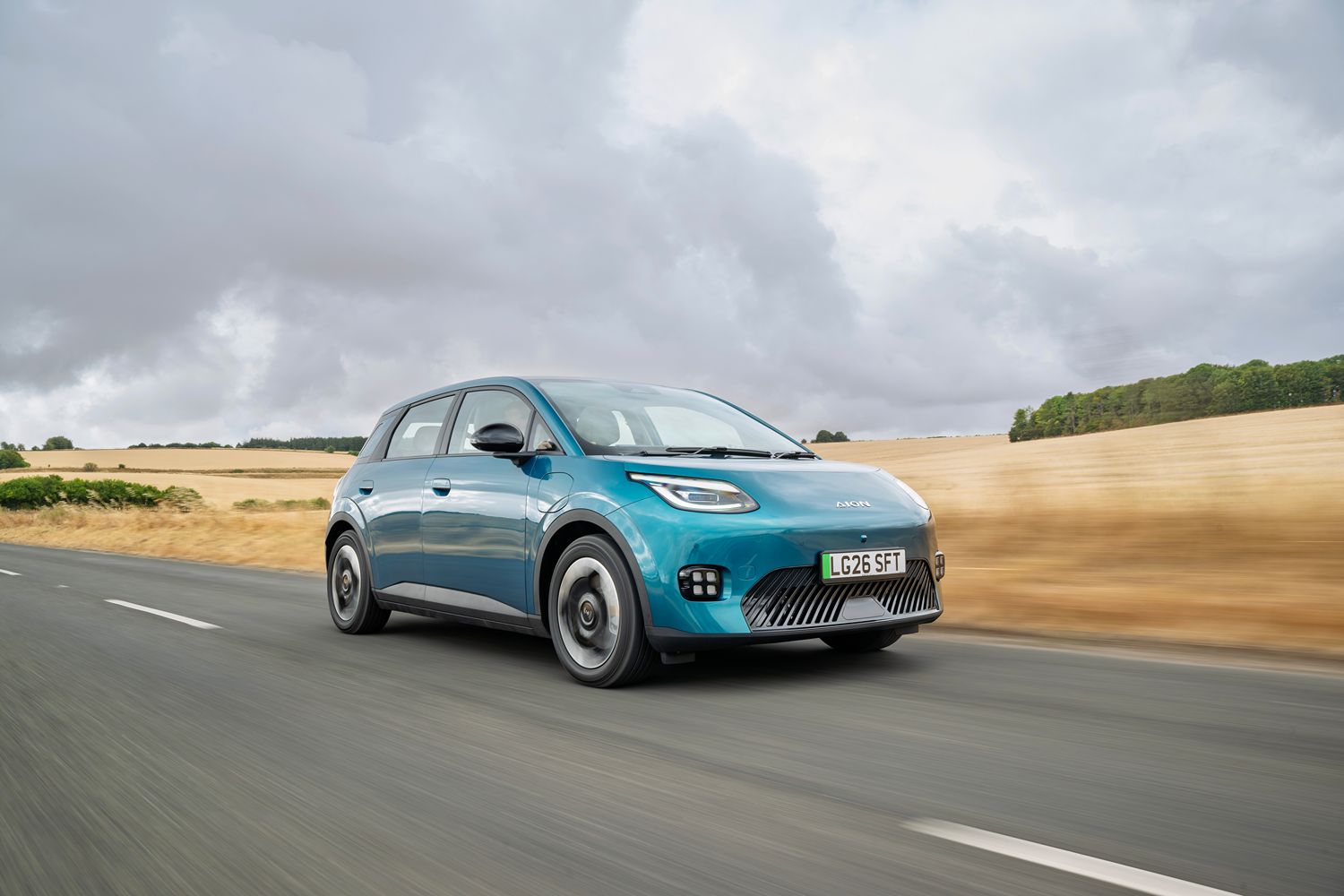
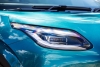
It isn't exactly bland, though, either. The smoothed-off front, with the owl's-eyes headlamps, and its general proportions (almost 4.3 metres long with a giant 2.75-metre wheelbase) do give it a character of its own, even if four-cube lights were something
Kia was doing a decade ago and the rear aspect of the UT is vaguely redolent of what might happen if someone were to over-inflate a
Suzuki Swift-shaped balloon with too much air.
We confess we find the Aion not too bad to look at, especially in some of the nicer of five colours available, such as Titian Red (no cost) or Jade Green (£595). It also comes on not-unattractive 17-inch alloys, although - as we shall come to see - what those are wrapped in presents something of a problem. Anyway, the UT's kerb appeal is at least broadly commendable, we reckon.
Interior
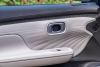
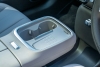
The passenger compartment of the Aion UT looks pretty decent as you climb in, especially if you've forked out the extra for the Premium Pack (see below) and can therefore specify the lighter 'French Cream' interior colourway. But once you start touching some of the materials in here, they feel quite cut-price, while the attempt to convince us that the upper door cards are finished in stitched leather, and are not in fact hard plastic, is most egregious.
Then, naturally, it's a Chinese vehicle with a dashboard which is an absolute wasteland, if you were hoping for any physical switchgear. What buttons there are all live on the Aion's steering wheel, which is at least mercifully round, but for some reason they're either minimalistically labelled, or not labelled at all. So it's a frustrating process of trial-and-error working out specifically which features they control.
Everything else, and we do mean
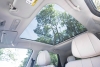
everything else, is then run through the 14.6-inch ADiGO infotainment screen. The lights. The wiper speeds. Opening the electrically operated sunshade for the panoramic roof, if you've gone for the Premium Pack. Operating the heated (and ventilated, again in the PP) seats, or the steering wheel. Trying to turn off some of the most vexatious of the demented advanced driver assistance systems (ADAS). It's all so counter-intuitive in the UT and the set-up requires a great deal of familiarisation to use anywhere approaching what you might term 'slickly'. And even then, it'll still feel occasionally obstructive in some regards.
We also don't remember being this irked by the similar system in the V, but a quick memory refresh shows the SUV is as bereft of buttons within as the UT, so maybe we were just in a better mood that day. Or something. Whatever; this is a driver interface that once again is miles off the standards of a good European car which isn't so blinkin' touchscreen-obsessed.
Practicality
Aion fights back in this regard because the UT has such a long wheelbase for this class of vehicle. Only the
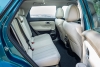
MG4 EV Urban can match it on a statistical basis and so rear legroom in the Chinese newcomer is well above the class average. Headroom's not bad either, although the sunroof in the PP-equipped version does trim a little from this area of the cabin due to the moulded housing for its electrically retractable sunshade.
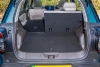
The one car which has more lounging space in the back than the Aion is that MG4 Urban, and it also has a much bigger boot (577 litres) than the UT, which packs in just 321 litres. A couple more of its compatriot competitors, namely the
all-electric Geely EX2 or the
part-electric BYD Dolphin G DM-i further outstrip the Aion in this regard, although with its 60:40 split-folding rear seats dropped down, a massive 1,600 litres becomes available in the UT and that's excellent.
Shame there's no front boot ('froot') in the Aion, due to the placement of electric ancillaries beneath its snub bonnet, although the company does cite fully 24 interior stowage compartments and cubbies for owners to seek out. Good luck finding all of those, but we're happy to say the practicality of the car overall is thoroughly decent.
Performance
It's not that the Aion UT lacks for power. In fact, its sole drivetrain choice is a 204hp/210Nm front-mounted electric motor that confers a 7.3-second 0-62mph time on a car which, at its heaviest, weighs only 1.7 tonnes (that's relatively light for an EV with a 50kWh-plus battery, even if it's a smaller body in the wider reckoning). No, it's that the Chinese hatch struggles to put said power to the road, due to the choice of tyres.
Where the larger V comes on the relatively well-known and mid-range Maxxis tyres, the UT is fitted with something called Chao Yang SU318a H/Ts. These are apparently durable, but they sure as hell aren't grippy. This will link to some serious issues we have with the Aion's roadholding in the next section of the review, but primarily the drawback here is that if you try to smartly take a gap when pulling out of side junctions, then even with the car's traction control fully engaged you end up with a lot of unnecessary wheelspin and embarrassing axle tramp.
Speeding up is one problem, slowing down is quite another. There are three main drive modes for the UT, called Comfort, Sport and Power Save, but you can also switch the braking response and steering weight individually in one sub-menu of the screen, through settings called Standard and Sport for the stoppers, and Comfort and Normal for the helm.
Don't, whatever you do, run the Aion UT with its brakes in Standard. Because they're
horrid in this setting. The mushy pedal feel is almost non-existent and you need to give the left-hand item in the footwell a panicked, hefty prod to even remotely get the EV to feel like it is going to slow down. Awful. The brakes are much better in Sport, but in no way exceptional by class standards - a
Cupra Raval makes the UT look positively stupid in this discipline, for instance.
By some small way of compensation for its woefully traction-limited behaviour and its abject Standard-spec braking performance, the Aion is at least electrically efficient. It managed a healthy return of 4.3 miles/kWh during our 31-mile test drive in mild conditions with the climate control running permanently, although we would caveat that by adding we never really extended the car too much during the loop due to its ill-resolved power delivery, plus our section behind the wheel didn't include any energy-sapping high-speed running on a dual carriageway or motorway.
Nevertheless, if you could match our showing on a regular basis, a realistic 258 miles between top-ups should be possible from the UT's 60kWh LFP battery pack. And that's only ten miles off the WLTP official claim. Good news, because the Aion's modest 87kW DC charging speed is not anything to shout about, in all honesty; it'll take a lengthy 32 minutes to go from 10-80 per cent battery at its quickest.
Ride & Handling
Keep the Aion UT well within itself and on the best-finished roads of the UK, and you'll find it is passable for ride comfort. As long as it doesn't encounter too many sharp ridges and significant undulations in a high-frequency order, it trundles along just fine and feels pretty capable. Until its suspension is really tested by our appalling road surfaces, it appears to support Aion's bold pre-drive claim that the UT's chassis has been specifically tuned for UK market tastes.
The illusion was soon shattered, though, on one B-road not far from High Wycombe, where the UT's torsion-beam rear axle mighty quickly got itself all out of sorts and felt as if it was skipping down the road like an unladen trailer. So bad was the Aion in this instance that we almost got back from our test drive to ask the company's representatives specifically
which British roads it had been tuned upon, as almost the very first one we subjected it to caused it to lose every last ounce of composure.
This then developed into handling which was alarmingly wayward in the corners, thanks to those Chao Yangs in the arches, and then there's the steering. Remember those two settings we mentioned earlier for this, as with the brakes? Yeah, well, again, don't use Comfort for the UT's steering, because in this mode it is horrendously wishy-washy, almost without any sensation of being connected to the car's front axle whatsoever, and there's way too much play in the steering wheel's movement when teamed to the responsiveness of the car's nose. It is markedly better in the Normal setting, but again not redemptive enough to have us saying the steering can then make up for the Aion's painfully obvious kinematic shortcomings.
If you think you'll drive the UT gently and not ever fall foul of these flawed facets of its character, then you might also want to know that there's more tyre road and wind noise at speed than there strictly should be, while clonks from the suspension as it attempts (and largely fails) to handle larger impacts to its set-up are all too audible as well. At about three-tenths commitment, the Aion is sort of OK on the move. Anywhere else and its entire dynamic case rapidly falls apart.
Value
We might have been easier on the Aion UT if it were a conspicuous bargain, but it's not even that. The company would like to draw your attention to the fact a base-spec car comes with a wealth of standard equipment, and that the £1,200 Premium Pack (the only trim upgrade you can perform on the EV) adds luxuries like the panoramic roof with a sunshade, electric-folding door mirrors, three-stage ventilation for the driver's seat (the front chairs are three-stage heated already), an auto-dimming rear-view mirror, an electrically operated bootlid, wireless charging for smartphones, and a rear USB-A port. You also have to choose the Premium Pack if you want Seine Silver paint on the outside of the car, an option that's another £595 on top of the PP, and/or the French Cream interior (a further £195 again).
But that means a non-PP Aion UT is £28,950, while the car with the PP fitted comes in at £30,150. Both more money than a Renault 5 E-Tech. Or a
156hp Peugeot E-208. We know we're comparing apples and oranges here by popping in a B-segment SUV, but the
stunning and brand-new Skoda Epiq is cheaper at base grade. As a Premium Pack, the Aion UT is dearer than the same Czech firm's
Fabia 130. Sure, the UT is available for £349pcm on a 76-plate-linked finance deal from Aion, but doesn't it seem overpriced to you? Especially considering the notably sub-par driving experience it serves up?
Verdict
While we weren't blown away by the Aion V, we did think it competent enough to drive and also sensibly positioned in its own marketplace that it could perhaps leverage a small degree of UK showroom success. The UT, unfortunate name aside, is sadly not anything like as convincing in its class.
Yes, it's roomy inside and as well-equipped as you'd expect of a challenger car hailing from China, the 268-mile range is one of the better numbers in this sector, and if you can get it to grip the road then it's reasonably quick too; it might, for instance, be massively improved by the simple expedient of a tyre swap to a brand of rubber far better than the one it comes with from the factory.
But you shouldn't really have to be modifying (at further cost) a brand-new motor to make it acceptable to drive and, otherwise, the Aion's average ride comfort, its poor handling, its at-times woeful brakes, its traction issues and its relative expensiveness all serve to detract substantially from the overall package. So where the V was promising, the UT - regrettably - simply seems markedly flawed.