Styling
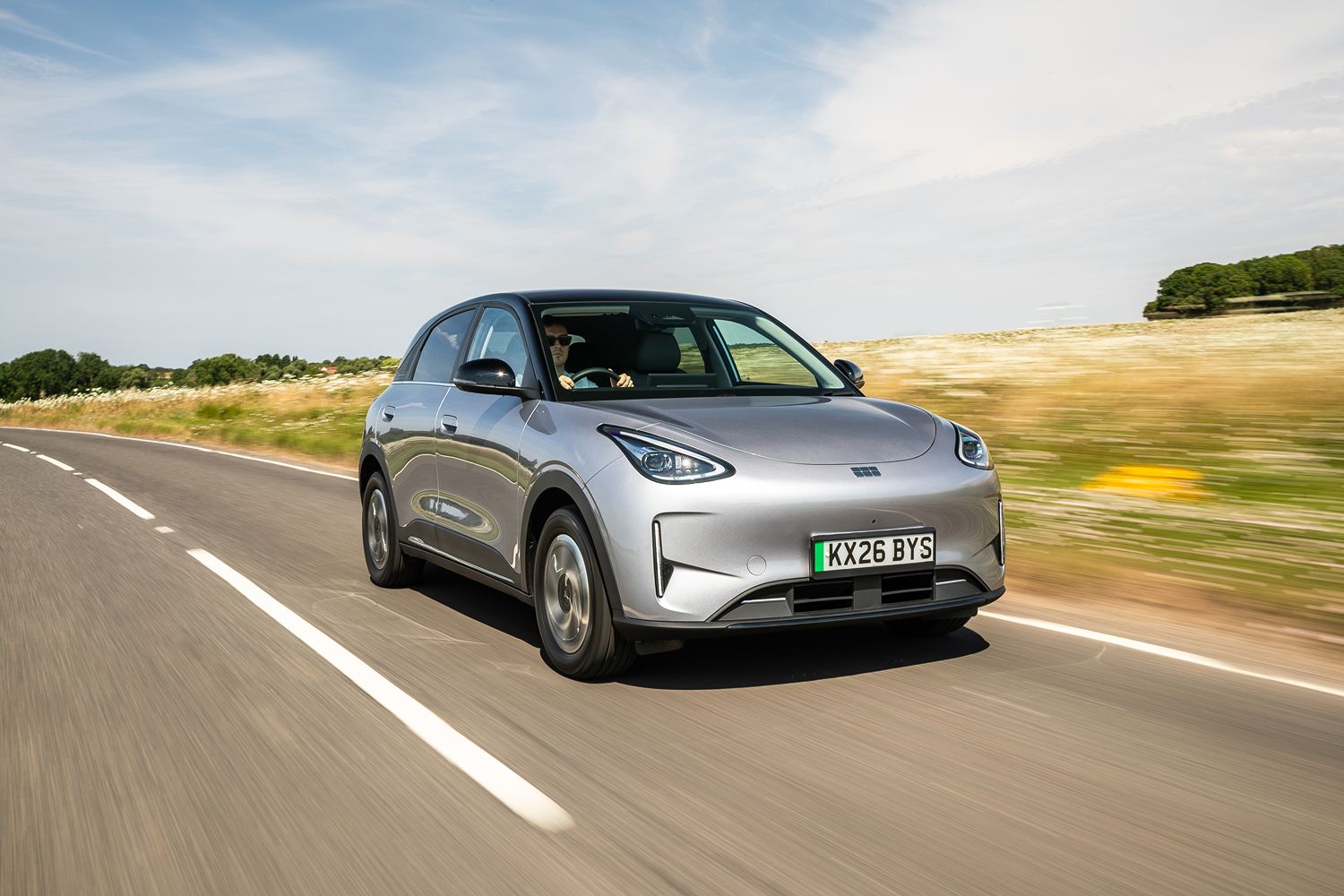
The Geely EX2 isn't going to win fans on the strength of its aesthetic appeal alone. It's not that it's an ugly car, but the design is that kind of inoffensive, safe effort that new-time automotive companies (this, despite the fact Geely is in fact 40 years old in 2026, believe it or not) often tend to churn out. And when you're competing with kerbside showstoppers like the Renault, Fiat (Panda), Hyundai, Kia and MINI alternatives, we're not sure this sort of risk-free approach is the correct one.
Still, there are things to commend, like that constellation graphic on the C-pillar of the grandest specification of the EX2, which is the Ultra. And the option of two-tone paint on the same trim grade. And some fairly interesting main colours, too, such as Blush Pink, Pistachio Green and Sandstone Beige, for instance. But, with its range-wide 16-inch alloys of the diddy variety, the Geely is clearly in the plainer design wheelhouse of the likes of the MG4 Urban, rather than something to be lauded, such as the R5 E-Tech.
Interior
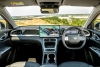
More of an effort has gone into the Geely EX2's interior and material quality is actually pretty decent across the board. There are two main ambience finishes for the cabin, called Pewter Grey and Pearl White, and the latter of these is thoroughly pleasant and airy, lifting the feel of the Chinese EV's passenger compartment no end - although even Pewter Grey is fine enough.
As you'd also expect of a value-oriented Chinese challenger, in any sector of the market, the EX2 comes loaded with kit on all three specifications, although the choicest tech cuts (like heated front seats and steering wheel, a wireless smartphone charging pad and 256-colour ambient lighting) are all reserved for the Ultra only.
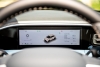
But it's once again Chinese Car Interior Ergonomics 101 in here. Almost every single product from this country we've tried, no matter what size, body style or price point they're operating at, nor which manufacturer they come from, follows a set pattern for cabin layout, which is this: slim, letterbox-type digital instrument cluster with a
Tesla-like car-and-surrounding-traffic animation taking up pride of place; gigantic central infotainment touchscreen; an almost complete dearth of physical buttons; no gearlever on a high central console bridge contrivance; and, connected to the former point, a column-mounted shifter, which does away with at least one of the traditional stalks you'd expect to find in its place in any other car.
The end result, in the EX2 as it is in all of its compatriot machines, is an interface which always annoys or irks you in one way or another. Chiefly, here, it is that the climate controls are all on the gigantic 14.6-inch central display, powered by Geely's proprietary Flyme Auto operating system, and sticking to that item there are some bizarre arrangements of apps and in-car controls/ADAS functions - so much so that we were shown how to quickly turn all the ADAS off with a 'master override' configurable 'switch', rather like the magnificent Renault MySafety Perso arrangement. Only, unlike in any Renault, where there's a dedicated piece of dash hardware which you reach out and press twice without even looking at it, operating the Geely's set-up still requires four presses of the screen, each and every time you start the car.
We could go on. So we will. The upright-tab window switches are installed the wrong way around. The process, which should be the work of a moment, of resetting the trip computer will take you more than five minutes, the first time you attempt it and have no idea where to find it in the murky depths of the infotainment. The strip of an instrument cluster isn't configurable beyond switching it between night and day mode, as far as we could work out, and too many of the important readouts are in too-small fonts, shoved to one side by Geely's (and every other Chinese company's) burning desire to imitate that Tesla graphic which tells you nothing of note that you can't already bloody work out,
simply by looking through the windscreen with your own damned eyes. The ADAS, if you leave it on, is over-zealous and immensely annoying.
So while we like the look of the EX2's cabin and the graphics are reasonably sharp on the main infotainment, there are plenty of annoyances in this EV that blight other Chinese cars too. Try operating this and then sitting in the majesty of the Renault 5 with its far-superior arrangement, and you'll see the differences all too clearly.
Practicality
Luckily, with a long wheelbase and high roof, plus a dedication to siting no fewer than 36 different in-car storage zones in the passenger compartment (four of which on their own manage to tot up 63 litres of in-cabin capacity), the Geely EX5 is super-practical for a supermini like this, and its helpfulness serves to redress the negative balance instigated by its sometimes-obtrusive interface.
For instance, this Chinese hatchback has a 10-litre pull-out drawer instead of a poky glovebox. There's 28 litres of underseat volume in the back, for which the company will even offer a moulded box to fit as an option. In the central armrest is another five litres of space, there's a further 20 litres in the under-bridge storage area, while the boot itself measures 375 litres all seats in use, 1,320 litres with the 60:40 split-folding seatbacks down, and another 70 litres of 'frunk', 'froot' or whatever portmanteau you want to append on an under-bonnet cube of cargo capacity can be found, well, under the bonnet.
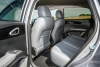
Add to this a healthy amount of leg- and headroom for people sitting in the back, and the overall picture for the Geely EX2 is a rosy one. But not completely flawless. That rear bench feels low-mounted relative to the floor, so taller occupants will find their knees crooked and their thighs unsupported by the seat's squab back there, there's not a lot of footroom beneath the front seats, the boot isn't particularly versatile beyond its outright spaciousness, and when the rear bench is folded down then there's a big step up from the boot floor to the flat backs of the chairs. Also, there's a pronounced lip to the tailgate, as well, so hefting large suitcases in and out of the boot won't be that straightforward.
Performance
There are two main powertrain specifications for the Geely EX2, which are 'small battery and lower power output', and then 'larger battery and slightly higher horsepower'. Either set of cells, though, are LFP items rather than NMC, and intriguingly the EX2 drives through the rear wheels, not the front. It's like a modern-day
Honda e.
Opt for the 35.3kWh battery and the motor is a 60kW unit. If you know your kilowatts-to-hp conversions, you'll be aware that's not an awful deal of grunt. In fact, it works out as just 82hp, backed up by one of the lowest torque figures we've seen on any EV so far at 150Nm. Sure, that beats the particularly reedy
e-C3 and Grande Panda rivals (124.5Nm), but not a lot else. The compactness of the battery pack does mean this Geely only comes in at 1,290kg at the kerb, but even so the 0-62mph time is a tardy 14.2 seconds.
Geely's UK reps, however, expect 19 out of 20 buyers of the EX2 to opt for the stronger variant, in one of its two trim grades (see 'Value', below). 'Stronger', there, is an extraordinarily relative term: this one has an 85kW motor, increasing power to 116hp, but the torque remains the same. The kerb weight also increases to 1,365kg, mainly because the battery is increased to 47.1kWh, but despite this the 116hp EX2 can run 0-62mph in a comparatively sprightly 11.5 seconds. Both models are limited to 81mph, nominally; we can neither confirm nor deny your allegations that we saw 87mph on the speedometer at any point.
What you can probably safely infer, just from digesting the information above, is that the Geely EX2 is not quick. Not in the slightest. Sure, in this affordable sector of the market, 800Nm of electric preposterousness is not the norm, but you might fairly expect small, lightweight, city-biased EVs to feel nippy off the mark and up to about 40-50mph. Not so the Geely. It does at least deliver its modest muscle in a smooth, linear fashion, because there's not a hope in hell of 150Nm overwhelming the rear tyres in dry conditions (at any rate), but this is subjectively one of the slowest-feeling EVs we've sampled so far.
It can, however, somehow keep up a passable showing on the motorway, and it's nicely calibrated underfoot for both acceleration and deceleration purposes, so controlling what little pace it has is an amenable proposition. But those wanting a little bit of zestiness to their EV? Look at the 150hp R5 E-Tech, and no further. It feels several classes ahead of the EX2.
Then there's range and charging speeds. Choose the 35.3kWh battery and just 156 miles of WLTP one-shot driving capability is theoretically possible. Go for the 47.1kWh unit, as tested here, and that figure increases to an OK-but-not-amazing 214 miles. This wouldn't be so bad, except the smaller battery peaks at a mere 60kW DC for replenishment. So although the stated 25 minutes of DC charging looks competitive, it's actually the time taken for 30-80 per cent - not 10-80 per cent, the metric quoted by almost every other EV manufacturer these days.
Due to its larger pack, it's the same 25 minutes for the 47.1kWh car, even though it increases the rate to a still-poor 80kW. And both UK versions, according to the spec sheets, have a 6.6kW onboard charging mechanism for AC top-ups, rather than 11kW. Nevertheless, expect the 35.3kWh car to take five hours 18 minutes and the 47.1kWh model to require seven hours 10 minutes for a 'full' 10-100 per cent top-up.
Ride & Handling
Dynamic redemption for the Geely EX2 comes in the form of its chassis tune. You can tell Geely is in the same house of automotive manufacturers as
Volvo,
Polestar and, most pertinent to what we're about to say,
Lotus. From the perspective of European drivers and their tastes, this is one of the most satisfying cars from China we've yet sampled.
It's evident from the first few miles on lumpy backroads on the very southern fringes of the Cotswolds that the EX2 rides better than almost every other affordable and semi-affordable Chinese product we can think of. It's not hamstrung by its small frame and light(ish) weight, instead covering off even the most lumpen of ground with a significant degree of grace. Aided and abetted by the 16-inch wheels wrapped in plump 60-profile tyres, the news only gets better when you hit better-finished roads and motorways, where the Geely settles down to a notably relaxed, and relaxing, gait. It also limits tyre, wind and suspension noises to nothing more than background considerations, too.
And it can handle sweetly as well. The steering is positive, well weighted and consistent across the lock, if almost a little bit hyperactively immediate at motorway speeds. But it's once again an area where other Chinese cars tend to fall down, yet the EX2 has a set-up that you can quickly gel with. It then teams this to impressive body and wheel control, and an unexpected but most welcome fluidity to the way the Geely flows through corners that makes it a deeply likeable car to pilot along twisting roads. It's not brilliant, you understand, because if you provoke it too much then it understeers somewhat easily, and we're in no way saying that we think that doyen of dampers, Lotus, played any active role in setting up this EV... but the way it keeps an even keel on interesting B-roads is reward for the manufacturer going with an RWD set-up for the car. It's just a shame it doesn't have a good deal more power to exploit this chassis, and to possibly overwork those rear wheels from time to time.
Yes, yes, we know: it's a great value, city-focused EV, it doesn't need to handle like a hot hatch, so asking for larger drivetrain outputs and even a realistic hint of oversteer is an exercise in futility. But without ever truly sparkling, we're happy to say this little EX2 drives a lot better than many of the rivals in this largely buttoned-down class. Not all of them, true. But enough to place it towards the top of the sector, rather than the bottom.
Value
There are three specifications for the Geely EX2 family from launch, which are Pro, Max and Ultra. Pro is solely reserved for the 35.3kWh/82hp car, and comes with the twin screens incorporating Apple CarPlay and Android Auto within, as well as electrically operated front seats (six-way driver, four-way passenger), single-zone climate control, 16-inch alloys, LED front lights and DRLs with high-beam assist, privacy glass, electrically adjustable, folding and heated door mirrors, keyless entry and go, a V2L power supply, a four-speaker sound system, keyless entry and go, and a massive great list of ADAS features with barely any exclusions, among much more. The price for all this is a very reasonable £20,990.
Stepping up to £23,490, a walk of two-and-a-half grand, for the EX2 Max doesn't add any extra equipment, but does swap out the battery and e-motor for the 47.1kWh and 116hp elements, so it's really at the Ultra level of our test car that the toy-count hits its high point. Using the same powertrain as the Max, the Ultra adds two-tone paint on the outside (a black roof, essentially), side skirts finished in metal, rain-sensing wipers, heating elements for both the front seats and the steering wheel, a powered tailgate, the wireless smartphone charging pad in the console, 256-colour ambient interior lighting, a 360-degree camera system with transparent chassis view, a six-speaker sound array, and direct tyre-pressure monitoring.
This is another £2,000 on top of a Max, bringing the Ultra's grand total to £25,490 - and you can only really add paint and the Pearl White interior (for £200) from there, so that the ceiling amount you can drop on the Geely EV is somewhere in the close vicinity of 26 grand. Launch finance deals will let you have it for a quid shy of £300 per month at 0% APR, if you put £1,999 down as a deposit. And if you still think all these numbers are too much, then bear in mind the company reckons the sales split will be 55 per cent Ultra, 45 per cent Max and just 5 per cent Pro, so potential owners apparently won't be put off by the 'expense' of the flagship grade.
Verdict
There are some issues with the Geely EX2, which cannot be ignored. The ADAS, for instance, is over-zealous if left on and not that straightforward to turn off, even with the shortcut 'master' programmed into the infotainment. The exterior styling is utterly unremarkable, in a class where there are several showroom standouts to choose from. The lack of switchgear does erode the on-the-move usability of the EV. It doesn't have a huge amount of range, the charging speeds are slow, and the on-the-road performance is even slower still. Glacial, almost.
And yet, for its roominess inside, for the well-made interior, for the unanticipated gloss of its chassis, for the excellent ride comfort and rolling refinement, for the practicality of the cabin and the boot, and for the value-for-money ethos the EX2 provides, we think it's a smashing effort from Geely. Sure, we'd still have a Renault 5 or Grande Panda instead in a heartbeat, and we suspect many other buyers will too, but as the manufacturer is only planning to sell 6,000 units of the EX2 in its first full year (2027) on sale in this country, of which 60 per cent will be retail cars, we're pretty sure there'll be at least 3,600 satisfied customers in the UK who take a punt on this newcomer. And possibly more than that, if the Geely zero-emission supermini gets the success it deserves.