Styling
Absolutely nothing has changed visually on the outside from the
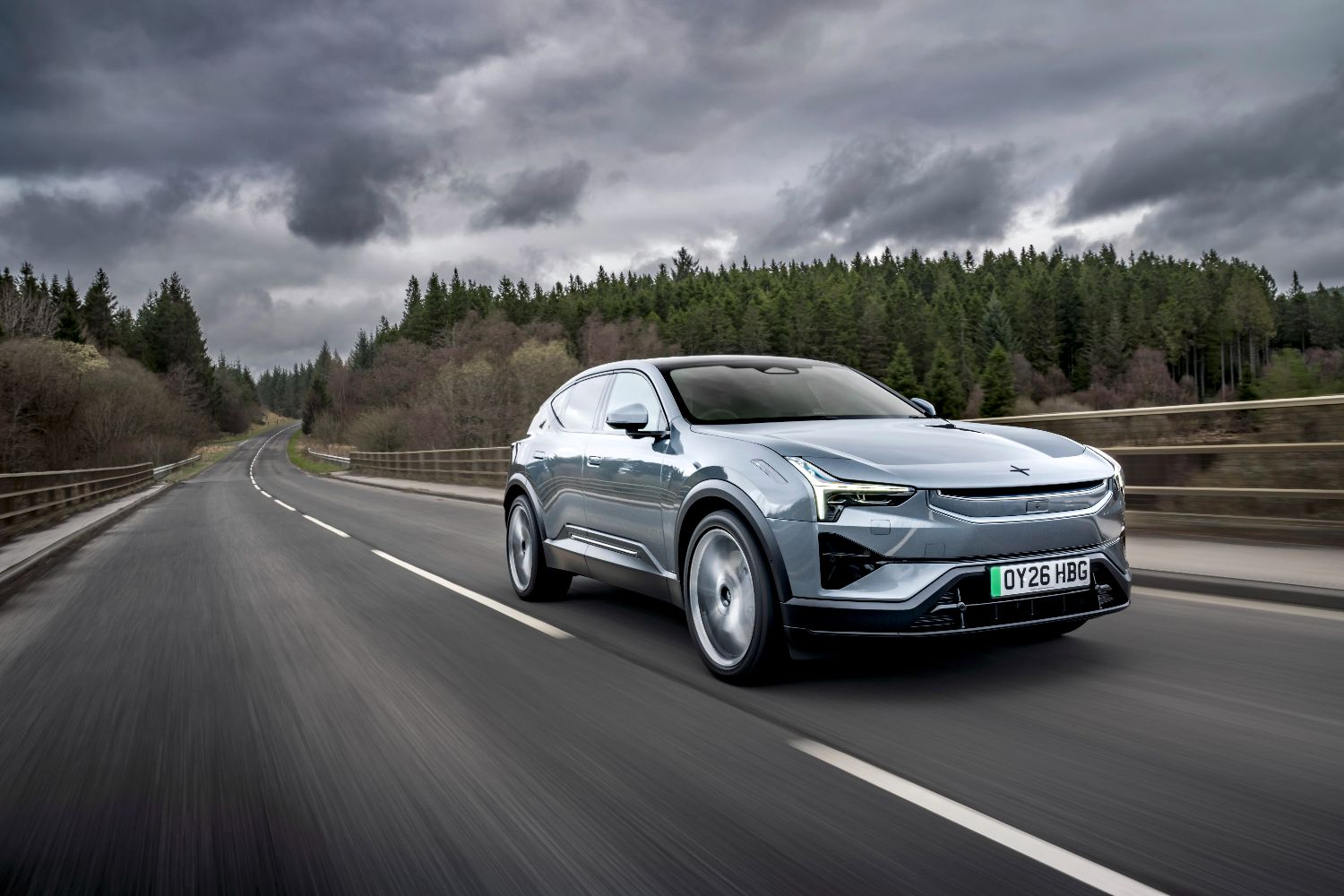
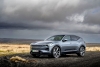
Polestar 3s which saw service in 2024 and '25 to this 'new' vehicle, which is known as the 2027MY (even thought it is launching well before '26 is halfway done). This means you have a handsome, low-slung SUV to look at, with a roofline standing not much above 1.6 metres off the deck and its long, wide body coming across as splendidly proportional.
Admittedly, the six colours offered for the Polestar 3 are judged to be premium and restrained, which in turn means they're fairly dull (there's a dark blue and a green called Krypton in there, but think a generally subdued palette for the car and you'll be on the right lines), yet it's hard to spec the P3 in any way that would make it look anything even approaching ugly. Although you can still see the
distant Volvo heritage evident in the Polestar's styling, the company has developed its own design language over the years to set itself apart from its parent firm's portfolio, so we very much like the Polestar 3 2027MY when appraising it from the kerb.
Incidentally, spotting the new cars will rely on clocking the number plate more than anything. Like all Polestars, the model designation (including the derivative's name, its battery size and its power output in kW) sits down at the leading lower edge of the front doors as a graphic, so if you're good at converting kilowatts to horsepower you'll know you're looking at the newer cars from the increased final figures, but generally these new versions are identical to those they replace. The Performance flagship, meanwhile, continues to be denoted by small, square and white badges fore and aft which read 'Polestar Engineered', plus the use of whopping 22-inch alloys as standard - behind which Swedish Gold brake callipers for the Brembo stoppers can be espied peeping out.
Interior
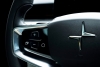
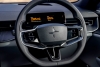
Again, the inside of the '27MY Polestar 3 is the same as that which went before, which is mainly good news but not without some qualms from our side. For instance, switchgear is limited to one column stalk and then the play/pause dial button on the console; everything else runs through the Google built-in 14.5-inch touchscreen infotainment. And on our test car, none of the haptic buttons on the steering wheel had any markings on them, making them utterly baffling to use. In this way, the P3's interface is tilting more towards the infuriating likes of the Volvos
EX30 and
EX90, rather than the SPA-era cars which had a fine control system.
However, in the Polestar's favour, we're told that all '27MY cars are actually going to get marked buttons on the steering wheel, which is a big improvement, while the infotainment itself is run by a new NVIDIA Drive AGX Orin processor that, with 254 TOPS, is more than eight times quicker than the item in the old P3s. So, with much-faster-responding infotainment, plus the appealing little nine-inch instrument cluster, a sharp head-up display, the superb Bowers & Wilkins sound system with Dolby Atmos and plenty of other desirable tech fitted, the Polestar's interior is as advanced as it is sumptuously finished. So it's a big tick for the car from us in this department of the review.
Practicality
The wheelbase of the Polestar 3 is only 15mm shy of three metres in total, and that out of a vehicle measuring 4,900mm from tip to tail. Concomitantly, and also thanks to the flat floor in the second row that you'd expect in a dedicated EV platform, there's masses of passenger space in the back of the SUV for taller occupants, while even carrying three people there for shorter journeys doesn't look out of the question because the P3's body is so wide too (about 1.97m, excluding the mirrors).
Elsewhere, storage solutions are thoroughly decent (save for the annoyance of having to open the glovebox by tapping on the touchscreen; for the love of god,
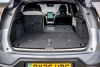
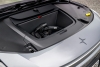
why?!) and the door pockets in particular are vast, but the same can't be said of the boot. Sure, with all seats in use, 484 litres isn't a terrible figure, but some of that amount is made up of underfloor storage and the 1,411 litres rear-seats-down volume is, for an SUV of this physical stature, below average at the very best. At least there's a circa-24-litre 'frunk' for the storage of the car's charging cables, which is a neat touch that leaves the rear boot completely free for the accommodation of luggage and so on.
Performance
Right, aside from the NVIDIA processor, so far nothing we've told you about so far appears to have been changed with the Polestar 3 2027MY. So what gives? Well, now we're about to get to the meat of the piece. As with
another electric SUV we tested recently, all the major updates are beneath the Polestar's skin. Principally, the car has switched from its old 400-volt architecture to a new 800-volt arrangement.
This drastically reduces charging times - every '27MY P3 can charge at anything between a peak of 310- and 350kW DC, depending on how many motors it has fitted, meaning 10-80 per cent should take around 22 minutes at its quickest - but it also sees the power outputs increased too. Significantly, in most instances.
The manufacturer has taken the opportunity to simplify the model names as well in the midst of all this, so things kick off with the Rear Motor. As its moniker suggests, the propulsion unit is on the trailing axle for rear-wheel drive and it's the only single-motor variant in the P3 range. It's also the only one with a 310kW DC max rate, because it has a smaller NMC battery pack of 92kWh usable capacity. Furthermore, the Rear Motor runs on standard mechanical springs with frequency selective dampers, when the other two P3s have a double-chamber adaptive air set-up, and the power of 333hp (allied to 480Nm) compares favourably to the old variant's 299hp, so even this 'slowest' Polestar 3 '27MY is quick with a 0-62mph time of 6.5 seconds.
We drove the Rear Motor briefly on some sensational roads up in the Cheviots and it's a delightful thing in and of itself, with positive steering, plenty of real-world pace and impressive rolling refinement. Nevertheless, if it suddenly encounters a rapid series of lumps, bumps and compressions in the tarmac, as you're wont to do on something like the B6277 running from Alston to Middleton-in-Teesdale, its rear suspension seems to get out of sync with the rest of the car and becomes quite bouncy, so we'd advocate looking at one of the two twin-motor P3s with their air-sprung pliancy.
The first of these is the, again, self-explanatory Dual Motor. Power here is up to 544hp, which not only eclipses the 489hp of the pre-update predecessor but even the 517hp the preceding
Long Range Dual Motor with Performance Pack (a wordy nameplate if ever we saw one) possessed. The 0-62mph time here tumbles to an impressive 4.7 seconds, while the larger 106kWh battery pack sees this mid-grade variant as the only one in the Polestar 3 '27MY range which can go more than 400 miles to a charge (officially, clearing that barrier by two miles).
Yet it's the simply named Performance we'd steer you towards, assuming you have quite deep pockets. Like the Dual Motor, it has air suspension with adaptive dampers and a 106kWh battery, but a sportier tune for the aforementioned chassis is accompanied by huge outputs of 680hp and 870Nm. This is data not only 163hp in advance of the previously most potent Polestar 3, but it even outpunches the mighty
Porsche Macan Turbo Electric - and is why, despite weighing in the region of 2.6 tonnes, the P3 Performance can rip off 0-62mph in just 3.9 seconds.
It's definitely the most premium-feeling driving experience as a result, even if you don't really need the best part of 700 horsepower to get around. The calibration of the throttle is magnificent and the sheer effortlessness of what would once have been called its midrange (when that term previously referred to engine revs) transforms the Polestar 3 from a moderately intriguing leftfield SUV choice into one of our favourite premium EVs of any shape or size.
Of course, driving it with some gusto for prolonged periods, as we did through the middle of the Kielder Forest and then on one of our favourite stretches of road anywhere in the British Isles, the A68 from Otterburn in the direction of Corbridge, you won't get anywhere near the WLTP claim of 373 miles per charge. Indeed, our test car was glugging down volts at the rate of 25.3kWh/62.1 miles, or about 2.45 miles/kWh if you prefer it expressed that way. That's a rate of electrical consumption that would see a full battery drained in about 260 miles, rather than something in excess of 370. Eep.
Ride & Handling
Polestar's chassis engineers told us that the slight changes in weight distribution in the revised 3 SUV, plus some feedback on the original cars that suggested the ride was a bit too crunchy, has seen them decide to soften off the front end of the vehicle, simultaneously fitting thinner anti-roll bars too. Sadly, one area where it looks like the Polestar 3 has taken a big technical backwards step is that the torque-vectoring rear axle has been dropped, even on this Performance flagship.
Beyond this, Polestar doesn't do overarching drive modes, so adjusting the power delivery, the weight of the steering and the level of damping you want requires prodding at different graphics on the touchscreen; they are, at least, all corralled on one sensible menu when you need them. When it comes to the air suspension for the Performance, your choices are Standard, Nimble and Firm - and the middle way is the answer here.
Kudos to Polestar for introducing proper light-and-shade between the various settings, because you can really feel a difference as you cycle through the three suspension options. However, Firm is a touch
too firm for a British B-road; it might be brilliant on a big, open, sweeping route with pristine surfacing, of a type you readily find over on the continent, or indeed a track, but who's ever going to take their 2,600kg electric SUV onto a circuit with any regularity? The obverse setting, Standard, would be excellent on a motorway or the cratered grid of streets in a town, but it permits too much movement of the Polestar's big heavy shell when cornering under duress.
It's therefore Nimble which does a marvellous job of blending off a trace of suppleness and the ability to breathe with undulating road surfaces, along with fantastic body and wheel control, all of which allows you to exploit the Polestar's wonderfully meaty steering, mammoth traction and surprisingly high levels of grip to the utmost degree. In all honesty, on the roads we didn't really lament the deletion of the torque-splitting rear axle; for what most people will ever subject their P3 SUVs to dynamically, the Performance is about bang on the money. Even if we accept some rivals, specifically the one with a Porsche badge on its conk, can be a more involving and well-rounded steer for the enthusiastic driver.
Nevertheless, the Polestar's ride comfort and rolling refinement are also right out of the top drawer, so it transpires there isn't a motoring scenario you'll realistically encounter where you'll find it severely wanting. It's a thoroughly well-sorted, rewarding and likeable thing to drive.
Value
Accepting that the Polestar 3 is a premium product, looking to compete with BMW's 'Neue Klasse' iX3 and that aforementioned Macan Electric, and also factoring in that it can have up to 680hp, we didn't think the prices of the revised car were that outrageous. But it would seem reaction on social media was quite the opposite, with the idea of a 70-100 grand 'posh Volvo' perhaps a little too much for many people to digest.
The equipment levels on all '27MY Polestar 3s are generous enough but the Performance gets a comprehensive kit list, including some of the tech bundles that would be optional elsewhere, such as the Pilot Pack, Plus Pack, Prime Pack and Climate Pack. Despite this, Bridge of Weir leather in Zinc (£3,900) and HD LED headlights (£1,600) on our car added another £5,500 to a starting ticket already beyond £90,000, so a final price of £97,540 has to be noted as pretty steep; even if you wouldn't get something similar of prestige that could outperform it for much less cash (the Tesla Model Y Performance notwithstanding).
At the time of writing, Polestar UK was doing a 'seasonal offer' event that was knocking £5,000 off all the list prices of the '27MY 3s, which would mean a base figure of £71,540 for a Rear Motor and about £87,000 for this Performance, with our optioned-up test car coming back down to its pre-offer starting ticket of £92,000.
Verdict
Aside from its considerable expense and a few minor gripes relating to the infotainment system plus the moderate boot space, switching the Polestar 3 to 800-volt underpinnings and bestowing upon it more power was a masterstroke by the Swedish outfit. It's maybe not the sharpest-driving top-end electric SUV going, but in terms of its feelgood comfort levels, smart styling and plush interior, it's a strong and talented all-rounder that deserves serious consideration in the current zero-emission prestige marketplace.