Styling
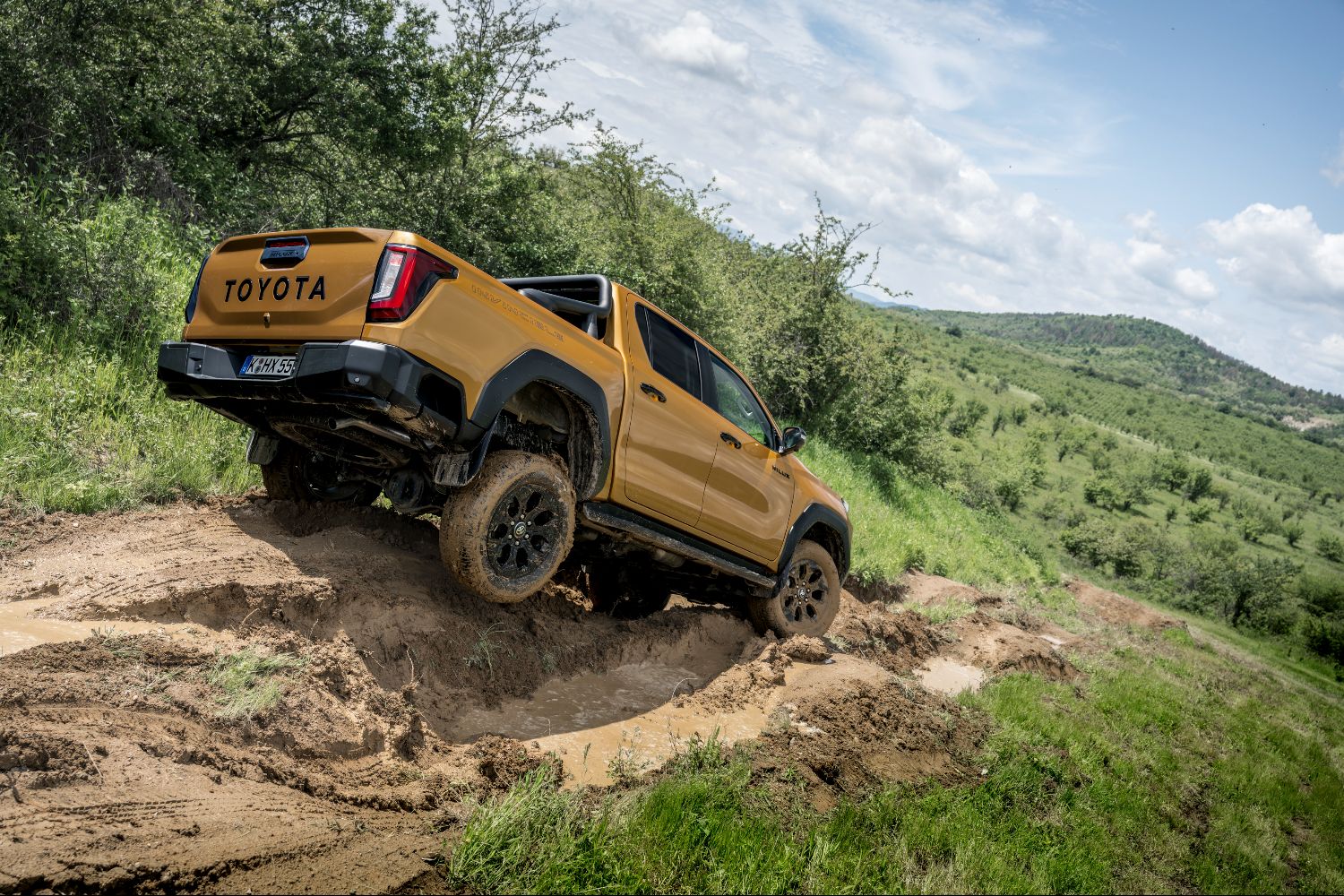
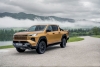
We're focusing on the 48V Diesel here but will reference the Hilux BEV throughout. Anyway, the Hilux is obviously a Hilux. It has a new, more-angular face as a Mk9 and it's now only sold in Double Cab form, so its hulking 5.3-metre four-door form will be familiar to you. Overall, it's a decent-looking thing, in a realm where styling has become increasingly important over the years, and it'll aesthetically stand up to scrutiny when compared with the
Ford Ranger and its related
Volkswagen Amarok.
As to visual differences between the 48V Diesel and the BEV, they are few. The most obvious one is the luscious paint you can see in these pictures, called Sulphur metallic. It is one of eight colours offered on the diesel pick-up but it's not available on the electric, which only has a selection of three finishes to go at. Other than that, the hexagonal-pattern grille beneath the front Toyota logo is open on the 48V Diesel and closed for the BEV, there's no tailpipe at the back of the latter, it wears a tiny 'BEV' tailgate emblem, the fuel filler cap is on the rear wing for the diesel but the charging port is front-nearside on the zero-emission model, and the BEV has its own design of 17-inch aerodynamically optimised alloy wheel, whereas the combustion model can sit on 18s depending on spec and options.
There's one final big difference to spot although it only counts with higher-spec 48V Diesels, which get plastic 'overfenders' as Toyota calls them, but which we'd say are wheel-arch protective cladding. If fitted, these widen the Hilux by 30mm to an overall breadth of 1,885mm, but they are omitted on all grades of the BEV in the pursuit of range-boosting aerodynamics.
Interior
With admirable material quality, accepting that underneath all the glitz the Toyota Hilux is still a commercial vehicle at heart and so must have a durable, hard-wearing interior, the passenger compartment of the truck is a hit. Technology is handled by a serviceable 12.3-inch digital instrument cluster alongside a 12.3-inch Toyota Connect infotainment touchscreen. Both work smoothly, but the best news of all is that physical climate controls are retained in the vehicle; a pragmatic and intuitive touch on Toyota's part.
Again, the differences between 48V Diesel and BEV are minor and amount to the different graphical readouts in the binnacle, plus changes to the gearlever and diff-lock-selecting mechanisms down on the tunnel. Other than that, these two feel broadly the same to sit in.
Practicality
Any one-tonne pick-up truck is a machine developed for practicality, but it is in this realm where the 48V Diesel starts to forge ahead of the Toyota Hilux BEV. Various sacrifices have to be made on the technical specification side of things which make the electric model less all-round capable than the one with a combustion engine up front.
For instance, while its loadbed is the same 1,555mm long and 1,540mm wide, with a depth of 480mm, the payload on the BEV is slashed by 350kg to a maximum of just 715kg, compared with 1,065kg for the turbodiesel. The towing weight is more than halved, as the BEV can lug up to 1,600kg of braked trailer, as opposed to 3.5 tonnes. The electric also has a maximum ground clearance of 212mm, as a result of its battery's mounting point, rather than the 310mm of the 48V Diesel, and its max breakover angle is also trimmed by four degrees to 20 degrees accordingly.
Still, the BEV has been developed for a certain type of end-user business, so if you've got a heavy-duty workload for your fleet of pick-ups, stick with the diesel - but if the benefit-in-kind tax breaks of the electric work for you and you don't need the maximum of capabilities from the truck, this could be the Hilux you've been waiting for.
Performance
The Toyota Hilux 48V Diesel has similar stats to the old 2.8-litre non-hybrid model it replaces, generating 204hp and 500Nm of torque from its mildly electrified powertrain. The manufacturer won't quote a 0-62mph time, but a top speed of 109mph is cited. The BEV, meanwhile, equips a 54kWh usable NMC lithium-ion battery under its floor and reduces power a little, to 196hp. Toyota only states that the front motor delivers 205Nm and the rear 269Nm, with no system max revealed, although its top speed is reduced to 87mph to preserve its battery as much as possible.
There's obviously a thrill of sorts in driving a big, rugged pick-up that makes no noise as it whirrs off down the road, which is a huge part of the specific appeal of the Hilux BEV. Designed to see off the likes of the electric
Isuzu D-Max and Maxus T90, Toyota has made a great fist of the BEV and it's a much simpler vehicle to drive, both on- and off-road, than the 48V Diesel; you just put the zero-emission Hilux into D and off you go, letting its clever onboard management propel you forward no matter what the terrain ahead.
Yet it's the turbodiesel we prefer, simply for its greater range and usability. And Toyota has done a grand job of making this powertrain feel and sound more refined and quieter than it has been in previous applications, although there's still a lot of boosty whooshing and hissing from the 2.8 up front if you're driving the Toyota with its windows down.
Generally, though, it's a fine thing to operate and even the six-speed autobox isn't too recalcitrant, as long as you're not expecting whipcrack DCT-like responses or shifts from it. And then there's the fact the 48V Diesel Hilux is 240kg lighter at the kerb than the BEV, so it does feel quite a bit quicker and more muscular in practice. Although not massively efficient: we saw just 20.8mpg from the truck during our test of it. To be fair, mind, that was while mainly off-roading it through the Bulgarian mountains, which requires lots of throttle, so something closer to 30mpg ought to be easily achievable for on-road driving.
Ride & Handling
Again, in this regard we prefer the diesel Toyota Hilux to the electric, but there's a big caveat here. The 48V model we tried had a big waterbag strapped into its loadbed to tie it down, whereas the electric version didn't - and so felt considerably more jittery and firmly sprung when out on the roads.
There have clearly been improvements made to the 48V Diesel Hilux's refinement, though, because it's a more composed and elegant truck than we've had the pleasure of sampling from Toyota before. New engine and cabin mounts are said to have greater multidirectional flexibility than the items they replaced in the Mk8, while the manufacturer has added 36 extra spot-weld points to the floor (30 up front under the cab and six at the back beneath the loadbed) to improve ride comfort, despite the fact that the Hilux remains on leaf springs at the back.
Another positive is the steering, which is an electric power-assisted set-up here, rather than hydraulic. It gets rid of a lot of the slow-witted responses you normally get at the helm as the driver of a one-tonne pick-up truck, making the Hilux Mk9 feel more agile, precise and eager. Of course, it's no handling doyen, as the tyres have limited grip on tarmac (they're designed for off-road use primarily) and the body still leans a lot, but overall the latest Toyota Hilux a pleasure to drive, either in BEV or turbodiesel guise.
Oh, and it's as immensely imperious in the rough stuff as it ever has been. Scrambling around up the side of scree-covered mountains and descending steep, low-grip surfaces, the Hilux was thoroughly assured in all circumstances. It's got more serious 4x4 hardware as the switchable AWD 48V Diesel, with locking diffs and low-ratio transfer cases and so on, but don't discount the BEV. The Multi-Terrain Select off-roading system and ease of control provided by its well-calibrated throttle and brakes makes it a doddle to thread around on challenging routes through the wilderness.
Value
One more compelling reason to opt for the 48V Diesel is that it is the markedly cheaper Hilux of the two, with or without VAT added. It starts at £42,845 with the tax added on, although an Invincible like our tester is the very top of the Toyota trim tree for this truck. The BEV, however, kicks off at a meaty £57,845 as an Icon and is the wrong side of 60 grand in Invincible trim, because it can't be considered a commercial vehicle under UK tax laws due to the fact it cannot handle a tonne in its loadbed, although it is eligible for the Government's plug-in-van grant of £5,000. But you'll be paying VAT on the electric version; it'll more be for benefit-in-kind that it draws certain punters in - that, and the ethical advantages of its zero tailpipe emissions.
Verdict
Toyota's big evolution of the Hilux story comes with the new BEV, which is an intriguing and unusual addition to the truck's ranks. It'll suit a very specific set of end users and is a fine execution of a zero-emission pick-up, yet we can't help but feel most people are going to simply stick with the far more versatile 48V Hybrid version. Tough, as supremely capable off-road as it ever has been, good to drive and decent on the inside, the turbodiesel MHEV Hilux is ready to take on the influx of rivals coming its way in the months ahead, as both the Mitsubishi L200 and BYD Shark line up on the horizon for the UK market. But the Toyota remains one of the best of its type of one-tonne load-luggers, so it'll easily continue the Japanese firm's remarkable success story for this model that is, at the time of counting, past the 27-million mark for global sales.