Styling
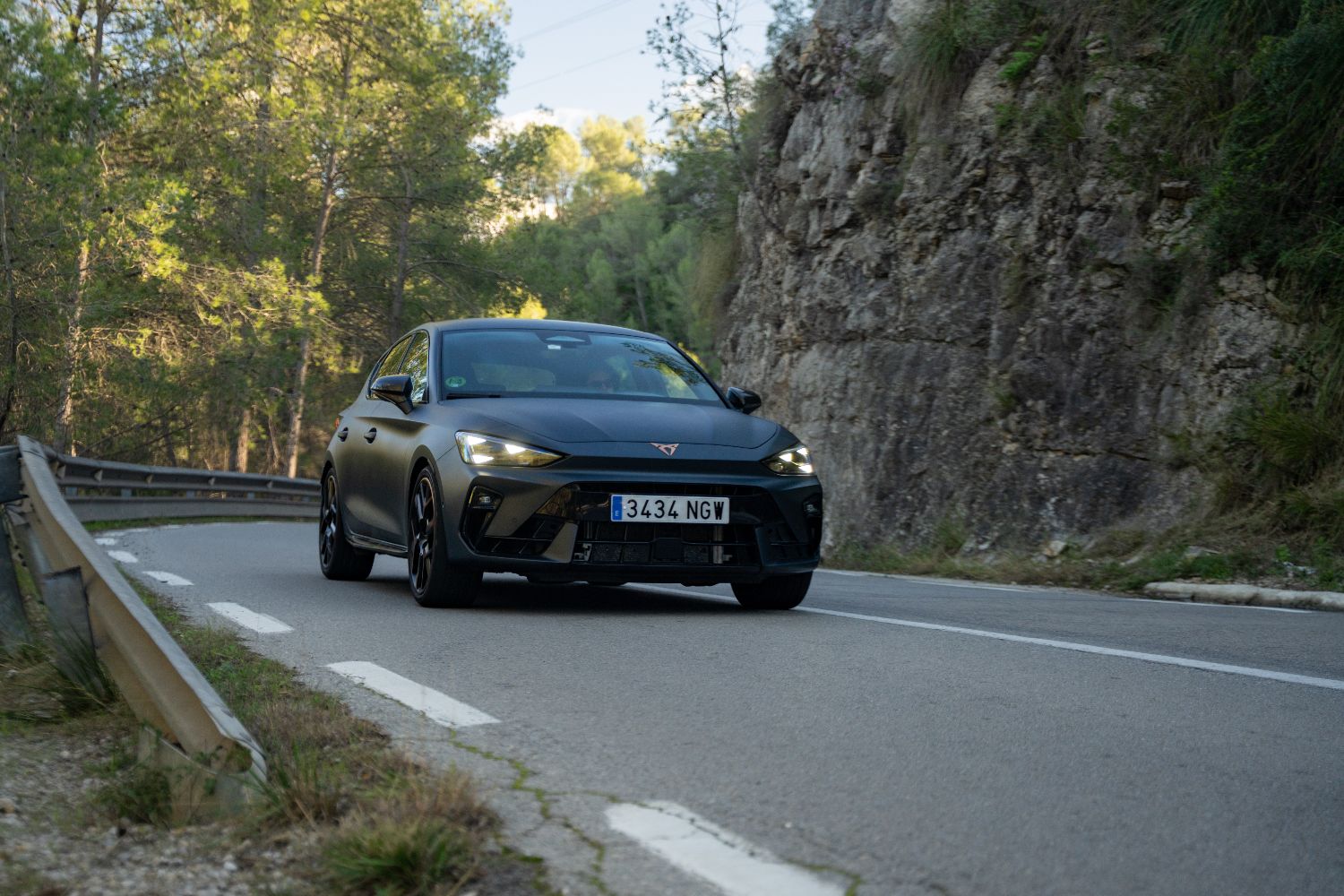
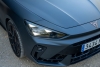
Visually, the VZ is going to be hard to spot, whereas the TCR clearly isn't. Anyway, the former model is essentially based on the top-grade VZ3 derivative of the Cupra Leon, which means it has the same 19-inch 'Hailstorm' alloys in a copper-and-black finish, plus it has copper-tinged quad exhaust pipes. The only obvious giveaway you're looking at the 325hp model, then, is the discreet 'VZ' logo that sits on the right-hand side of its bootlid. Overall, the VZ is a fine-enough-looking thing, as long as you don't mind the beaky facelift appearance that Cupra foisted upon the entire Leon family in 2024.
Interior
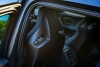
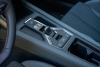
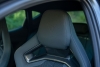
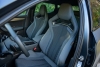
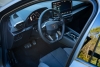
The cabin of the VZ is almost identical to that of any other high-spec Cupra Leon, but this is no bad thing as it means you get a great interior overall which, in this instance, is enhanced by an exquisite set of carbon-backed bucket seats, which are the main upgrade for the limited-edition car. Beyond that, it's the usual excellently put-together and tastefully rendered Cupra cabin, complete with the twin digital screens that form the main human-machine interface. While this generation of Leon is hardly in the first flush of youth, it remains a brilliant place to sit when it's in top-level Cupra specification like this, although we do wish those magnificent front seats were mounted a little closer to the floor than they actually are.
Practicality
There's no difference when it comes to passenger space or boot room (380 litres all seats in use, 1,210 litres with the second row folded down) in the Cupra Leon VZ, compared to what you'd get in any other hatchback Leon model. Therefore, as hot hatches go, this Spanish machine is about as user-friendly as you're going to get for this sort of car.
Performance
The 2.0-litre turbo four in this VZ has seen service in what feels like umpteen-million VW Group performance products over the years, so there's a danger of a little familiarity with it creating a small degree of contempt here. The other problem with it is that we drove the Leon VZ on exactly the same day and exactly the same closed (by local police so we could have a play) mountain road in Spain as the mighty
Formentor VZ5. And in the shadow of that five-cylinder firebreather, the Leon VZ felt like something of an afterthought.
It's quick, no doubt about that. But then, so's a 300 TSI. Or a Leon Estate 333 TSI with 4Drive. And without strapping timing gear to both the 300- and 325hp versions of comparable front-wheel-drive Leon five-doors, we'd struggle to tell you that the additional 25hp and 20Nm on the headline figures have made much of a difference to the Cupra's feeling of straight-line strength - even if the 0-62mph sprint is apparently trimmed by 0.3 seconds (to 5.4 seconds all-in) and the speed limiter is removed so the VZ can hit 168mph flat out, if you've got enough room, and nerve, to test such a thing.
What has happened is that the soundtrack has become, er, quite
boosty. Cupra makes a big thing of saying the impending VZ TCR will have a difference voice to a 300hp model, but if it sounds like this stepping-stone VZ then all we're reminded of is the turbo-heavy hissings of the old
RS Meganes. It's a sort of brutally effective, industrial noise and it leaves you in no doubt that the car is accelerating, fast, in response to heavy applications of the throttle. But tuneful and alluring, it most certainly is not; and it sounds considerably less appealing in the wake of the majestic warbling of the 2.5-litre engine you can now get in a Cupra Formentor. Oh well.
Ah, one last thing: we wouldn't normally criticise the seven-speed DSG, but in this car it felt strangely hesitant and indecisive at times. It probably wouldn't have worked for the TCR that's still on the horizon, due to its track-biased ethos, and we're sure there's some sort of torque-related reason that this wouldn't be possible, but the VZ might have stood out as far more special in the rapid Leon family if Cupra had been brave and ditched the DSG for a good old six-speed H-pattern manual. Double oh well.
Ride & Handling
Again, we shouldn't keep comparing the Leon VZ to the Formentor VZ5, because they're quite different machines: one's a lower, lighter, front-driven hatchback with a four-cylinder 2.0-litre, and the other is a taller, heftier crossover-SUV-coupe-thing complete with the utterly compelling motor from an
Audi RS 3, plus the 'blast it, anywhere' security of four-wheel-drive traction.
That said, from our full-on thrash up the closed road, we couldn't really say that the Leon VZ felt any more invigorating to drive than a 300 TSI model, or indeed the
Volkswagen Golf GTI Clubsport. In fact, on the gravel-strewn surface of that Spanish route and in temperatures which were cool but not UK-winter freezing, the VZ felt quite skittish and flighty.
Sure, a hot hatch with a playful rear axle is what most driving enthusiasts crave, but there was something about the VZ which meant it didn't feel that secure at or approaching the dynamic limit - as if the movements of the chassis were unintentional and bordering on the out-of-control, rather than planted, dependable and fun. There's clearly a lot to like here, of course, as the Leon's steering is excellent, the brakes are strong and fuss-free, the wheel and body control is broadly first-rate, and there's enough adjustability in the platform that if you lift mid-bend with the car's suspension fully loaded, you can rest safe in the knowledge you're not about to have a massive crash.
It's just that... we dunno, maybe we'd been spoiled by the Formentor VZ5. Or maybe we were simply wondering about Cupra's decision to launch a VZ model with its new, 'special' drivetrain, ahead of the star-turn TCR that's coming later in the year. Either way, we sort of felt quite lukewarm about the Leon VZ. It's intriguing, for sure, but it's not something where we're about to proclaim it the 'last of the all-time great hot hatchbacks'. In all honesty, it feels very much like the Leon 300 TSI VZ3 with some fancy seats (good) and a strangely nasal aftermarket exhaust (less good) fitted.
Value
The price of the VZ in the UK hasn't been confirmed as yet, although the intimation from the company's representatives in this market was that the 325hp Cupra Leon would be in the ballpark of £50,000. That might sound excessive, given our rather ho-hum appraisal of the car in the performance and handling sections above, but two things in the VZ's defence: one, only 1,500 examples of this car will be built worldwide, with no clear word on the allocation for the UK - but that means it'll be rare (although not as stupidly rare as the brilliant old
SEAT Leon Cupra R, of which just 24 units made it to these shores); and two, a 300 TSI DSG Cupra Leon hatch in halo VZ3 trim is already £50,135 as it is. So for the extra power of the VZ and those seats, plus limited-build status? Maybe 50 grand's not so bad. Or maybe it is, we're not so sure.
Verdict
Look, in many ways we're delighted Cupra has seen fit to give us the Leon VZ, on top of the impending arrival of the TCR. We're in an age where so many hot hatches are either dying off, such as the imminent demise of the spectacular
FL5 Honda Civic Type R, or they're already dead - RIP,
Ford Focus ST.
So the fact that any 325hp, front-driven, pure-petrol, high-performance hatchback is still making it to market in the current climate is something to be thoroughly celebrated. However, for various reasons, we're not blown away by this new Cupra VZ, and those reasons are these: one, it doesn't feel markedly different to the pre-existing 300 TSI; two, it might have taken some of the gloss away from the incoming VZ TCR; three, Cupra shouldn't have let us drive it back-to-back with the brilliant Formentor VZ5; four, it doesn't seem to have the same rawness and baked-in X-factor as the old Cupra R; and five, it's going to cost the wrong side of £50,000 when prices for the UK are eventually announced.
Still, if you've never driven a Cupra Leon before, you could obviously do a lot worse than plumping for the largely excellent VZ limited-edition model. And given hot hatchbacks are so thin on the ground these days, we have to conclude by saying this Spanish creation remains one of the best of its endangered breed in 2026.