Styling
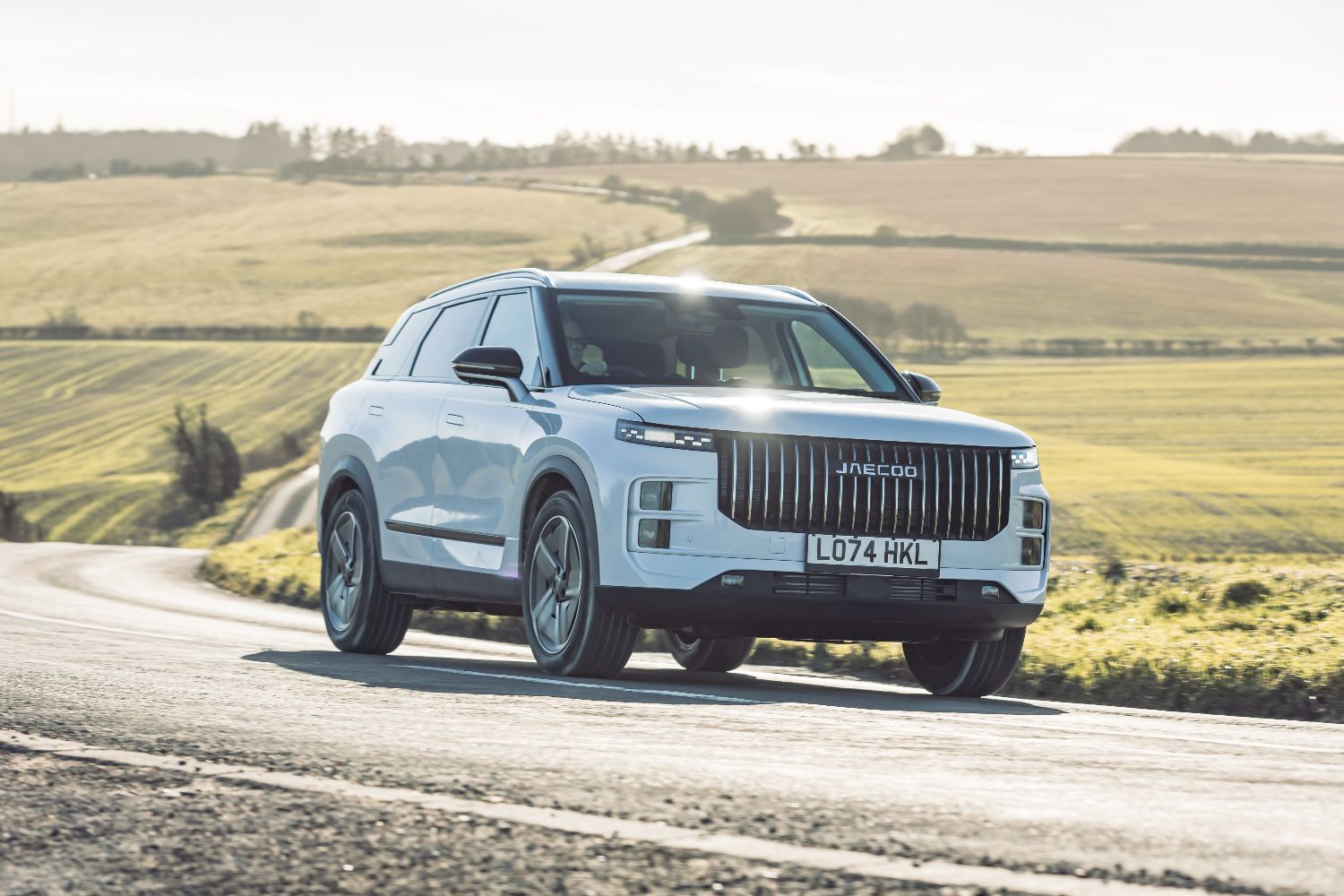
The obvious main attraction of the Jaecoo 7 is the appearance which is a little bit like a Range Rover Evoque. If you really, really squint and use the more fevered parts of your imagination, that is. Sure, the J7 is not ugly and with that distinctive 'waterfall' front grille, it's certainly not boringly anodyne like so many indistinct, vaguely SUV-shaped machines which have heralded from its homeland in recent years.
But with those odd double-stacked square lamps in the front bumper, incongruous chequered-flag motifs dotted about the place (explain to us Jaecoo's 'glittering' motorsport heritage, then?) and the totally unnecessary vertical 'vents' aft of the rear wheels, we're also not about to call this a beautiful creation. We will at least concede showroom/kerb appeal has to be a large part of the Jaecoo 7's baffling allure. Because we're struggling to find anything else decent about it.
Interior
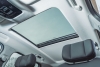
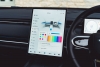
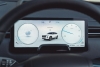
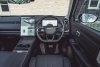
Step into the Jaecoo 7's interior and, before you've touched anything, the first impressions are decent. Some effort has clearly been made in attempting to make the dashboard architecture look quite nice, even if - as the SHS-P PHEV - it has the usual Chinese-car interior layout: massive central touchscreen, letterbox instrument cluster, bridge-like central tunnel, column-mounted shift lever and, if you're lucky, a head-up display for the driver.
But when you're building a car down to a cost and you want it to feel suitably plush, instead of scratting about at the bottom of the bargain-basement barrel, you put all the best materials you can afford in the 'high traffic' areas of the cabin - the things you'll touch every day, like the steering wheel, the column stalks and the door handles. And you put all the cacky plastics in out-of-the-way zones, such as the very furthest point of the dashtop or way down low in the footwells; Toyota, for instance, is a master of this particular conceit.
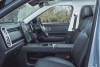
What Jaecoo has done with the 7, though, is made the fascia's upper surface and the door cards out of nice, squishy plastics. And then rendered the steering wheel in horrible, slippery fake leather, equipped the naffest set of column stalks in recent automotive history (calling the plastics used for these 'lightweight' would be an understatement of colossal proportions), and generally ensured all the key touchpoints are the ones which convey the nastiest tactility. So the 7 always feels cheap when you're operating it.
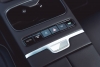
There are further annoyances here, like another one of those godawful 'Last 50km' trip computers - these should be deleted, as they offer information which is simply meaningless gibberish; our test car, for example, offered up such thoroughly worthless gems as '832.3 miles/kWh' and then '-630 miles/kWh' in short order for electric consumption, while its two indicated fuel economy figures never, ever matched up, not even once - plus the fact that every bit of information on the instrument cluster seems to be rendered in minuscule 8pt font to squeeze it all in, the realisation that the window switches are the sodding wrong way around for their orientation on the door cards, and of course a recalcitrant infotainment system which controls way too many in-car operations because there are hardly any physical buttons of note in the Jaecoo 7. But we'll stop there for now.
Oh, wait; no, we won't. The Jaecoo 7 has the worst DAB receiver in the history of all time. The car flat refused to pick up any radio signals anywhere in the lower half of the UK. Not in Nottinghamshire, which is hardly renowned for its mountainous terrain. Not while running down the spine of England on the M1. Not while in the vicinity of Heathrow airport. No other test car
we've ever tried was this appalling at the straightforward task of picking up some radio signals.
Practicality
The Jaecoo 7 is reasonably spacious in the second-row seating. So there's that on its side, we suppose, but then most Chinese SUVs which have arrived in the recent past are roomy in the back, so this is hardly a genuinely 'unique' selling point of the J7. And the boot measures just 412 litres. Which is
smaller than the cargo bay you get in the supposedly inferior Jaecoo 5 model (480 litres in its petrol format). So really, just how practical is the Jaecoo 7, when you boil it right down? Be honest, now.
Performance
Is there a gentleman's agreement in the Chinese automotive industry that all brands must deliver a drivetrain output of 150kW (204hp), and they must also all use a 1.5-litre turbocharged four-cylinder engine if they're not making an EV? Honestly, we write these stats out so many times among all the different companies' products from the Asian country that we're beginning to get snow-blind to the outrageous idea of some differentiation in powertrains. Y'know, just for a bit of variety and all.
In a brief moment of credit, we will at least acknowledge that the J7 SHS-P has a mammoth combined range from its petrol and electric resources. A 60-litre fuel tank and an 18.3kWh battery pack gives it a theoretical one-shot maximum of about 750 miles before having to visit either pump or public charging point, and our test car arrived with 15 per cent battery showing and yet still managed to give back around 45-50mpg across 552 miles of testing. Well, we think it was about that. As we can't know for certain, because the blasted trip computer is effectively useless at recording any cogent medium-term data.
Other than that, though, the powertrain is incredibly coarse in the Jaecoo 7. The 1.5 is noisy and vibrates noticeably through seat and wheel if you're working the throttle hard, while the switch between hybrid and electric running is not as seamless as it should be. The brake pedal has a horrible sponginess to it and the calibration of it isn't very progressive either, so slowing the J7 down isn't a pleasant job. Nor is speeding it up, because if this vehicle can ever hope to run 0-62mph in the claimed 8.5 seconds, we'll eat our metaphorical hats. It's reedy and undernourished in the extreme.
And then there's the most bizarre trick of all that this car pulls. If you ever use full throttle - and you might scoff and say there's never any reasonable need to do such a thing, but we'd suggest if you're pulling out of a side junction into fast-flowing traffic, or you're attempting to burst onto a busy roundabout, or you perform an overtake on a two-way road and realise in the middle of the manoeuvre that you've spectacularly misjudged the situation, then you absolutely will use full throttle - then when you lift off the pedal, the Jaecoo 7
keeps accelerating, for what feels like almost a second. We've talked about throttle lag in cars before, but that's usually when you're applying the gas and waiting for the drivetrain to respond and build acceleration; we've never encountered a car which demonstrates lag when you come off the power instead. What possible need could there be for this feature? Is it not potentially unsafe? How has anyone mapped a throttle pedal to do something as egregious as this?! Bonkers.
Ride & Handling
Oh lord. If you're hoping for Jaecoo 7 redemption in this section, look away now. You might just about be able to tolerate the unrefined drivetrain if you never drive the car particularly hard, but you surely won't be able to stomach the dreadful dynamics for the three or so years of a PCP or lease deal. Imagine having to live with this drivel for 36 months. It makes us shudder just thinking about it.
The 7 SHS-P performs the totally unwanted twin 'achievement' of doing neither ride and refinement, nor handling well. Some people will tell you this car rides nicely. We're here to emphatically tell you it does not. The suspension is so loose and slovenly that the Jaecoo slops and wallows lamentably in the wake of only modest bumps in the road, so while it might be softly sprung, it does not have anything like the vertical control needed to deal with anything other than billiard-table-smooth surfaces. You don't need us to tell you that such things are as rare as rocking-horse poo on the UK's roads network.
Worse than that is the constant jostling the Jaecoo 7 subjects you to. Even if your eyes tell you that, while looking out of the windscreen, the road in front of the car appears to be in a semi-decent state, the sensation you actually get is that you're sitting on an upturned plate that's situated atop a viscous liquid. You are permanently being shuffled about laterally, like a giant invisible hand is shaking your shoulder, and it induces needless head-toss and an insufferable fidget to the J7 that makes every long motorway trek into a chore. Well, that and the enormous amount of road roar permeating the cabin at anything above 40mph. The din inside the Jaecoo at speed is terrific, and we don't use that adjective as a superlative; we mean the noise in the passenger compartment is frightful.
Still, that's OK, because you can drown it all out by turning the radio up... oh, wait. No. No, you can't. Because the bloody DAB receiver is so ineffably dismal.
And then there's the handling. Which is little short of abject. The primary offender here is the steering, which has the worst trait imaginable in the automotive world: it's inconsistent. Turn the wheel a few degrees off dead centre, and it is sickeningly light and completely devoid of all meaningful feel or any sensation that it is attached to the vehicle's front axle whatsoever. And then, all of a sudden, with just a touch more lock dialled in the nose of the Jaecoo veers violently to one side or the other, depending on which direction you're steering. It's vile. And it doesn't improve no matter which of the three driving modes you're in.
Couple that diabolical steering to the comically roly-poly body control which we've already touched upon, and when you get these moments of unnecessarily sharp response from the front end of the J7 then you also get associated hideous lean from the car, and an alarming wobble from the SUV's shell in the aftermath of such incidents as it tries (and fails) to quickly settle back down on its woeful springs and dampers. So don't for a moment dream that there's a good chassis hiding beneath all this dross, because there patently isn't.
The Jaecoo 7 is spiteful in towns, where it crashes and thumps disconsolately about the place on its 19-inch wheels that feel every last ounce of their unsprung mass, and more besides. It's unsettled and unpleasant out on faster-flowing A-roads, where it permanently shoves its occupants from side-to-side as it rolls along. It's not even very good on well-finished motorways, because it's so rowdy at pace and the secondary ride has a perpetual background judder to it that speaks of the lack of sophistication in the cut-price springs and dampers. And it's comprehensively pathetic on an interesting B-road, just to cap off the 'perfect' display of kinematic ineptitude.
Seriously, is
anyone actually trying these J7s before they buy them? If they are, have they somehow been rendered insensate? How the hell would you be able to put up with this miserable standard of vehicle tuning for anything more than, ooh, about six hours, max? It's atrocious.
Value
Here we come to the great nub of the matter. Apparently, some aggressively competitive finance deals and the wealth of standard kit you get on the Jaecoo 7 makes it unbeatable value, so people are simply saying 'it's all about the monthly cost and nothing else', somehow justifying ending up with this abomination of a car. But the one we tested was
in excess of thirty-five thousand pounds before options. How, in any right-thinking person's world, is that cheap? Wouldn't the 28-grand Jaecoo 5 ICE be even more affordable, if you really must have something like this and not a well-established European, Japanese, Korean or American rival?
We'd also sound caution about the fact that some of the tech on our very young, very low-mileage test car didn't work. Like the DAB receiver. And the proprietary satnav mapping (we apparently had to register a SIM card to get it to operate). And, linked to this, the wireless Android Auto, which had a complete meltdown when heading to the launch of the
Jaecoo 8, of all things, down near High Wycombe, so that the map kept glitching to an indeterminate point of the A46 near Bingham in Notts, when we'd in truth driven all the way through Northamptonshire and were currently on the M40 near Bicester. Or one of the indicators, which for the entire week the Jaecoo was on test sounded with an arrhythmic pattern in the cabin like an ECG signalling a heart attack. How in the name of all that is holy have LED indicators malfunctioned on a car which hadn't yet even covered 2,000 miles of its working life?
And then there are the reports you can find with the online owners' clubs about cars shearing their driveshafts within the first 700 miles. Or dumping their coolant everywhere. And the fact that the much-vaunted, seven-year, 100,000-mile warranty which is supposed to offer such peace of mind to consumers actually has several worryingly significant exclusions in it, for parts that would normally be covered by other manufacturers and which will be big-ticket repair items if they go wrong.
So what if the Jaecoo 7 is 'less than 300 quid per month'? Is that really justifiable, if you have to put up with so many sizeable and excruciating compromises to end up with this SUV? We say: no, it absolutely is not. If anything, the J7 SHS-P is not nearly cheap enough.
Verdict
Look, we've driven lots of Jaecoo, Chery and Omoda products in the past few years, and while some of them have been quite mediocre,
like this one or
this one, others we've sampled, we've been rather taken with. The
Omoda 9 SHS was promising enough, despite some obvious flaws. The
Jaecoo E5 turned out to be a surprisingly impressive budget EV. And, later still, the aforementioned Jaecoo 8 and its closely related
Chery Tiggo 9 alternative both, in our view, showed just how far this Chinese conglomerate has come in an inordinately short space of time.
All of which leaves us stunned by precisely how bad the Jaecoo 7 is, especially as it is the one which is generating the biggest uptake with the British motoring public. In its defence, the 7 was the first model the company launched here and it has moved on markedly in vehicle tuning since then, so there's every chance a facelift of the 7 might see its chassis tightened up by a large degree. And we are also going to bring you a far less harsh review of the Jaecoo 5 petrol on this site soon, which should hopefully prove that we're not just guilty of anti-Chinese bias.
But the Jaecoo 7 SHS-P is a truly terrible car. There is a whole world of difference between something being great value because it offers an experience similar to dearer rivals, only for less cash, and then something simply being cheap and nasty, and the J7 is definitely in the latter camp of these two. Yes, it's roomy inside. Yes, it looks OK on the outside. And yes, it has lots of kit and is a bit more affordable than some of its key rivals. But there's a reason it's cheaper than the competition, and that's because it's a heck of a lot worse in all key regards. Seriously, do yourself a favour and avoid the Temu Range Rover. Buy something else instead, even if it costs you more dough. Anything. All the even vaguely similar alternatives are far superior to this mess of an SUV.