Styling
OK, OK; of
course we're going to expound a little more on the latest fourth-generation Cayenne SUV than that ridiculously brief intro. We were just being facetious, because the sheer power of the thing dominates a lot of the experience of being behind the wheel of the all-electric machine.
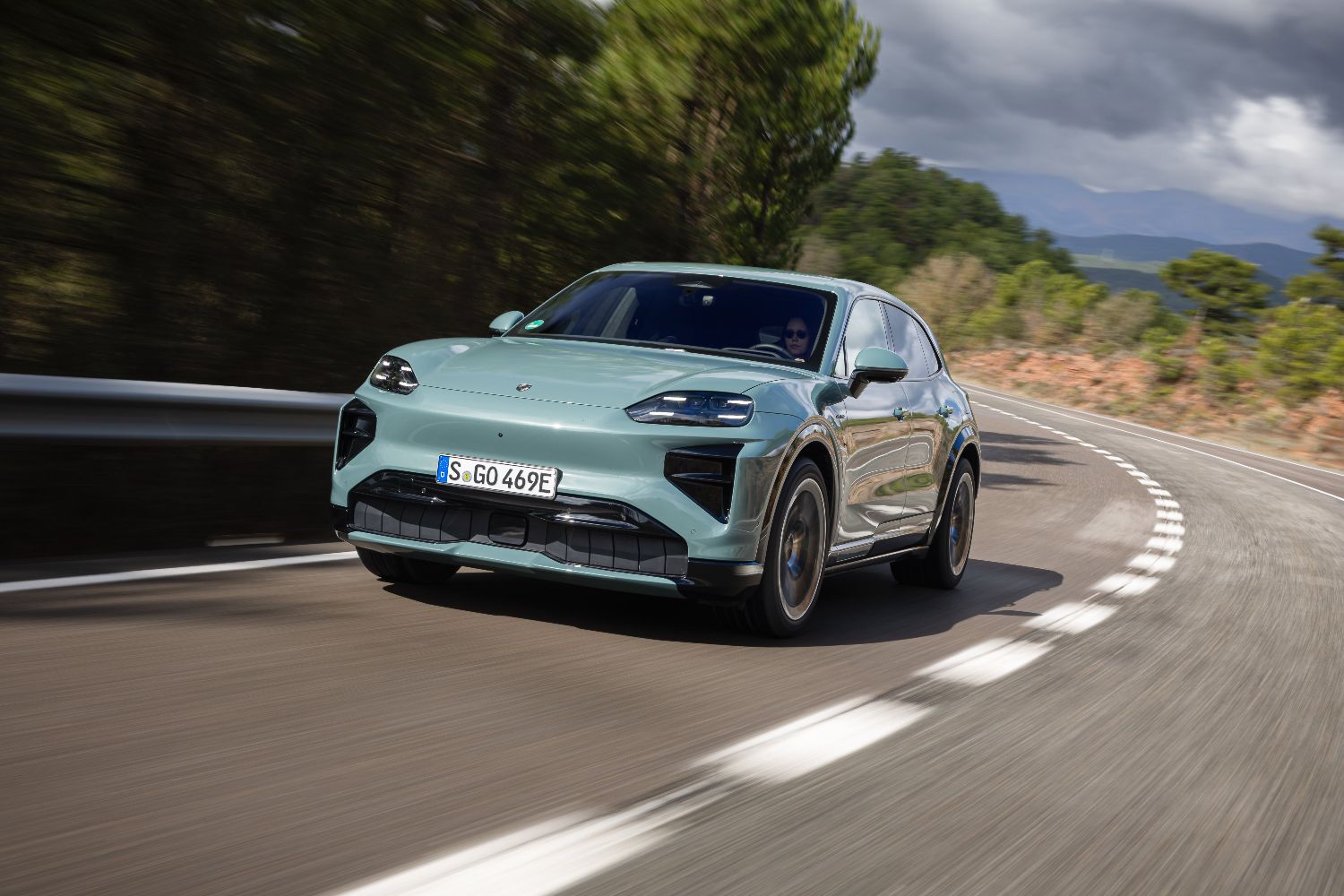
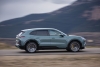
But starting with the exterior looks, they're potentially divisive. The Cayenne Electric follows the aesthetic path first trodden by Porsche's preceding two EVs, the
Taycan and the
Mk2 Macan, which means it has flattened-out, rectangular-shaped headlights framing a largely featureless nose.
This last detail is important because the resulting aerodynamic slipperiness quotient of the big Porsche SUV is an impressive 0.25Cd, which should be to the benefit of both rolling refinement and outright range. And big the Cayenne most certainly is, measuring almost five metres long (of which more than three metres is made up by the wheelbase), two metres wide
without the mirrors and getting on for 1.7 metres to the tops of its roof rails with its air suspension at its standard right height (it can drop 3cm closer to the deck or raise up 5.5cm from there for off-roading purposes, giving it an 85mm range of movement that can affect its stated ride height). But that snub-nosed look at the front is what might put some people off the Cayenne Electric, although we'd counter by saying that along its sides and, certainly, from the back, this SUV has plenty of sporty presence.
Porsche also says this is the most configurable Cayenne yet for the visuals, with 13 exterior colours, 12 interior combinations, nine designs of alloy wheel (from 20 to 22 inches in diameter, with some splendidly deep-dished items among their number), and five each of internal and external accent packages. There are also the Exclusive Manufaktur and
Sonderwunsch bespoke programmes to go at too, although we'd steer you towards one of the excellent standard finishes of Maderia Gold metallic; very orangey, very smashing.
Interior
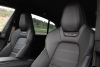
An ultimately well-made cabin did, on the launch models, have one or two areas where the quality looked a bit suspect. Some of the trim finishing in out-of-the-way places appeared a little ropey and observations were made that the leather on a couple of seat squabs was already showing signs of sagging. We'll wait until we've had longer with the Cayenne back on home turf to report back on this questionable matter further.
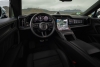
In terms of the upper-level interfaces, though, the areas you're most likely to touch and operate, it's another near-faultless showing from the German firm. It's also a technological
tour de force, with 50 per cent more digital real estate in the Cayenne Electric than you could ever spec up in the
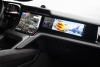
Mk3 ICE-powered forebear. The centrepiece of this graphical razzmatazz is the new OLED Flow Display. Porsche calls this a curved screen but we'd say it was more kinked (steady...), with an angled lower third and then a vertical upper portion.
Watching the icons on this screen 'flow' upwards, hence its name, really is quite impressive and it's a pleasure to operate - plus Porsche has, as you'd expect of this firm, adhered to ergonomic correctness on the move and provided a handrest pad so you can use the Flow Display safely, even on bumpy roads, while some of the climate controls are retained on physical switches. Beyond this OLED star, the Curved Display instrument cluster has grown in size for the new SUV, to 14.25 inches, as has the optional Passenger Display at 14.9 inches across the diagonal. There's also a ginormous augmented-reality head-up display on offer for the Cayenne, which has an effective area of 87 inches; whopping.
Practicality
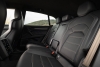
Thanks to the space between its axles and the flat-floor electric underpinnings, the Porsche Cayenne Electric has much to recommend it on interior practicality. But permit us to start with a few negatives. First of all, there's no seven-seat option, the amount of chairs in the Cayenne EV limited to just five. Or, more accurately, '4+1'. Yep Porsche is continuing with this arrangement, because the centre-rear pew on the bench is small, narrow and nothing like as sculpted as the two semi-bucket seats either side of it.
From there, though, it's a glowing report. There's a simply huge central stowage area between the seats up front, housing wireless smartphone charging pads, cupholders and USB sockets among more, while legroom in those outer two positions in the second row is generous to a fault. So is headroom, even on cars with the optional (or standard-fit, depending on model) panoramic roof installed.
And then there's the boot. It measures 781 litres with all seats in use, which is a vast figure. It's also super-versatile too, with various hooks, lights, underfloor solutions, small netted pockets, and both 12-volt and vehicle-to-load outlets incorporated into its dimensions. But don't get too fooled by that one stat. All Cayenne Electrics, from base-grade to flagship, have electrically adjustable seats in the back and that 781 figure is only available if these are in the completely upright position. If your rear-seat passengers decide to recline and relax, the space comes down to 553 litres; still decent, just not seismically good. Ditto the back-bench-folded capacity of 1,558 litres, which is not exactly parameter-redefining for a car as sizeable on the outside as this. That said, a 90-litre 'frunk' does help the Porsche's usability even further, so it's an overall highly practical machine.
Performance
Just how fast do you think the most-powerful production Porsche of all time is going to feel at full chat? Well, double your expectations. It is farcically, breathtakingly, indecently quick in all possible situations. We made the mistake of performing Launch Control, which is where the full 1,156hp and 1,500Nm of the Cayenne Turbo Electric are delivered with such venom at the surface of the planet, on a slight descent and in the preposterous subsequent showing of we're-going-to-light-speed acceleration, even a 2.5-second to 62mph time seemed conservative. In the extreme. Succumbing to temptation and giving this Porsche EV full reign by planting the throttle makes you wonder where the laws of physics are hiding - nothing this gigantic, this hefty, should be able to explode at the horizon like this. It must be akin to what it would feel like being on an Imperial Star Destroyer as it leaps into hyperspace.
Despite the fact that the Cayenne - a family SUV at heart, remember - is outpunching even the mighty
Taycan Turbo GT (nominally 789hp to the SUV's 857hp, and 'only' capable of 1,108hp in Launch Control), and is delivering fully 445hp and 700Nm
more than the astonishing new
992.2 Turbo S T-Hybrid, it doesn't mean this immense electrical power is hard to measure out. Porsche gives you a fabulous throttle pedal and monster brakes (PCCB carbon stoppers, in our test car's case) which make modulating your (stupendous) pace a doddle. And being able to dip into the seemingly endless reserves of torque on the roll to easily up your speed is so effortless and luxuriating, which only adds to the Cayenne Electric's prestige air.
Kudos, too, for the Porsche Electric Sport Sound (PESS). This is not going to win universal acclaim, we know, but even for those who abhor synthesised noises in EVs, you'll have to admit Stuttgart has done a terrific job with it. In Sport mode, the Cayenne Turbo Electric sounds a little like the
old GTS, while Sport Plus ramps up a harder edge to the tune that's reminiscent of the preceding
full-on capital-T Turbo. We really liked both, as they did bring an extra element to the monstrous acceleration phases of the electric SUV.
Economy is not quite so hot, as we got 1.8 miles/kWh out of the Turbo while mercilessly 'thrashing' it (or whatever the colloquial noun is for driving an EV hard for a prolonged period of time) in the Pyrenean mountains. We did get plenty of time in the model at the other end of the Cayenne Electric's range, the 'regular' 442hp variant, which you could hardly call slow (0-62mph: 4.8 seconds), and that gave back a more respectable 2.5 miles/kWh on a steadier motorway cruise, but if you want to get anywhere like near the Cayenne Electric's claimed 380-405-mile range, you're going to need to get much closer to the latter EV economy than the former.
Incidentally, the huge 108kWh battery can be charged at up to 400kW DC, so a 10-80 per cent charge at such speeds will take less than 16 minutes - and more than 200 miles of range can be added for every 10 minutes of hook-up. Conversely, at the other end of the scale, a 7.4kW AC wallbox will need something like 15 hours to do a full top-up of such an enormous electrical reserve, although Porsche will offer up to 22kW AC capability which'd reduce the same replenishment cycle to less than six hours.
Ride & Handling
The crucial thing with the Porsche Cayenne Turbo Electric is not the speed, but the way it handles the power and disguises its mass. All models, from entry-level 'plain' Cayenne Electric through the midgrade Cayenne S Electric up to this Turbo halo variant come with air springs all round, teamed to Porsche Active Suspension Management (PASM) dampers. And, as we've already said, driving the 442hp entry point to Cayenne Electric ownership (admittedly, optioned-up as it was with the agility-enhancing Rear-Axle Steering kit), we never once thought it was sloppy or lacking from a kinematic perspective.
But the Turbo gains access to some of Porsche's more intriguing technology. Such as a Porsche Torque Vectoring Plus (PTV Plus) electronically controlled limited-slip rear diff as standard, with the witchcraft that is Porsche Active Ride (PAR) on the options list. We tried this first with the mighty
Panamera Turbo E-Hybrid, and - if we're honest - we didn't entirely gel with it.
Here, though, Zuffenhausen has clearly refined the formula. Because the Cayenne Turbo Electric is nothing short of astounding for dynamics, its performance for roadholding, ride and refinement almost as gobsmacking as its quite outrageous power. Nothing this physically large and so unavoidably heavy should have any right to feel as agile, as deft, as adjustable and as approachable as the Cayenne Turbo Electric. Mullering it up some twisty mountain roads, you'll revel in its precise, weighty and feelsome steering, as well as the way there's
juuuust enough squidge in the PAR to let you know when the limits of adhesion are approaching and how balanced the chassis is at any given moment, yet the body and wheel control is as absolute on this honking great SUV as it can be on some sports cars that are half the weight. The PCCB stoppers are mega and never once struggle to cope with the hard-charging mass of the Turbo. And as already stated, the gradation of the throttle is just so, in order that you can mete out the prodigious power with laser-like precision to get the Cayenne Turbo boiling away.
Drive it in a point-and-shoot approach, reducing all intervening straights between any corners to the equivalent of metaphorical rubble with the almighty grunt of the twin-motor drivetrain if you want, or get it into a more rewarding, even flow, it doesn't matter - you'll be having a ball in the Porsche electric SUV. About the only handling criticism is that the Rear-Axle Steering can occasionally blur the lines over the moment when grip is becoming slip at the mahoosive Pirelli P Zero rear tyres, so you can occasionally dial in a little corrective lock that isn't strictly necessary as you exit tighter bends. But that's a minor quibble. And anyway, getting the Cayenne Turbo Electric to break either traction or its phenomenal adhesion to the road surface takes an inordinate amount of provocation with the electronic aids turned on, which'll mean you'll have to deactivate traction control if you want to get it sliding on the roads. And, as we keep alluding to, given the size, weight and expense of the thing, is that really going to be the most sensible of ideas?
Flipped the other way, the Cayenne Turbo is a paragon of sumptuous sophistication. It oozes along even rougher roads with extraordinary grace and dignity, barely ever letting you know there are 22s hanging unsprung at all four corners. Sure, there's always a tautness to its comportment, even in the softer settings of Comfort and Normal, and this firm nature to its ride increases to bearable levels in Sport and only just about tolerable up in Sport Plus, but the way this machine glides over most imperfections is true testament to the excellence of its damping. And as you have no engine to deal with, then NVH levels are significantly reduced - and the Porsche doesn't infill the lack of an ICE engine's rumblings and vibrations with any notable increase in all of wind, tyre and suspension noise, so it's quite simply a delight to drive in all situations.
Including off-road. Yes, we took a Turbo off-road. It was on all-terrain tyres and there's an Offroad Package, which not only improves the approach angle at the front of the SUV, but which also increases its maximum towing capacity by half-a-tonne to the 3,500kg braked-trailer max, yet we can't help but wonder why (and how) Porsche has made it so blinkin' capable away from the metalled surfaces. Granted, it won't ever delve as far into the scenery as, say, a good Range Rover would, but the Cayenne Turbo Electric is way more talented in this department than it has any need to be. Thus proving that the Porsche EV excels
absolutely everywhere.
Value
At £83,200 for the Porsche Cayenne Electric, this 442hp, 4.8-to-62mph machine is only £5,700 more than the 353hp V6 petrol-powered entry-level model in the ICE Mk3 range (which is going to stay on sale alongside the Mk4 EV until 'well into the next decade', apparently). And a 739hp Cayenne Turbo E-Hybrid, at £140,600 basic, is indeed more money than the thunderous Turbo Electric (from £130,900) - yet won't get anywhere close to the EV's accelerative force (the PHEV flagship third-gen Cayenne takes a positively slovenly 3.7 seconds to get the 0-62mph run done, and it would take it an entire 4.8 extra seconds to attain 124mph in a standstill compared to the Turbo Electric, which can post a scandalous 7.4-second sprint for that benchmark). Incidentally, the seemingly big leap from the mid-level Cayenne S Electric, with its devilish 666hp output (from £99,900) up to the Turbo is not just about the power; there's a lot of extra kit fitted to the latter as standard which would otherwise be costly optional upgrades on the S.
Verdict
If you were panicking that Porsche might have ruined the Cayenne by switching it from ICE to EV propulsion, worry not. If anything, this astonishing SUV has only got better by becoming a zero-emission machine, rather than worse. And if you can stump up for the utterly barmy Turbo Electric, then you'll have your entire world regarding what you think is a fast car reordered comprehensively by this stupidly potent machine. Honestly - 1,156hp in a bloody SUV. It's madness. Brilliant, wonderful, intoxicating and thoroughly desirable madness.