Styling
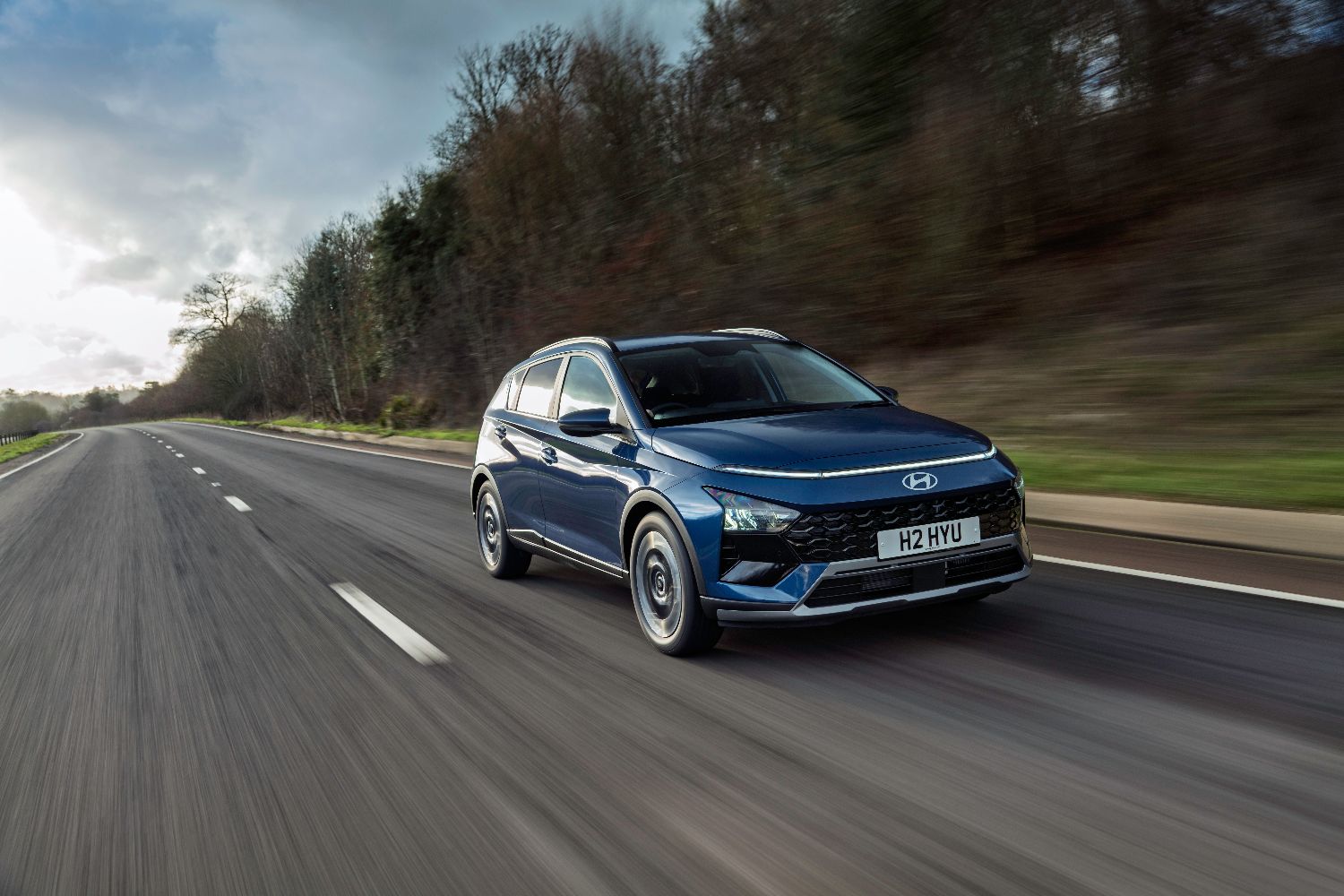
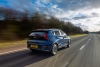
Without subjecting it to drastic remedial work, the '24 facelift for the Bayon did sharpen its appearance, primarily with the inclusion of a 'Seamless Horizon' front DRL bar which was clearly inspired by the look of the latest
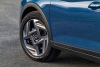
Kona. Along with revised bumpers and air intakes, and some fresh designs of alloy, the overall effect is generally beneficial for the Bayon's aesthetics, although it's still somehow all somewhat forgettable; Hyundai has some very striking-looking things on offer right now, and this isn't one of them. For what it's worth, the 2026MY updates created the Black Line and Tech Line cars, with the former denoted by (yes, you guessed it) lots of black exterior detailing. Our model, though, was a range-topping Tech Line, complete with some attractive 17-inch alloys.
Interior
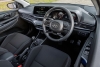
Hyundai provides lots of nice, sensible and cleverly laid-out switchgear for the major controls inside the Bayon, so that you're not lamenting being overly reliant on the twin 10.25-inch digital screens which form its human-machine interface. Thus, ergonomically the cabin of the crossover is a hit, and it certainly doesn't let itself down when it comes to build quality either. A big thumbs up, then? Well... not quite, no. The weird thing about the Bayon is that there is just one interior colour for it, which is an all-black ambience. Whereas, in the closely related
i20 supermini, with its very similar dash architecture, you can have the lower fascia panels, the transmission tunnel and some of the door cards finished in a lighter beige trim - which just does enough to lift the passenger compartment from being dour. Question is, why can't you spec this in the Bayon too? Because it desperately needs it - this is otherwise a dull place to have to spend some time.
Practicality
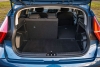
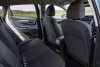
The purpose of the Bayon's being is to offer some more boot and rear passenger space than the i20 hatchback, and on that score it succeeds. A 411-litre cargo bay is fine by class standards, albeit not exceptional, while room in the second row is more than adequate, although again it's not amazing. There's also a hump in the middle of the floorpan in the back of the Hyundai, so seating five there would need the person occupying the central-rear seating position to be on the small side for everyone to be comfortable.
Performance
The Smartstream T-GDI 1.0-litre three-cylinder turbocharged petrol engine has been around in the more affordable Hyundais of this world for some time now, and very good it is too. Variously, it has delivered either 100- or 120hp, but the bad news for the 2026MY Bayon (and the i20, for that matter) is that it has been detuned back to 90hp for reasons of emissions, economy and longevity.
It doesn't matter too much, though, because with a light kerb weight of around 1.2 tonnes and a beautifully positive yet slick-shifting six-speed manual transmission, the Bayon 1.0T Tech Line feels peppier than it has any right to off the back of a published (and mediocre) 11.9-second 0-62mph time. The powertrain is a rev-happy delight and it sounds good as you spin it out, never becoming coarse or breathless even as the redline approaches. It also has enough muscle, with peak torque of 172Nm available to it and all smeared across a 1,500rpm low-range band, to get about the place without needing to endlessly stir the H-gate 'box, although you'll love to do that nonetheless. So yes, it's a shame the T-GDI is now down to 90 horses, and indeed it's the only powertrain you can select for the Bayon (your only choice is whether you want to fork out for the seven-speed DCT auto option instead), but it proves to provide ample go for the little crossover.
The Bayon also turns out to be reasonably economical in the real world, as during a 25-mile loop it managed to record an indicated 36.8mpg under a fair amount of duress. Owners will undoubtedly tend to drive them a lot more calmly than we did, so the idea of getting close to the circa-48mpg claimed figure on a day-to-day basis is not some far-fetched fantasy.
Ride & Handling
There's a rather predictable dynamic summation for the Bayon 1.0-litre manual model, which is this: we, and we suspect a lot of other people, would much rather have an i20 with the same powertrain instead.
Now, this is not a fair assessment with which to single out Hyundai for criticism alone, among all car manufacturers. After all, how many B-segment crossovers, from any brand, are better to drive than their equivalent superminis from within the same stable? Off the tops of our heads, we can't think of one. So the fact the taller, heavier and less aerodynamic Bayon with a 90hp triple is not as much fun as an i20 with the same set-up should really come as a surprise to nobody.
Furthermore, the Bayon is surprisingly amenable to drive, all things considered. Hyundai's steering is pretty good these days in its run-of-the-mill models, while the blend of body control to ride comfort is probably better struck and more commendable than it needs to be for this type of vehicle. Therefore, if you get the little three-pot up front buzzing away and settle yourself into an even flow, the Hyundai crossover will deliver an adept performance on twisting roads.
Yet its main area of strength is plush ride comfort and excellent rolling refinement. About the only thing you'll hear from outside the passenger compartment at speed is a touch of road and suspension noise bleeding into the interior from the wheel arches, but it's not at unbearable levels and, for the rest of the time, the Bayon is lovely to just amble about in. Dynamically speaking, it's a nicely polished and capable thing, ultimately. It's just that an i20 is that little bit more sparkling to steer still.
Value
The 2026MY revised Bayon range starts from a competitive £23,795 for a Black Line manual. From this start price, you add £1,500 to upgrade the spec from Black Line to Tech Line, and then £1,250 at each level to switch the six-speed manual for a seven-speed DCT auto. On the Tech Line, there's also an optional Tech Pack bundle - incorporating an electric tilt-and-slide glass sunroof, acoustic film on the windscreen, and a Bose Premium Sound System as well - for another grand. Therefore, the most you can drop on a Bayon is to buy a Tech Line DCT with the Tech Pack for £27,545, although our test car - a middle-of-the-tree manual Tech Line but without the £1,000 Tech Pack - comes in at £25,295. Pushing its price up slightly was the attractive Vibrant Blue pearlescent paint, at £650, but that still leaves you with a generously equipped and quality-feeling crossover which comes in 55 quid shy of £26,000, which is a bonus.
Verdict
The Bayon is a throwback to the middle of the last decade, to a time when Hyundais were safe, they were stolid and they offered well-equipped, good-value-for-money alternatives to the more desirable mainstream and class-leading rivals - but they were also not that interesting to look at or drive. Give it its dues, the Bayon is certainly not terrible from a kinematic perspective - in fact, it's admirably good - but there's something unexceptional about it that simply renders it as the least-interesting model in the company's current line-up. That's more a reflection on how good modern-era Hyundais are across the board, rather than the Bayon being actively bad. And as the Hyundai is fair value and backed up by
that warranty, we can see why people would still choose it in this day and age, even with some super-interesting alternatives available from companies operating elsewhere in this style-conscious class.