Test Car Specifications
Model: 2025 Peugeot 308 SW Plug-In Hybrid GT
Price: 308 range from £29,995, SW from £38,395
Engine: 1.6-litre turbocharged four-cylinder petrol with 92kW e-motor and 17.2kWh lithium-ion battery
Transmission: seven-speed e-DSC7 dual-clutch automatic, front-wheel drive
Power: petrol 150hp at 5,500rpm, electric 125hp at 2,500rpm, system max 195hp
Torque: petrol 300Nm at 1,750rpm, electric 118Nm at 500-2,500rpm, system max 360Nm
Emissions: 43-60g/km
Economy: 106.9-148.1mpg, 45-59 miles electric range
0-62mph: 7.9 seconds
Top speed: 140mph (hybrid system combined, 84mph electric)
Boot space: 467-1,483 litres
Kerb weight: 1,675kg (EU)
Styling
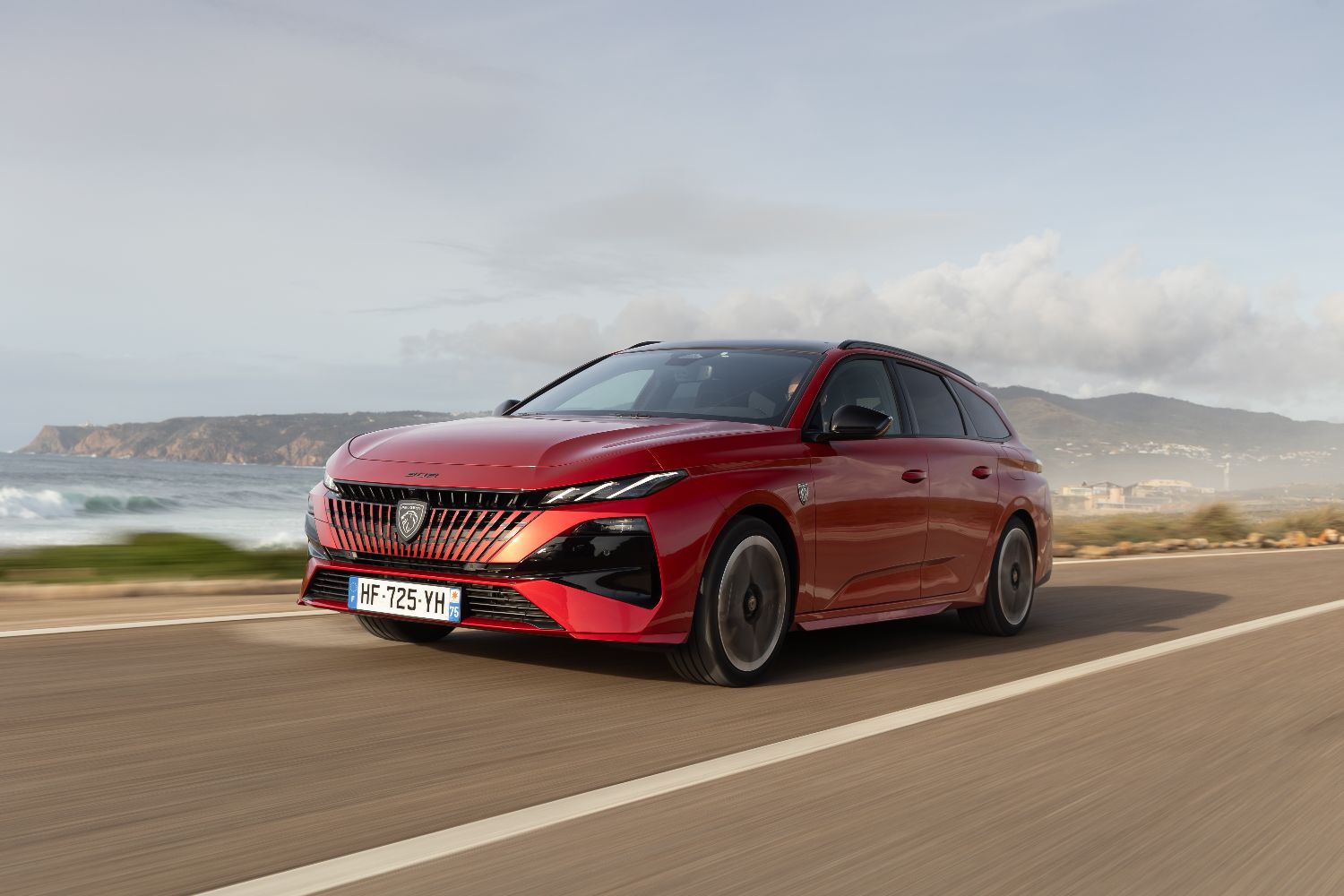
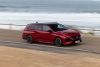
This is when facelift means facelift. If you were to look at the sides and back of the updated Mk3 308, in either regular hatchback or svelte SW estate format as tested here, all you'd really spot would be some new designs of 17- and 18-inch wheels, subtly altered LED-rear-light signatures, and a bit more black at the bottom of the bumper. You might be lucky, if you're an avid 308 spotter, in that the owner could've specified the car in one of the two new blue paints: Lagoa for the hatch, and Ingaro for the SW.
Otherwise, if you want to clock one of these updated 308s easily, you must look at the front of the car, where a fair amount of work has gone on. A more dramatic grille has necessitated the deletion of the old 'fang' blades that ran down either side of the Peugeot's face, so to make up for that the French firm has installed a full-width light strip that mimics the lines of the grille below with illuminated, angled LEDs in matching positions, while the corporate shield emblem lights up at night too.
However, the illuminated grille and front logo are only standard-fit on the mid-grade GT and flagship GT Premium models; the entry-level 308 Allure makes do without this visual glitz and glamour.
Interior
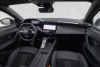
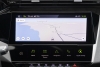
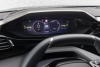
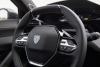
The interior has hardly changed at all, save for some tidying of the 3D instrument cluster on models where it is fitted. Whether you like this or not will largely hinge upon whether you get on with the 308's idiosyncratic Peugeot iCockpit layout, which teams the small, low-set, button-like steering wheel with a high-mounted driver's binnacle. We don't mind this arrangement, as we're neither excessively tall nor, um, markedly less tall, but we're not as enamoured with the twin 10-inch screens which make up the human-machine interface.
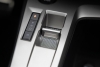
We've not got so much of a problem with the cluster, that's fine, but the way too many ancillary functions are run through the central touchscreen on the Peugeot is an annoyance - it's a multitude of taps just to turn your heated seats on, for instance, when a simple button on the fascia would do the job a million times better, and safer. Also, the five 'iToggle' configurable pads don't actually make the process of using the infotainment that much simpler, in all honesty, and then when there are six more physical shortcut switches beneath, it all looks a bit confusing and poorly thought-out.
Nevertheless, material quality inside the 308 is excellent, so aside from these infotainment-related grumbles, the cabin of the Peugeot is a hit.
Practicality
With a reasonable spread of in-car stowage solutions and various USB ports, the main issue with the practicality of the 308 comes in the form of limited rear-seat room for passengers. Larger adults might find leg- and headroom in the back are not as generous as they could be, but for a family of four with younger children, the Peugeot should be fine. At least there's the SW for those who need more boot space than the 314-412 litres of cargo capacity the hatch can provide, although - as ever with PHEVs - this drivetrain has the smallest boot of any of the estates at 467 litres. The E-308 wagon manages 505 litres, while the Hybrid model has 599 litres at its disposal.
Performance
Until the 1.5 BlueHDi arrives in spring 2026, the revised Peugeot 308 line-up is made up entirely of electrified petrols and a fully electric E-308 derivative. This is a familiar format to the pre-facelift range, with proceedings kicking off with the Hybrid. This pairs a 1.2-litre three-cylinder turbo engine with a very mild hybrid system, for peak outputs of 145hp and 230Nm. Drive goes to the front wheels via a six-speed dual-clutch e-DSC6 transmission.
At the other end of the CO2 scale, the all-electric E-308 continues with its 156hp/270Nm powertrain, but the battery is increased marginally to 58.4kWh (gross, 55.4kWh usable) so the claimed range has improved by around 25 miles, to a peak of 279 miles for the hatch and 275 miles for the SW.
The most intriguing work of the update therefore relates to this PHEV in the middle. Where before there were two plug-in models, with either 180- or 225hp, this new one is an upgrade on the former of these. It uses a 150hp 1.6-litre turbocharged four-cylinder PureTech petrol engine and an e-motor enhanced to 92kW (up from 81kW previously), while the battery pack has also been enlarged from 12.4kWh to a new gross figure of 17.2kWh, of which about 14.6kWh is usable.
This gives the new 308 Plug-In (an epitaph it wears proudly on its bootlid) an electric-driving range of between 45 and 59 miles now, when it stood at 35 before, and the combined power of the drivetrain has climbed 15hp to 195hp (peak torque is the same 360Nm as it was previously). Of course, a bigger battery pack means more weight, so despite the greater muscle it turns out the new 195hp PHEV is two-tenths of a second slower to 62mph from rest than the old car, which could do the run in 7.7 seconds.
Of more interest is the new gearbox. The PHEV now has a seven-speed e-DSC7 dual-clutch unit, rather than the old EAT8 automatic. It means with the e-DSC6 in the Hybrid and the single-speed reduction gear in the E-308 and this e-DSC7 here and then the EAT8 in the forthcoming diesel, the Mk3 facelifted Peugeot 308 has four gearboxes for four models. Bizarre.
Anyway, the latest PHEV 308 is a lovely thing to drive, with decent performance, and nicely calibrated throttle and brake pedals. It's a shame the 1.6 makes a weird, thick, buzzy noise that's obviously augmented when it accelerates hard, mind, and we achieved 29.7mpg from the SW Plug-In during a spirited test drive on the launch. We wouldn't be that fussed about 30mpg from a PHEV in such circumstances, if we didn't then go and achieve 42.2mpg from the 308 Hybrid in much the same conditions later the same day. Sigh.
Ride & Handling
The 308's forte is its superb rolling refinement and ride comfort, and the updates thankfully haven't harmed this side of its character. There's not really much more we need to say here: on urban streets, while traversing extra-urban main roads and country lanes, and when cruising along a motorway, you'll rarely be discomfited by the Peugeot's ride and you won't hear an awful lot of exterior noise contributors worming their way into the passenger compartment. It's a delight to travel in.
Where you might wish for a bit more from the 308 is in the handling stakes, certainly if you associate Peugeot with (traditionally) crisper driving dynamics. It's not that the SW PHEV is bad, of course, as the steering is direct and nicely weighted, and the balance of the car from front axle to back is pretty assured throughout, so you rarely encounter fun-sapping understeer. It's just that the car is not particularly playful, although does a family plug-in hybrid estate need to be that? Who knows.
The bigger point here is that, once again, our gaze turns to the Hybrid. Because it's not lugging around a massive lithium-ion battery pack like its two stablemates, it's fully 248kg trimmer than this PHEV, and a giant 276kg lighter at the kerb than the E-308 SW. And that just makes the 1.2-litre 308 far more chuckable and entertaining to drive, even though it has a significant power deficit to this Plug-In model.
Value
The 308 range is not particularly cheap overall, but things kick off with a Hybrid hatch for £29,995. The SW is a £1,200 price walk from there, and when you spec a Plug-In Hybrid in GT trim like this, it'll cost at least £38,395. That's because the PHEV is more than £4,000 dearer than either the Hybrid or E-308 variants, model-for-model, throughout the Peugeot's family. It's yet another reason why we'd steer you towards the Hybrid as a better representation of the 308's all-round abilities, at a preferable price as well.
Verdict
The third-generation Peugeot 308 didn't need a vast amount of remedial work and so, understandably, the French outfit hasn't treated it to such. Instead, it has gently massaged the electrified models with the longer-range driving capabilities, while also tidying up the front-end design. We'd say the Hybrid is our pick of the three launch models, but if you can make the Plug-In Hybrid's multitalented abilities work for you, then you won't be disappointed with this charming and sophisticated family car. It definitely makes for a nicer-driving machine than one of the default SUVs in this class, that's for sure.