

|
|
G90 CONCEPT CAR LEADS GM'S 'GREEN' DRIVE |
|
|
(14 September 1999 - General Motors press release)
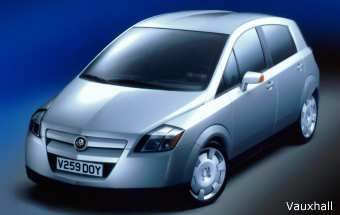
R�sselsheim/Frankfurt. The "G90", an innovative, minimal-consumption concept car, will be one of the major attractions on the Opel stand at this year�s Frankfurt International Motor Show (IAA). With its 44 kW/60 hp, three-cylinder gasoline engine, the concept car produces only 90 grams (G=90) of CO2 emissions per kilometer. This undercuts by more than a third the limit of 140 grams per km planned by the European Union to become the manufacturer's average fleet value in the year 2008. 90 grams of CO2 per km represents MVEG-standard fuel consumption of 3.88 liters per 100 km. |
|
|
This exceptionally low figure for a spacious four-seater in the Astra class was achieved by innovative weight-saving and a drag coefficient of cD = 0.22. At the same time the G90, which hints at the direction that Opel's body styling could take in the future, demonstrates new approaches in interior design. "With its aerodynamic design and low curb weight of only 750 kilograms, the G90 concept car demonstrates an alternative approach to future mobility on the eve of the next millennium", says Hans Demant, Opel's Head of Development. "This new vehicle concept shows that - independent of the power train and without having to resort to exotic materials or detract from passenger comfort - it is possible to make a reasonably priced car with fuel consumption in the region of three liters per 100 kilometers - and one that is also great fun to drive!" From the very start of the project, Opel�s engineers had a clear picture of the basic design of their concept study. As far back as 1997, during the forward engineering phase, two fundamental decisions were taken: the engine should not be a special design but a unit in the Opel production program. And it had to be a gasoline engine. Walter Treser, Opel's Director of Advanced Engineering says, "There were two reasons why we went for a gasoline engine: first, the direct-injection principle has a lot of potential, and second, it's cheaper to make a gasoline engine than a diesel. That clearly benefits the customer and is in keeping with our philosophy of offering top technology at reasonable prices."
Light and Efficient: Three-Cylinder ECOTEC Engine In the G90, the performance of this compact three-cylinder engine is truly astounding: it whisks the 750-kilogram car from zero to 100 km/h in only 14 seconds, accelerates from 80 to 120 km/h in 18 seconds and goes on to reach the impressive top speed of 180 km/h. Another well-suited engine for the "G90" study is the 1.2-liter, four-cylinder unit from the ECOTEC Compact engine series. With this lively 55 kW (75 hp) four-valve engine, the G90 would reach a top speed of 200 km/h.
Aerodynamic Design: Perfect Droplet Shape Cuts cD Value to 0.22 With elements such as these the study's styling not only speaks the technically-oriented design language already expressed by the Astra and Zafira. It also establishes new trends and points the way to Opel's future styling intentions. This is exemplified in the "crease", designer jargon for the raised line running down the center of the engine hood but also in the styling and technology of the headlamps. Integrated at different levels in a single unit are the headlights, fog lights, and the indicator lights which use light-emitting diodes (LEDs).
Visuals: Technical Design with High Functionality The aerodynamic detailing is also easy to see at many points on the body - the partly concealed rear wheels, the smooth side panels or the two aerodynamic "humps" in the roof. These guarantee excellent headroom for all four occupants (980 mm at the front, 970 at the rear), while the recess between the domes also helps to reduce the total frontal area to only 2.05 square meters. The most distinct feature of the 1650-mm-wide, 1477-mm-high car is the wind tunnel influenced teardrop-shape at the rear. To ensure that the G90 kept as closely as possible to this pure, natural shape with a narrow tail section, and to prevent the additional drag caused by turbulence, its rear-end dimensions were greatly reduced. At 1360 mm the rear tread is distinctly narrower than the front (1452 mm). As a result the G90 offers two individual seats instead of a conventional bench. The concept car's comprehensive range of safety features includes seat belt tensioners, front and side airbags and Opel's Pedal Release System that reduces the risk of inury to the driver's legs in a frontal collision. Active Head Restraints on both front seats significantly reduce the risk of whiplash.
Plenty of Space for Four People and their Luggage
Progress: Smooth Underfloor with Efficient Diffuser Effect The greatest aerodynamic progress in the G90's underbody area, however, was obtained by allowing the floor to rise at the rear by an angle of six degrees. This results in a "diffuser effect", well known from racing car design. Together, the rearward sloping roof line and the low trailing edge on the tailgate combine to reduce the rear surface area. The airflow above and below the car passes the body faster, resulting in less turbulence and reduced drag.
Lightweight Construction: Systematic Use of Aluminum and Magnesium
Novel Design: Entire Exhaust System Weighs Only 13 Kilograms Differences in weight are even more marked where G90 components are made of ultra-light magnesium. As well as the transmission housing, steering wheel and elements of the seats, they also include the roof, though the body is otherwise made entirely of aluminum. Superfluous weight is eliminated further and the reduced weight at this height on the body lowers the center of gravity, which improves road. The optimum weight distribution of the front-wheel drive G90 is also aided by the unusual low-slung battery position.
Road-holding: Lower Center of Gravity and Agile Handling
Interior: Ingenious Ideas for Greater Convenience
Fact-Finding: Information at the Touch of a Button The chronometer-look instruments are reminiscent of a motorcycle cockpit and are placed in the driver's unobstructed field of vision. This is achieved by the perfect ergonomic positioning of the speedometer and rev counter behind the adjustable-angle steering wheel. Separate displays in the center ensure that additional information such as the trip-distance or the gear selected remains visible even when the steering-column angle is adjusted. Other clever ideas in the G90 passenger compartment include indirect lighting in the roof, footwells and doors (which makes driving at night more pleasant), as well as a draft-free ventilation system that has a broad outlet on the passenger's side to keep the airflow speed lower than from usual vent nozzles. Robert W. Hendry, Chairman and Managing Director, Adam Opel AG, says: "The G90 incorporates such well-known Opel characteristics as excellent aerodynamics, attractive design and outstanding fuel economy. It therefore represents the essence of our company's 100 years of automobile manufacturing tradition and engineering skill. In addition, the concept study expresses the responsibility which we bear as a car maker for the environment and for future generations." |
|
| [This Week] [Full Contents] [News] [Features] [Car of the Week] [Motorsport] [A-Z] |