

|
|
MULTI-MEDIA LADEN ESTATE BECOMES THE OMEGA V8.COM |
|
|
(14 September 1999 - General Motors press release)
R�sselsheim/Frankfurt. At this year's Frankfurt International Motor Show (IAA), Opel presented, for the first time, a visionary study of the on-road communications center of the future. It offers a realistic insight into what a multi-media mobile could look like in the years to come. The sophisticated concept car is full of innovative ideas and intelligently networked systems including Internet access via PC, a complete video outfit, a pioneering infrared night-vision system with head-up display, and the very latest audio, navigation and mobile phone systems. |
|
|
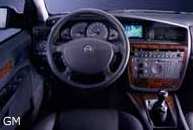
The study, called "Omega V8.com", is based on the station wagon version of the new Omega, concealing under the hood the 5.7-liter, 300 hp V8 aluminium engine that will power Opel�s flagship from next summer. To create the "Omega V8.com" a new Omega station wagon was elongated by 130 millimeters, providing plenty of room inside for four people, all of whom can enjoy the highest degree of comfort in individual, adjustable seats. Other notable characteristics of the interior are the center console, which extends right through to the back, and a split load compartment cover, which adapts to differences in the back seat positions. The primary beneficiaries of the multi-media facilities in the "Omega V8.com" are the three passengers whose seats are designed as fully equipped information terminals. Separate, retractable 9.5 inch LCD screens (16:9 format) are unobtrusively integrated in the co-driver�s instrument panel and the front seat-backs. Ergonomically designed knobs and switches, tidily tucked away in the center console, allow each passenger to access the systems separately. Loudspeakers integrated into the head restraints ensure that each passenger can enjoy individual audio reception without disturbing anyone else in the car. The audio system includes a high-quality CD and cassette deck, as well as digital radio with music and speech in CD quality. The video equipment can be used to watch TV or play films from video CDs.
Mobile office: video conferencing and voice control for the driver Apart from the link to the mobile radio network, the passengers can also surf the Internet, send and receive e-mails or listen to music downloaded from the Web on a so-called MP3 player. For this, they use the infrared-controlled computer keyboard that also forms part of the communications system in the "Omega V8.com". The driver can call up incoming electronic mail by voice command. There are various other functions - for example the mobile phone mode - which also respond to voice control. The range of multi-media services is completed by a modern navigation system and Opel's OnStar telematics service, which, like some of the other components, is already available for Opel's production line vehicles today. Latest transmission technology: fiber-optic cables and data bus Highly developed data transfer technologies support the extremely complex multi-media network. Instead of conventional cables, an optical cable is used to transmit the data via the bus. The data bus reduces the large number of individual connections to a single circuit, through which all control commands and information are sent. Special codes ensure that the relevant components can identify "their" signals from among the multitude of other commands. These data and control commands are generated by laser diodes and sent through the circuit in the form of ultra-fast light impulses. In this way, it is possible not only to send large volumes of data through the network at the speed of light, but also to guarantee excellent electromagnetic compatibility.
Driver support: "Night Vision", variable AFS front headlamps One major advance in terms of safety in the dark is the new Advanced Frontlighting System (AFS), which automatically adjusts to the road conditions, driving situations and weather. It features, for example, headlight programs for urban streets, country roads, motorways and wet surfaces. The light distribution of the Xenon lamps is dynamically adjusted for optimum beam width. For example, as the car enters a bend in the road, the headlamps shine into it as the steering wheel is turned, lighting up the part of the road which otherwise remains in the dark. This results in much improved visibility and reduced dazzling of the oncoming traffic. The future use of this technology nevertheless depends on the new European legislation, for which all the big car manufacturers and suppliers are currently developing a joint draft. The advanced headlamp technology is complemented by the innovative "Night Vision" system. Images produced by an infrared camera in the car's grille are projected on to the windshield (head-up display) so that the driver can see the additional information without taking his eyes off the road. The system can also be used in daylight and can ergonomically display important information so well that the driver can perceive it without being distracted. The "Omega V8.com" also has an electronic eye for easy parking: a miniature camera with a wide-angle lens located near the rear windshield wiper sends distortion-corrected pictures of the area behind the car to a driver display in the cockpit. |
|
| [This Week] [Full Contents] [News] [Features] [Car of the Week] [Motorsport] [A-Z] |