|
|
|
|
CHEVROLET CORVETTE:THE LEGEND LIVES AND PROSPERS!
- Latest evolutionary stage of the famous Chevrolet small block engine
- Ideal weight distribution thanks to transaxle construction
|
|
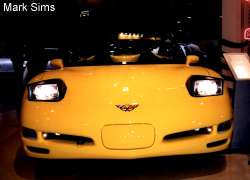
For 2000, Chevrolet will continue to offer unparalleled performance and excitement with its out-and-out sports car, the renowned Corvette.
The Corvette has become an American motoring icon since its first appearance in the �50�s with a worldwide following that has seen this car become the world�s best selling sports car.
|
|
The excitement starts with the latest evolutionary stage of the famous Chevrolet �small block�. Mounted behind the front axle to optimise vehicle weight distribution, the 5700 cc V8 engine known as the LS1 generates 344 hp at just 5400 rpm, and reaches a maximum torque of 483 Nm at 4200 rpm.
The LS1 block and cylinder head are made of aluminium. With all inlet channels at exactly the same length and leading straight to the valves, the engine is highly efficient in both output and fuel consumption. Also enhancing efficiency, the intake manifold is made of a lightweight composite material. Its low heat conduction compared to metal and a smoother intake surface improve cylinder charging. Two catalytic converters, mounted near the engine, reach their optimum operating temperature very quickly after a cold start.
Power is conveyed to the rear axle via a choice of a six-speed manual or four-speed electronic automatic transmission. In the fifth generation Corvette, the transmission is not flanged to the engine, but positioned in a transaxle arrangement, i.e. on the rear axle. Since the engine itself is mounted towards the centre, an ideal total vehicle weight distribution of 50 percent on each axle is achieved.
Corvette's status as a high performance sports car with a comfortable ride is thanks to the sophisticated suspension with independent double wishbones, front and rear. The front upper triangular control arms are made of wrought aluminium, the rest of cast alloys. Chevrolet holds the patent on Corvette's synthetic cantilever springs, which are mounted crossways at front and rear. Fixed to the chassis via rubber-isolated bearings, they are much lighter than steel coil springs. Exceptionally compact, their use allows the design of an extremely flat vehicle front and hence even better aerodynamics. The absence of conventional strut domes also increases the boot volume.
Springs and dampers have been carefully tuned to fuse agile handling with a smooth ride. The Corvette buyer can order variable shock detection, with a choice of three different settings: "Tour," "Sport" and "Performance". The system reacts to the vehicle's lateral and longitudinal motion. At high speeds the dampers automatically switch to a rigid bias. Speed sensitive servo steering further enhances the Corvette's sporty handling.
Corvette is equipped with oversize brakes, a four-channel Bosch antilock braking system, and traction control as standard. An Active Handling System for additional stability control can be ordered as an option. This electronic device deals with the threats of oversteer or understeer by selectively applying the brakes and throttle to keep the car on course. Sensors for lateral acceleration, brake pressure, yaw and steering angle register the slightest critical motion. Sporty drivers can deactivate the system via a cockpit switch.
|
|
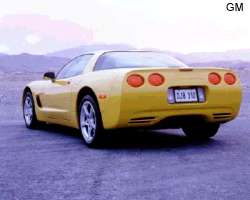
Corvette is available as a full convertible or as a coup� T-top with a removable centre section. In the latter the driver need only snap open three simple locks to remove the lightweight magnesium centre section, which is easily stored and anchored in the boot. The convertible's interior roof lining covers the frame and blocks out noise. Other practical features of the convertible roof include a heated rear window made of scratch resistant safety glass.
|
|
|
Made of fibreglass-reinforced composite material, the attractive and super-aerodynamic Corvette shell (Cd value 0.29) covers a steel frame built on hydroformed side beams and a box-shaped centre tunnel. The floor of the Corvette chassis is made of panels in a highly advanced composite construction. The space between two aluminium layers is filled with absorbent balsa wood, which effectively isolates noise and vibrations from the passengers. This layered design boasts a rigidity 10 times that of conventional composite constructions offering superior handling.
The Corvette interior is pure sports car, but with exceptional room for the occupants. The driver's bucket seat and the passenger's seat are both in leather trim, and both feature power adjustment for length and height. That and a height-adjustable steering column allow every driver to find an ideal seating position. In cars equipped with the electronic memory option, as many as three different drivers can recall their preset configuration for seating position, wing mirror angle, climate control, and even favourite radio stations (on the standard Bose sound system) all at the touch of a button. Another technical highlight is the Head Up Display (HUD), which projects the most important indicators, such as speed and rpm level, onto the lower half of the windscreen.
The Twilight Sentinel feature automatically activates parking lights or headlamps at the onset of darkness.
In addition to the easy-to-read analogue dash instruments, a digital display can be set to show the air pressure in each tyre. Air pressure is permanently monitored by sensors inside the tyre valves. A warning signal indicates reduced pressure. However, a flat tyre won't stop the Chevrolet Corvette. Its Goodyear F 1 EMTs (Extended Mobility Tyres) with reinforced side sections are built to maintain their shape. In fact, the Corvette can be driven up to 100 miles on an airless tyre. The car's front tyres measure 245/45 ZR 17, with 275/40 ZR 18's in the rear.
The Chevrolet Corvette comes as standard with a comprehensive three years/60,000 mile warranty and six years anti-perforation warranty.
|
Back to Chevrolet @ The 1999 London Motor Show
|

