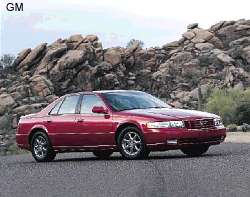
The Northstar is tuned to produce 305hp and 6000rpm with maximum torque of 400Nm at 4400rpm, making it the most powerful front-wheel-drive production car in the world.
The cylinder head has undergone 2000 changes - the new inlet channels are almost equal in length, the combustion chambers have larger inlet and smaller outlet valves and especially low-friction roller followers actuate the valves.
Each spark plug now has its own high-voltage ignition coil raising the ignition energy by 130 per cent. The spark plugs need inspection every 100,000 miles and coolant and transmission oil need changing only at 150,000 miles.
The Seville STS features performance algorithm shifting (PAS), which detects and reacts to changes in driving style, reprogramming the transmission to change the gear shift point to allow for either sporty or more sedate driving.
Acceleration slip regulation (ASR) cuts power when a loss of traction is detected, eliminating wheel-spin, thereby conveying power to the road cleanly.
The multilink suspension on the Seville has been designed for the European market. StabiliTrak and CVRSS (continuously variable road-sensing suspension) work in tandem.
StabiliTrak monitors the steering wheel and if the vehicle fails to react as commanded the system selectively applies the brake to either front wheel to maintain the desired course. The second generation StabiliTrak includes two new functions, side slip rate control and active steering effort compensation which detects insufficient traction or sudden manoeuvres and momentarily raises the steering effort to give the driver more feedback from the steering wheel.
CVRSS makes use of the fast reacting dampers employed in the STS. The computer registers any change in road texture or damping load within milliseconds and corrects the damping rate accordingly.
Working in tandem with StabiliTrak the dampers are individually adjustable, when StabiliTrak applies the brake to a given front wheel, stability control interaction calibrates the damping rate of that wheel to the diagonally opposite rear wheel. This maximises the rear wheel�s traction and lateral support to maintain stability.