

|
|
OUT WITH TDI 110, IN WITH TDI PD 115, PRICES ARE UNCHANGED(VW UK press release - November 1999)Volkswagen has introduced a new-technology TDI "PD" 115 bhp unit to replace the renowned TDI 110 bhp engine across all models except the Sharan, offering 20 per cent more torque and standard traction control, but with no price increase. The term "PD" is derived from the German "Pumpe-D�se", meaning "unit injector". This describes a new and advanced fuel injection system which can operate at pressures of up to 2050 bars or 30,000 psi, considerably more than common rail systems of under 2.0-litres which reach approximately 1350 bars or 20,000 psi. |
|
|
Higher injection pressures mean better mixing of fuel and air. In turn this allows more fuel and air to be burnt cleanly in each cylinder of Volkswagen's advanced catalyst TDI engine to provide a new industry benchmark power unit which comfortably outperforms the stringent EU-III-D exhaust emissions regulations. This technology recently enabled Volkswagen to announce for the German market the Lupo TDI 3L, the world's first full size production car capable of 94 mpg on the combined cycle. |
|
|
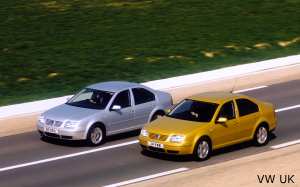
In the Passat saloon, for example, the TDI PD unit develops 115 bhp at 4000 rpm, compared with 110 bhp at 4150 on the outgoing unit. Torque, however, rises from 173 lbs ft at 1900 rpm to 210 lbs ft at the same engine speed. This is more than that delivered by the 2.8-litre 30 valve 193 bhp engine in the Passat V6 4MOTION and more than any other production 1.9-litre unit, and it makes in-gear acceleration particularly impressive. The Passat saloon's acceleration from rest to 62 mph drops from 11.3 seconds for the 110 bhp to 10.7 seconds for the PD, while top speed rises from 121 to 124 mph. There is, however, no penalty in terms of emissions or economy, the Passat returning 65.7 mpg on the extra urban cycle, 53.3 mpg on the combined cycle and 40.4 mpg on the urban cycle. At 143 g/km, CO2 emissions are more akin to those expected of a modern supermini than an upper medium car with highly respectable performance. Despite its impressive performance and economy, the Passat saloon costs no more than the TDI 110 bhp model it replaces, plus it gains ASR traction control as standard: a Passat saloon S TDI PD can be driven away for �17,465, while SE and Sport trim levels with automatic air conditioning and estate versions are also available. The Passat is offered with the �1725 option of five speed tiptronic transmission, which gives the choice of five speed automatic or manual sequential gear selection. Across the Volkswagen range, 22 models benefit from the engine upgrade. All TDI 110 bhp versions of the Golf hatchback, the new Golf estate, the Bora and the Passat saloon and estate will be replaced by TDI 115 bhp powered versions as production begins progressively over the coming month. All versions powered by the new engine also come with ASR traction control. To signify the engine upgrade, the bootlid TDI badge now contains a red "D" in addition to the red "I" which distinguished the TDI 110 from the 90 bhp model. The Bora TDI PD is offered in either SE or Sport trim, like the TDI 110 it replaces. As with the TDI 110, these are priced at �17,685 and �18,630, even with ASR traction control as standard. The similarly-engined Golf GT TDI PD, with even more torque than the forthcoming V6 4MOTION, is priced at �16,975 for the three-door, while the five-door version costs �17,595 - exactly the same as the outgoing TDI 110 models. Two trim levels of the new Golf estate TDI PD are offered, an S and SE priced at �16,510 and �17,630. Both the Golf hatch and estate are without rivals in the traditional small family car market sector. In fact, cars as economical yet rapid as these from rival manufacturers are rare in the class above, too. |
|
Main news page
| [This Week] [Full Contents] [News] [Features] [Car of the Week] [Motorsport] [A-Z] |