| Maintenance advice | VW Polo BlueMotion |
Although new cars don't need much maintenance it is still important to carry out certain checks. In fact, with extended service intervals a little time spent making regular checks is more important than ever to avoid a nasty surprise and big bill at the garage.
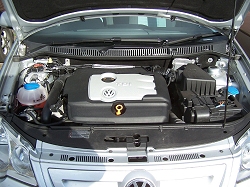
Under the bonnet of our Polo BlueMotion, the items that may need attention are coloured either yellow or blue. The oil dipstick is yellow, the oil filler has a yellow oil-can label on it and the brake-fluid reservoir has a yellow cap. The last of these is buried at the back of the engine bay, making it practically impossible to check the fluid level visually. There is a "Low Brake Fluid" warning light though and if it comes on add DOT4 brake fluid and take the car to a garage as soon as possible to check the system for leaks.
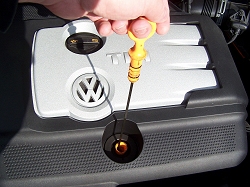
Everything else is easy to check for yourself. The oil dipstick is prominent at the front of the engine bay and the correct oil level is indicated by an indented portion of the dipstick. If the level is low the handbook suggests adding a litre of oil that conforms to VW 507 00 specification - a 5W-30 grade such as Castrol EDGE, Mobil 1 ESP or Shell Helix Ultra. As noted, the filler cap is easy to access and releases with quarter of a turn. To prevent spillage it is worth using a funnel when topping up the oil level.
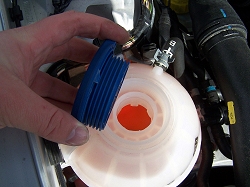
The coolant level is easy to verify too; the expansion tank is roughly spherical and transparent on the left of the engine bay (as you face it). The maximum and minimum levels are clearly marked on the side of the tank. VW recommends a mixture of water and 40% G12 Plus coolant. However, if you need to keep topping up the coolant it is important to find the source of a possible problem. Check the radiator and hoses for leaks and look for signs of coolant in the oil (a mayonnaise-like substance under the oil filler is a giveaway).
Visual checks of the windscreen washer fluid reservoir are not possible but the information panel should warn when it is running low. The cap is easily accessible on the right of the engine bay (as you face it) and the reservoir has a two-litre capacity. Volkswagen produces special washer fluid and the handbook warns that using the wrong stuff will block the washer jets.
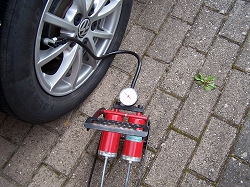
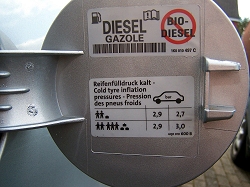
Probably the most important item to check regularly on any car is tyre pressure. On the Polo the correct pressures are listed on the inside of the fuel filler cap. The energy-saving tyres fitted to the BlueMotion are supposed to be inflated to 2.9-bar at the front and 2.7-bar at the rear with up to two people and light luggage on board. It is also worth checking for tread wear and general condition while you are inflating the tyres. If you do nothing else checking tyre pressures regularly is vitally important; not only will tyre life and fuel consumption be adversely affected but the tyres won't grip properly at the wrong pressures.
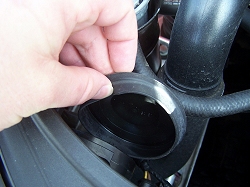
A simple maintenance task that every driver should be able to perform is changing a bulb. Some modern cars make the job difficult by obstructing the back of the light clusters. It proved impossible to get behind the offside headlamp to change the dipped-beam bulb in the Polo for instance. On the nearside, headlamp access is tricky but possible. To change the bulb peel off the rubber cover from behind the bulb holder, then twist the back of the bulb and withdraw it from the head lamp. After that you can unclip the bulb from the plastic block containing the wiring, which is a fiddly job as there isn't much slack on the wires. Getting the bulb back in is not easy either, as the tabs on the bulb have to line up with the holes in the back of the headlamp then press and twist to hold the bulb in place.
Access to the main beam bulbs is slightly easier: again there is a rubber cover to remove first, then detach the black plastic terminal from the back of the bulb, release the metal clip and withdraw the bulb. The shape of the bulb means it has to be upright otherwise it won't come out and similarly the replacement bulb must be the right way up before it will go in. Note the position of the flat portion of the metal part of the bulb. Try not to catch any wires with the wire clip when inserting the new bulb, re-attach the wire and make sure the rubber dust cover is properly fitted. Oh and try to avoid touching the glass part of any bulbs with your fingers.
Changing the indicator bulbs with the headlamps on the car appears to be impossible. The indicator is below the dipped beam lamp and it looks like removing the assembly is the only way to do the job. Getting at the tail lamp bulbs also means removing the relevant lamp cluster. These are secured from inside the boot by a large wing-nut, which proved too tight for fingers to undo. Overall, the simple task of replacing bulbs is not easy.
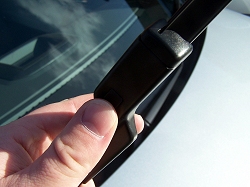
Probably the easiest job to do is to replace the windscreen wipers. The front items are secured by a little plastic tab on the top of the wiper arm; push this down and the wiper slides off easily. The rear wiper is slightly trickier: lift the wiper off the tailgate, turn the blade at right angles to the arm and gently but firmly pull the wiper blade until it unclips.
Running through the checks shouldn't take much more than ten minutes every couple of weeks. Compared with the possibility of damaging your engine through low oil or coolant levels (unlikely but it can happen), it is a small price to pay. It is also worth remembering that the driver is responsible for ensuring that the car is in good roadworthy condition.